
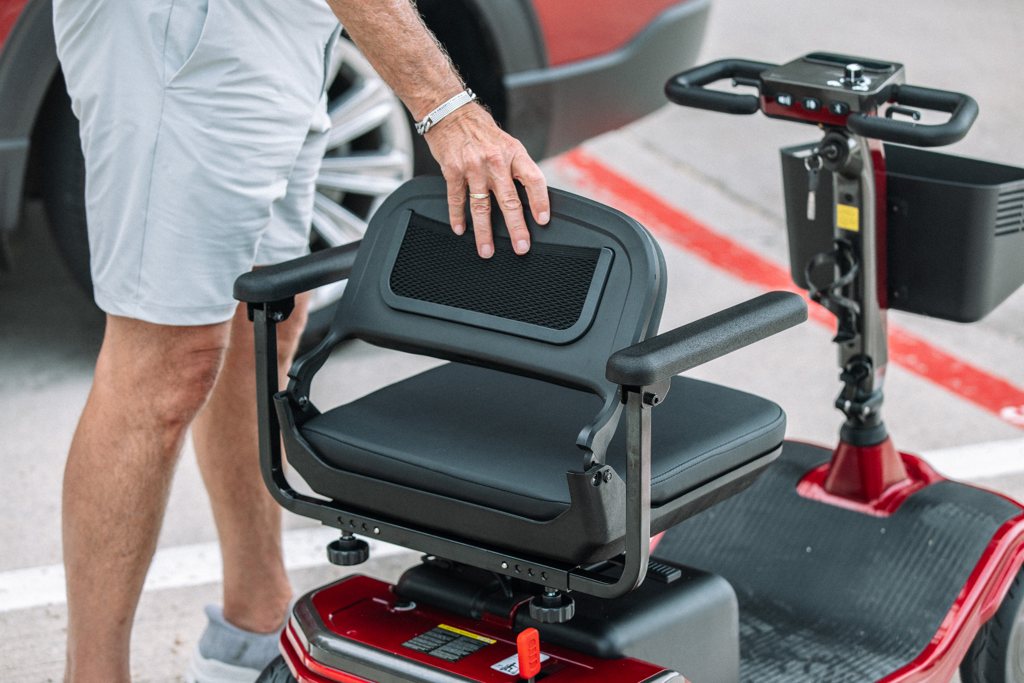

Yes, you can take a foldable mobility scooter on many cruise ships, provided the cruise line accepts your exact device and it fits, parks, and charges safely inside your assigned cabin. Folding helps with storage, yet approval depends on the scooter's widest operating dimension, battery type, total weight, and your ship's rules. Standard stateroom doors are often much narrower than accessible-cabin doors, and keep in mind that a scooter can't block a corridor or emergency route.
Before final payment, send the accessibility team your model, dimensions, weight, battery chemistry, and cabin number, then ask for written confirmation. Measure the doorway and the space inside the room; a scooter that crosses the threshold can still block the bathroom, bed, or exit. This guide explains the current rules, shows how Hoverfly T3, T4, and T5 specifications affect cabin planning, and gives you a cabin checklist for embarkation day, charging, elevators, and ports.
Cruise Lines Allow Mobility Scooters but the Exact Rules Differ
A cruise line usually treats your scooter as an assistive device, but each operator sets its own safety, storage, battery, and dimensional requirements. “Cruise approved” is not a universal product label. The useful approval is a written answer tied to your booking, cabin, and device.
Carnival's mobility device requirements say scooters must be stored inside the stateroom. A guest using a standard or ambulatory-accessible cabin must get the device through a 22-inch entry door, and Carnival directs guests with a scooter wider than 21 inches to a fully accessible cabin with a wider doorway or to a smaller rental. Royal Caribbean's accessible cruising policy also requires in-cabin storage and charging, while stating that a device should fit through a 23-inch door for a standard stateroom; accessible stateroom doors are 32 inches. These two policies show why advice based on an average doorway is unreliable.
Contact the accessibility department before booking an ordinary cabin. Provide the model, dimensions, weight, battery type and capacity, folding method, and whether you can walk a short distance. Ask about form deadlines, charging, prohibited electrical equipment, embarkation assistance, tenders, and your cabin's exact doorway. Save the reply.
Measure the Foldable Mobility Scooter in Its Travel Configuration
Start with the widest point you will actually take through the door. Measure across the wheels, armrests, seat, basket brackets, and any oxygen or cane holder. Manufacturer dimensions are the starting point. Your setup may be wider after you adjust the armrests or add an accessory.
Measure length and folded height. Length affects an angled entry and parking; folded height matters beside a desk or under a bed. Confirm the storage location with the line. Record total weight and the heaviest handled part. Folding does not make a heavy section safe to lift.
Our mobility scooter transport guide uses the same fit-first method for cars: compare the device with the narrowest opening, then test the complete handling path. Apply that logic to the stateroom. Tape a doorway of the confirmed width at home, drive through it slowly, fold or separate the scooter, and leave a clear route from the bed to the cabin door.
How Hoverfly T3 T4 and T5 Specifications Change the Cabin Decision
The comparison below uses specifications published on our current product pages. It is a planning reference, not cruise-line approval. The operator must still confirm your exact scooter, cabin, and sailing.
|
Hoverfly model |
Published dimensions (L × W × H) |
Handling weight |
Battery |
Cruise planning takeaway |
|---|---|---|---|---|
|
Expanded: 45.28 × 26.77 × 38.78 in; Folded: 39.37 × 26.97 × 17.91 in |
61 lbs total; 50 lbs heaviest part |
25.6V 8Ah LiFePO4 |
Fast folding helps with storage, but the published width requires an accessible cabin on lines with 22–23 in standard doors. |
|
|
Expanded: 47.2 × 20 × 39 in; Folded: 41.1 × 20 × 16.7 in |
100.86 lbs total; 60 lbs heaviest part |
24V 12Ah lead-acid |
The narrowest body width of the three gives it the best starting point for standard cabin doors. Confirm the configured armrest width, turning space, and charging rules. |
|
|
Expanded: 48.4 × 22 × 34.5 in; Folded: 45.6 × 22 × 18.1 in |
125 lbs total; 76 lbs heaviest part |
25.6V 15Ah LFP; 384Wh |
Its body width is close to common standard-door limits. Measure the widest configured point and obtain written cabin approval. |
These specifications reveal three separate cruise-planning questions. Width determines whether the scooter can cross the stateroom threshold, turning space determines whether it can maneuver and park inside, and heaviest-part weight affects how safely it can be handled during transfers or transport.
The T4 offers the most favorable published body width for a standard cabin, while the T3 provides the quickest folding routine. The T5 offers the longest published range of the three, but its adjustable armrests and heavier chassis call for closer cabin and handling checks. All three models have the same published maximum weight capacity of 330 lbs, so the T5’s advantage is range rather than load capacity.
A foldable or separable design can make storage easier after the scooter enters the room. It does not confirm doorway clearance by itself. Send the cruise line the linked product page, your actual configured measurements, battery information, and cabin number before relying on any of these models for a sailing.

Cabin Checklist Before You Pay the Final Balance
Use this list while the booking can still be changed:
- Ask the accessibility team for the clear doorway width of the exact cabin, including any threshold or angled entry.
- Send the scooter's widest configured width, full length, folded dimensions, total weight, heaviest part, battery chemistry, voltage, amp-hours, and charger input.
- Confirm that the scooter can remain inside the room without blocking the cabin door, bathroom, balcony, bed access, or a passenger's walking path.
- Request an accessible stateroom if you cannot transfer safely, need a roll-in shower, or need more turning space. Door clearance alone is not enough.
- Ask where the scooter may be charged and which extension cords, adapters, power strips, or surge protectors are prohibited. Use only the correct charger and equipment approved by the line.
- Confirm embarkation help, rental delivery rules, tender limitations, accessible shuttles, and shore-excursion vehicle capacity. Keep the written answers on your phone and in print.
Plan Safe Charging and Battery Documentation
Carnival and Royal Caribbean require mobility scooters to be charged inside the cabin. Confirm the applicable charging requirements with any other cruise line for your specific sailing. Park near the approved outlet without stretching a cord across the route to the bathroom or door. Switch the scooter off, remove the key if the manual directs you to do so, inspect the charger and cable, and allow ventilation around the battery and charger. Stop charging and contact the crew if a battery is damaged, swollen, unusually hot, or giving off an odor.
Photograph the battery and charger labels. Record chemistry, voltage, amp-hours, watt-hours, and removability. Bring the manual and support contact. If you fly to the port, our guide to flying with a mobility scooter explains the separate airline review. Approval by one operator does not guarantee approval by the other.
Use the Scooter Safely Around the Ship
On embarkation day, luggage and service carts narrow corridors. Drive at walking speed, approach thresholds squarely, and allow extra stopping distance on sloped or wet decks. In the cabin, practice entering, turning, parking, reaching the bathroom, and exiting without using the hallway for storage.
Elevators are often the bottleneck. Avoid show-ending and dinner rushes, let passengers exit, and enter straight before turning slowly. Ask dining staff for a location that keeps aisles clear. Arrive early for accessible theater seating.
Pack the charger in your carry-on, along with the key, a spare key if supplied, a basic tool allowed by the cruise line, and a rain cover. Practice the fold or separation steps at home. Our
foldable mobility scooter selection guide recommends testing the folding effort, handled weight, battery access, and real storage dimensions because those are the features you will use repeatedly in a small cabin.
Check Every Port Instead of Assuming Shore Access
A scooter accepted onboard may still stay on the ship at a tender port. Tender access can change with the vessel, transfer equipment, sea conditions, tides, and your ability to transfer. Crew members may guide you, but you should never build a plan around someone lifting you or a heavy scooter unless the cruise line has confirmed that assistance in writing.
For each port, ask whether the ship docks or tenders, whether the shuttle has a lift, and whether the excursion vehicle can secure your scooter. Check surfaces and distances. Cobblestones, heat, and long piers reduce range and comfort. Keep a battery reserve and an onboard alternative for uncertain ports.
The Practical Answer
A foldable mobility scooter can be an excellent cruise companion when its real-world dimensions and handling requirements match the cabin, ship, and itinerary. Judge the fit by the scooter’s widest operating configuration—not simply by the word “foldable.” Confirm that it can be parked and charged inside the cabin, keep the route to the cabin door and bathroom clear, and obtain written approval before the final-payment deadline.
Whichever Hoverfly model you choose, prepare one information pack containing the product page, a clear photo of the battery label, folded and expanded dimensions, total item weight, heaviest-part weight, and your cabin number. If you need help confirming which specifications to provide, contact our mobility scooter support team. Send the completed pack to the cruise line’s accessibility department, and keep its written approval with your travel documents for check-in at the terminal.
FAQ
Do cruise ships rent mobility scooters, or should I bring my own?
Many cruise ships do not keep mobility scooters onboard for personal rental. Instead, the cruise line may work with approved equipment providers that deliver a scooter to the terminal or directly to your stateroom. Reserve well before departure and confirm the delivery location, pickup arrangements, scooter dimensions, battery type, and cancellation terms. Bringing your own foldable mobility scooter may be preferable if you already know its controls, comfort, range, and folding process.
Does a foldable mobility scooter count as luggage on a cruise?
A mobility scooter is generally treated as an assistive device rather than ordinary checked luggage, but you must still declare it according to the cruise line’s accessibility procedures. Do not hand the scooter to a luggage porter unless the cruise line has specifically instructed you to do so. Keep the key, charger, approval email, battery details, and folding instructions with you during embarkation.
Does travel insurance cover a mobility scooter on a cruise?
Coverage depends on the policy. Some travel insurance plans exclude mobility equipment, apply a low single-item limit, or cover only theft and accidental damage rather than mechanical failure. Ask the insurer whether your foldable mobility scooter is covered onboard, in the cruise terminal, during flights and transfers, and on shore excursions. Keep the purchase receipt, serial number, photographs, and written valuation in case you need to make a claim.
Can you take a foldable mobility scooter on a river cruise?
Possibly, but river ships can present different challenges from large ocean vessels, including smaller cabins, narrow gangways, limited elevator access, and steep ramps that change with the water level. Ask the operator whether the scooter is permitted on the specific vessel and whether every deck and planned excursion is accessible. Obtain written confirmation before booking nonrefundable travel.



Leave a comment
All comments are moderated before being published.
This site is protected by hCaptcha and the hCaptcha Privacy Policy and Terms of Service apply.