
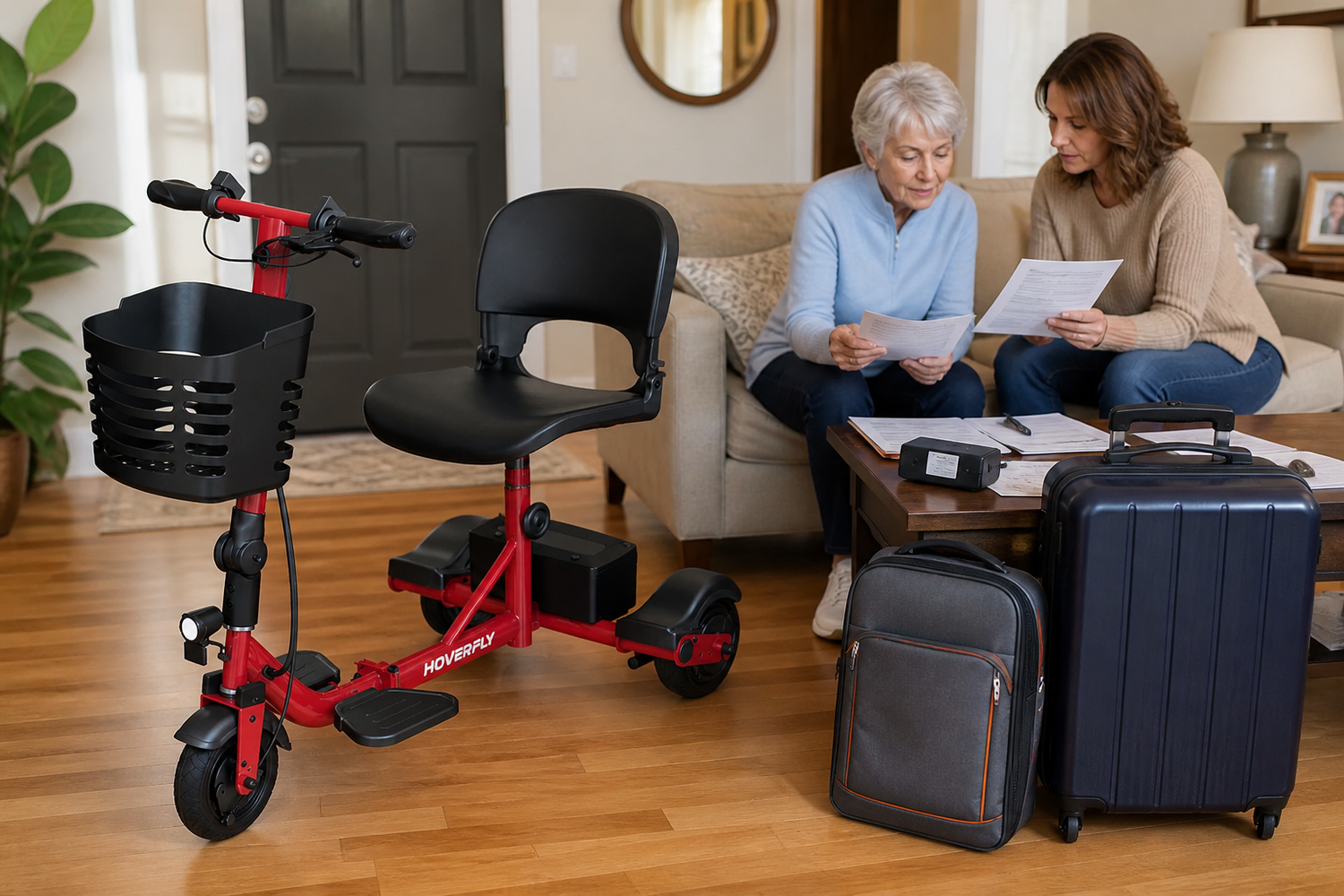
Flying with a mobility scooter often raises questions before travel day about battery watt-hours, battery removal details, and where your scooter will be returned after landing. While your route can still be changed, keep your battery label, the airline's mobility-device policy, and your scooter handling plan in the same travel file.
If you ride a Hoverfly scooter, we organize the product details an airline is most likely to ask for. Your travel file can include your battery-label photo, our product page, the matching page from our Hoverfly User Manual, folded size, removable parts where applicable, item weight, heaviest-part weight, charging details, and route information. The carrier can review the battery and handling details in one place, while you keep the final approval question with the airline.
Key Considerations Before Taking a Mobility Scooter on a Flight
While your ticket is still adjustable, a complete airline reply covers battery documents, scooter handling, and the return point after landing. Compact folded size makes transport easier, and written carrier confirmation protects the travel plan.
At the airline counter, your battery label matters more than the model name. We match that label with our product page and manual so your travel file shows battery type, rated capacity, charging notes, and removal details in one place.
Once airline staff take your scooter, they work from your handling note. Our product page and manual supply folded size, removable parts where applicable, charging method, item weight, and heaviest-part weight, giving staff the details for moving, separating, or securing your scooter.
Backup planning covers the time when you and your scooter are separated. Common separation points include gate check, baggage-claim return, delayed return during a connection, and different handling by a partner carrier or smaller aircraft. You still have to reach the next gate, restroom, baggage area, shuttle, or pickup point, so airport wheelchair assistance, help from a travel companion, or another mobility plan is easier to arrange while your ticket is still adjustable.
Your final airline reply can sit in the same message thread as the flight number, battery-label photo, our product page, our manual page, and agreed return point. A partner-operated segment still requires a separate written reply from that carrier.
Understanding Battery Requirements for Air Travel
Battery details decide how the airline reviews a mobility scooter. The FAA PackSafe guidance for wheelchairs and mobility devices separates four paths: lithium-ion batteries that remain installed and protected by design, lithium-ion batteries that must be removed, non-spillable or dry batteries, and spillable batteries. The 300 Wh figure applies to lithium-ion batteries that must be removed from a mobility device, with terminal protection and carry-on transport for the removed battery. A removable design explains battery access, while the actual handling path comes from the battery label, device protection, airline policy, and whether the carrier allows the battery to stay installed. For a lead-acid scooter battery, the airline may ask whether it is non-spillable or spillable and how it will be secured. Individual airlines may still apply stricter acceptance rules.
When you email the airline, we recommend writing the battery line exactly as it appears on your battery label, such as "25.6V 15AH LFP battery, 384 Wh by calculation." Attach a photo of the battery label beside that line. If the carrier asks for model documentation, include the product page for your exact Hoverfly model from our mobility scooter product pages and the corresponding page from our Hoverfly User Manual.
| Model | Battery Listed on Product Page | Watt-Hours | Battery Setup | Our Airline Check |
|---|---|---|---|---|
| T3 three-wheel mobility scooter | 25.6V 8Ah LiFePO4 Battery | About 204.8 Wh | Built-in in Help Center; product page notes removal only for airline travel or maintenance | We recommend confirming the latest T3 battery path with our support team and the airline. |
| T4 four-wheel mobility scooter | 24V 12AH lead-acid battery | About 288 Wh by calculation | Removable lead-acid battery | We frame T4 mainly as a ground-travel model. For air travel, ask our support team and the airline before planning the route. |
| T5 four-wheel mobility scooter | 25.6V 15AH LFP battery | 384 Wh | Removable LFP battery | We recommend written airline approval for the 384 Wh LFP battery, especially if removal is required. |
Airport Procedures for Mobility Scooter Travelers
The U.S. Department of Transportation recommends calling the airline in advance for boarding help, deplaning help, connections, and loading or stowing an assistive device. DOT's general travel tips for persons with disabilities also say airlines can require up to 48 hours' advance notice and earlier check-in for certain services, including hazardous-materials packaging for a wheelchair battery or other assistive device, and transportation of a powered wheelchair on aircraft with fewer than 60 seats.
Build your one-page handoff note from our Hoverfly product page and the matching page from our Hoverfly User Manual. It can show your scooter model, battery label, charging location, folding or disassembly steps, removable parts where applicable, and lifting or handling notes from our manual. Our support team is available through Contact Us for product questions, while the carrier decides how your scooter is handled for that route.
A useful handling note should include:
- Battery label photo and product page
- Power switch, freewheel lever, battery location, and charging port
- Folding steps, removable parts, and lifting cautions
- Airline written confirmation, flight number, and agreed return point
- Photos of the scooter before travel, including controls, battery area, frame, tires, and accessories
At check-in or the gate, your handling note goes to airline staff before your scooter is taken away. Battery location, power-off step, freewheel lever, lifting cautions, and return point can be settled during that handoff. Keep your battery details close during security screening. For security-related disability questions, TSA Cares can help travelers ask about checkpoint procedures before they arrive at the airport.

Key Features of a Travel-Ready Mobility Scooter
After the airline reviews the battery side of flying with your mobility scooter, your trip becomes a handling test. The pressure shows up at the hotel curb, in the transfer vehicle, and in the room where your scooter has to charge overnight. The real travel test is the heaviest section, folded size, charger access, and the space available for overnight storage.
A scooter's listed weight does not always show how hard your travel handling will feel. The real pressure comes when your helper lifts one section into a car, does it again at a hotel, and repeats the same move after a shuttle ride. Our guide on how much a mobility scooter weighs gives more context for judging total weight, heaviest section, and your daily loading effort before travel.
Instead of judging travel readiness by total scooter weight alone, test four practical points before the trip: the heaviest section your helper must lift, the folded footprint in your planned car or hotel space, where your charger and removable parts will ride, and the overnight charging spot.
Choosing the Right Mobility Scooter for Different Travel Scenarios
Your best model usually depends on the hardest ground moment after landing. Start with your route, then check lifting, storage, charging, and battery review.
For a fuller product overview, our mobility scooter lineup by travel scenario page separates the models by use case. In this travel context, use the short split below:
- T3: Best for compact airport-to-hotel routes, grocery stops, indoor spaces, paved sidewalks, and trips where trunk or closet storage matters. Check the fully folded size, 61 lb item weight, 50 lb heaviest part, and current battery-handling instructions before flying.
- T4: Best for ground travel after arrival, especially hotel stays, family visits, errands, and maintained paths with your helper for car loading. Check the four-piece breakdown, 21 lb battery, 13 lb seat, 60 lb main chassis, and lead-acid battery acceptance before building a flight route around it.
- T5: Best for longer destination use, resort paths, outdoor sightseeing, and routes where range and ride comfort matter more than compact handling. Check the 16.78-mile max range, 350W motor, heaviest section around 76 lb, and 384 Wh LFP battery approval before flying.
For cruises, add one more check: your cabin space, charger placement, and removable-part storage after boarding. For chargers, baskets, key switches, or model-specific replacements, review the official mobility scooter accessories and parts page before the trip.
Common Mistakes When Flying With a Mobility Scooter
An airline inquiry based only on the model name can leave you with unclear check-in answers. Your battery-label photo, our product page, our manual details, and route information give the airline a specific file to review.
Folding mainly solves ground handling: trunks, hotel rooms, shuttles, and storage. Battery details decide the airline review. In our travel checks, we separate your handling plan from the carrier's battery review, so both questions get answered clearly.
Your return trip needs its own confirmation. Your way home may involve a partner carrier, smaller aircraft, or regional connection, so the written answer for the outbound flight may not cover the full itinerary.
It is easy to mix up how much your scooter can carry, how much your scooter weighs, and how heavy the largest lifted section feels. Our mobility scooter weight limit guide explains why your body weight plus bags can affect stability, range, and motor strain. During travel planning, your helper should test the actual section they may lift, because rated capacity does not show loading effort.
Mobility Scooter Pre-Flight Checklist
Use this checklist after the main flight risks are clear. Battery path, model boundary, operating carrier, aircraft size, connection plan, and scooter return point shape your airport file for check-in and gate handoff.
- Airline confirmation: Save the written reply from each carrier with your itinerary. It should cover the powered mobility device policy, battery details, and scooter return point after landing or during a connection.
- Battery file: Your battery-label photo, watt-hour calculation, our matching product page, and our manual details stay in one folder. When airline staff ask about battery type, capacity, or removal, you have one file to open.
- Photos: Clear photos taken before travel cover your charger, controls, battery area, removable parts, frame condition, tires, and accessories. After arrival, these photos help settle damage or missing-part questions.
- Handling note: Airport staff receive one short page showing the power-off step, freewheel mode, folding or disassembly process, lifting point, and battery location.
- Airport assistance: A backup movement plan is already arranged for times when you cannot move comfortably without your scooter. The airline reply names the landing return point, connection procedure, and wheelchair assistance plan if your scooter comes back later than expected.
- Charging check: Our manual, charger protection, and loose-part check are handled at home before your scooter leaves for the airport.
Our mobility scooter maintenance guide can support battery care and pre-trip inspection as you prepare your scooter for the route.
FAQ
Can I take a mobility scooter on an airplane?
In our current Hoverfly lineup, T3 is the strongest flight-preparation candidate because it has a compact folded size and a 25.6V 8Ah LiFePO4 Battery, though the carrier still makes the route-specific battery decision. T4 uses a lead-acid battery, so our current product guidance does not treat it as a regular airplane-loading option. T5 has a 384 Wh LFP battery, which calls for written carrier review, especially around whether the battery can stay installed and protected during transport.
Do airlines charge extra for mobility scooters?
On flights covered by U.S. DOT rules, assistive devices receive special handling protections under the Air Carrier Access Act overview and do not count against the carry-on limit when stored in the cabin under applicable rules. Airlines may not charge for required accommodations such as hazardous-materials packaging for batteries. Separate battery shipping through FedEx or another carrier is a shipping or freight case, so cost and acceptance need to be confirmed separately.
Can I bring a mobility scooter battery onboard?
The airline assigns the battery path after reviewing your battery label, installation status, and removal instructions. A lithium-ion battery that stays installed and protected by design can follow a different handling route from a lithium-ion battery that must be removed and carried in the cabin. For lead-acid batteries, ask whether the airline treats the battery as non-spillable, dry, or spillable, and how it wants the battery secured. Send your battery-label photo, our scooter model page, and route before travel so the carrier can answer from your exact battery, not a general scooter category.
When should I contact the airline about a mobility scooter?
Contact the airline while your ticket can still be changed. The U.S. DOT notes that airlines can require up to 48 hours' advance notice and earlier check-in for certain services, so earlier contact leaves more time to confirm your battery, aircraft, connection, and return point.
What type of mobility scooter is best for air travel?
Air travel selection has two sides: your route after landing and the airline's battery review. In our Hoverfly lineup, T3 suits compact airport-to-hotel routes, indoor areas, and paved paths. T4 makes more sense for trips with repeated car loading when your helper can manage the main chassis. T5 fits longer destination use, outdoor sightseeing, resort paths, and routes where grass or gravel may appear after arrival. Your carrier still has to confirm the exact battery label, installation or removal method, aircraft, and route in writing.
Conclusion
Flying with a mobility scooter goes more smoothly when you handle airline confirmation early. Your prepared travel file should include battery proof, handling notes, return-point confirmation, and a realistic plan for using your scooter after landing.
Keep the exact battery label, airline route, and carrier response together before setting your travel plans. Send your model name, battery-label photo, and route to our support team first, then contact each operating carrier with your prepared battery and handling details.





Leave a comment
All comments are moderated before being published.
This site is protected by hCaptcha and the hCaptcha Privacy Policy and Terms of Service apply.