
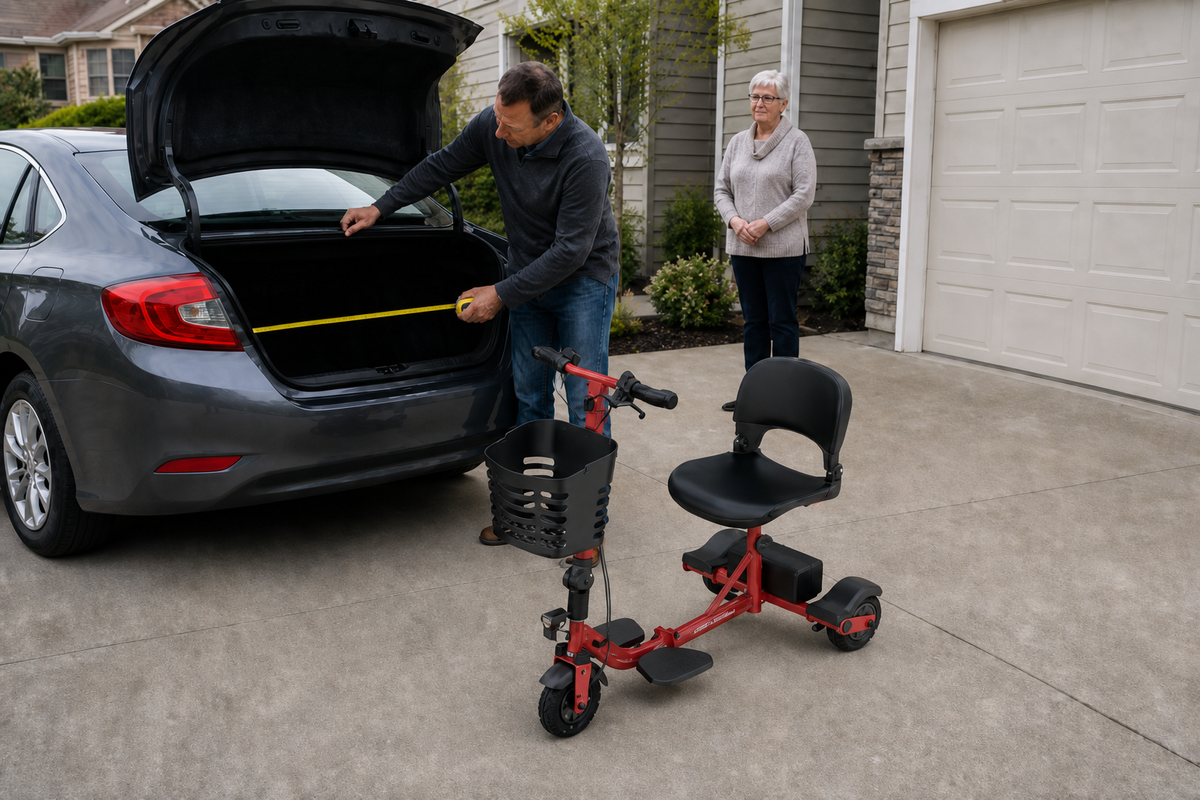
Vehicle transport comes down to fit, lifting weight, and securement. The scooter has to pass through the trunk or cargo opening, the heaviest handled section has to match the loader’s real lifting ability, and the frame has to stay fixed during braking, turns, and rough pavement. Sedan trips center on folded size and trunk entry. SUV and van trips add cargo-floor height and ramp angle. Longer trips add charger storage, loose-part control, weather exposure, and space for luggage.
On our Hoverfly mobility scooter models, we list folded dimensions, item weight, and heaviest-part weight so you can compare the scooter with your vehicle before travel. Foldable and portable describe storage behavior. Vehicle transport still requires a measured opening, a tested lift, and a clear choice among trunk loading, disassembled loading, ramp loading, a hitch carrier, or a vehicle lift.
When Do You Need a Mobility Scooter Transport Plan?
Plan mobility scooter transport before any trip that puts the scooter in a trunk, SUV cargo area, van, truck bed, hitch carrier, or vehicle lift. The trigger is the loading job: folded size must clear the vehicle opening, the heaviest handled section must match the loader’s strength, and the scooter needs a stable tie-down or locking point before the vehicle moves.
Sedan trunks favor folded scooters or separated pieces that clear the narrowest opening. SUV and van loading adds cargo-floor height, making ramp rating, ramp angle, and controlled walking guidance part of the decision. Truck beds create a higher lift and a steeper loading path, so heavier scooters move toward longer ramps, assisted loading, or lift equipment. Repeated weekly loading, one-caregiver loading, and a heavy main section point toward a hitch carrier or vehicle lift when vehicle type, hitch class, mobility device, and physical capability all have to match.
Transport planning also prevents damage during the drive. Remove or secure baskets, keys, chargers, mirrors, armrests, and seat parts before loading. Keep the charger dry and away from loose cargo. After unloading, check the frame, wheels, brakes, controls, battery area, and reattached parts before riding, then follow the model manual before the scooter goes back into use.
Match the Vehicle Situation to the Right Scooter Handling Method
Check the vehicle before choosing the handling method. A low hatchback, tall SUV, pickup truck, and compact sedan all change the loading work. The scooter model matters, while cargo opening, floor height, and available help often decide whether manual loading makes sense.
| Vehicle or trip situation | Better handling method | Check before choosing |
|---|---|---|
| Sedan or compact trunk | Fold the scooter or remove small parts | Trunk opening height, folded length, folded width |
| Hatchback or small SUV | Fold, then slide or lift from the rear opening | Cargo depth, bumper height, rear-seat position |
| SUV, van, or truck with a high cargo floor | Ramp loading or assisted loading | Ramp rating, ramp angle, scooter weight |
| Heavy scooter or frequent travel | Hitch carrier or powered vehicle lift | Hitch class, carrier rating, weather exposure |
| Caregiver cannot lift the main section | Lift, carrier, or lighter scooter | Heaviest part weight, loading frequency, available help |
NMEDA’s mobility equipment guidance explains that vehicle lifts are selected by vehicle, hitch class, mobility device, and physical capability. That gives buyers a useful checkpoint. When the person loading the scooter cannot safely manage the heaviest section, a lift or carrier becomes part of the transport plan.
Measure Vehicle Fit With Folded Size, Weight, and Cargo Space
Vehicle fit is confirmed by comparing two sets of numbers: the scooter’s folded dimensions and handled weight against the vehicle’s narrowest loading opening, cargo depth, interior height, and cargo-floor height. Measure the opening at the tightest point, then check the path from bumper to cargo floor. A trunk floor can look long enough while the trunk lip, hatch angle, or roofline blocks the folded scooter.
Each Hoverfly model has a different loading step before it goes into the vehicle: T3 folds, T4 separates into four parts, and T5 has a heavier main chassis to plan around. T3 folds for trunk loading, T4 separates into four parts for trunk or cargo-area loading, and T5 breaks down into heavier pieces with the main chassis at about 76 lbs.
| Hoverfly model | Key transport specs | Best vehicle fit | How this model should be loaded |
|---|---|---|---|
| Hoverfly T3 3-wheel Foldable Mobility Scooter | 61 lbs item weight; 39.37 × 26.97 × 17.91 in folded size; 50 lbs heaviest part | Compact car trunk, hatchback, or small SUV when the opening is wide enough | Fold the scooter, remove loose accessories, then lift or slide the 50 lbs handled section through the trunk or hatch opening. T3 is the most practical Hoverfly option for manual trunk loading. |
| Hoverfly T4 Electric 4-wheel Mobility Scooter | 100.86 lbs item weight; 41.1 × 20 × 16.7 in folded size; 60 lbs heaviest part | SUV, van, or hatchback with a lower cargo floor | Break T4 into its four parts, place the smaller parts in the trunk or cargo area first, then load the 60 lbs heaviest section through the rear opening. Manual loading is easier from a low hatchback or SUV cargo floor than from a high truck bed. |
| Hoverfly T5 4-wheel mobility scooter | 125 lbs item weight; 45.6 × 22 × 18.1 in folded size; 76 lbs heaviest part | Larger SUV, van, truck, hitch carrier, or vehicle lift setup | Break T5 into its basket, battery, seat, and main chassis, then load it through a larger rear cargo opening or onto a hitch carrier or vehicle lift. With the main chassis at about 76 lbs, repeated one-person trunk lifting is a poor routine for regular transport. |
Check the Heaviest Part Before Manual Loading
The heaviest section is easier to load when the cargo floor is low. In a hatchback or low SUV, the lift is short, and the section slides inward soon after it clears the opening. In a taller SUV or pickup bed, the loader must raise it higher and guide it across the bumper lip. When a deep trunk forces twisting, reaching away from the body, or regripping mid-lift, regular manual loading becomes too difficult.
Folded dimensions show whether the scooter can pass through the trunk, hatch, or cargo opening. Heaviest-part weight shows whether the person can lift and guide that scooter with control. T3’s 50 lbs handled section keeps trunk loading realistic for many compact-car routines. T4’s 60 lbs heaviest section needs a more controlled part-by-part loading routine. T5’s about 76 lbs main chassis makes one-person trunk lifting a poor regular transport method.
For regular transport, the clearest loading path is the one the owner can repeat without strain or guesswork. A larger rear cargo opening, hitch carrier, or vehicle lift gives heavier Hoverfly models a more practical loading routine than repeated one-person trunk lifting.
Secure the Scooter So It Does Not Shift in Transit
Securement is finished only after the scooter passes a movement check. Power off the scooter, remove the key, place the frame low and flat, then fasten the frame to cargo anchors or the carrier’s locking points. Straps should stay clear of the control panel, wiring, tiller joints, seat hardware, and plastic trim.
In a trunk or cargo area, heavy bags belong beside the scooter or in another part of the vehicle, not on the seat, tiller, battery area, or controls. An outside carrier adds more checkpoints: platform latch, ramp lock, hitch connection, strap path, and the carrier’s own instructions.
Push the secured frame from the side and rear before driving. Rolling, tipping, sliding, strap slack, or a shifting accessory means the scooter is not road-ready. Change the anchor point or strap angle until the frame stays in place during a firm hand check.
NMEDA’s mobility equipment options describe securement as equipment that keeps a mobility device in a safe position during vehicle use. The same guidance notes that manual tie-downs often require caregiver assistance, which sets a useful boundary for scooter transport: cargo anchors, carrier locks, and tie-down equipment have to match the scooter position, vehicle setup, and person handling the load. Model-specific handling still belongs in the product manual.
Power Down, Pack Loose Parts, and Protect the Scooter From Weather
Power off the scooter, remove the key, and check the brake or freewheel setting in the model manual before the vehicle moves. Pack the charger, basket, keys, pins, and removable parts in one bag or bin. At arrival, the rider or caregiver can rebuild the scooter on level ground instead of searching through the trunk or cargo area.

Outside-carrier transport exposes the scooter to rain, road spray, dust, direct sun, and vibration. Cover the seat, controls, battery area, and stored charger during the drive. At arrival, look for wet controls, visible frame damage, loose wiring, trapped debris, or missing parts before charging or riding again.
Use the manual for battery and charging steps. The CPSC micromobility safety guidance advises using the charger provided with or recommended by the manufacturer and following manufacturer charging directions. For our scooters, Hoverfly user manuals provide model-specific handling, while the Hoverfly mobility scooter maintenance guide gives general care, storage, and inspection reminders.
Avoid Common Vehicle Transport Mistakes
Transport problems often begin with one overlooked measurement. A scooter can pass through the opening and still be too heavy to lift. It can be light enough to lift and still too tall for the cargo space. It can load correctly and still shift during the drive.
| Mistake | What Can Happen | Better Action |
|---|---|---|
| Measuring only the trunk floor | The scooter cannot pass through the opening | Measure the narrowest trunk, hatch, or cargo-door entry point |
| Looking only at total item weight | The heaviest handled section is too much for one person | Test the actual lift with the same vehicle and loader |
| Treating “foldable” as easy to transport | Folded size fits, but lifting angle or cargo height creates strain | Compare folded dimensions, heaviest-part weight, and cargo-floor height together |
| Leaving accessories attached | Basket, charger, keys, pins, or removable parts get damaged or lost | Pack loose parts in one bag or bin before loading |
| Using a ramp without checking rating | The scooter becomes hard to control on a steep or under-rated ramp | Match ramp rating, scooter weight, vehicle height, and ramp angle |
Regular transport is about repeating the same load safely. An occasional trip is manageable with extra help, a larger vehicle, or more time to remove and pack parts. Weekly loading works when the heaviest section clears the opening without twisting, loose parts have one fixed bag or bin, and the frame has a clear strap-down or locking point before the vehicle moves.
After unloading, reattach removable parts on level ground, confirm that no strap, mat, bag, or loose item is trapped under the frame, then test steering, braking, reverse where available, horn or lights, and unusual sounds. Rain exposure, wet controls, visible frame damage, loose wiring, or battery-area damage means the scooter stays parked until our support team or a qualified technician confirms the next step.
FAQ
Can a mobility scooter fit in a regular car?
Yes, when the folded scooter or separated pieces clear the narrowest trunk opening and leave enough usable cargo depth. Measure opening height, opening width, interior depth, and folded scooter dimensions before travel; for trunk-only planning, see Can a Mobility Scooter Fit in a Car?.
What is the easiest way to transport a mobility scooter?
Match the method to the trip you repeat most. Trunk loading fits compact folded scooters, ramp loading fits higher cargo floors, and a carrier or vehicle lift fits heavier handled sections or frequent loading.
Do I need a ramp, hitch carrier, or vehicle lift?
Use a ramp for roll-in loading into an SUV, van, or truck when the ramp rating and angle are safe for the scooter. Limited interior cargo space points toward a hitch carrier. Heavy or frequent manual loading points toward a vehicle lift.
Is a folding scooter always easier to transport?
No. Folding helps with storage, while heaviest-part weight decides the lift. A car-ready scooter still has to match the trunk opening, cargo-floor height, and person doing the loading.
How do I stop a mobility scooter from moving during transport?
Place the frame low and flat, secure it to cargo anchors or carrier locking points, and keep straps away from controls, wiring, tiller joints, plastic trim, and accessories. The side-and-rear push test passes only when the frame shows no roll, slide, tip, or strap slack.
What do I need to check before bus, train, cruise, ferry, or air travel?
Check the operator's size, weight, battery, boarding, and storage rules before booking. Air travel has separate battery requirements, so review the FAA PackSafe mobility-device guidance and contact the carrier with the scooter model and battery information.
Conclusion
Each Hoverfly model has a different transport path. T3 folds and loads through a trunk or hatch. T4 separates into four parts, then loads into a trunk or cargo area piece by piece. T5 is better suited to regular travel through a larger rear opening, on a hitch carrier, or with a vehicle lift.
To choose the right setup, share your scooter model, vehicle make/model or trunk measurements, cargo-floor height, heaviest-part weight, and loading frequency with our support team. We can compare those details with current Hoverfly specs and manual guidance before you choose trunk loading, ramp loading, a carrier, or lift equipment.



Leave a comment
All comments are moderated before being published.
This site is protected by hCaptcha and the hCaptcha Privacy Policy and Terms of Service apply.