
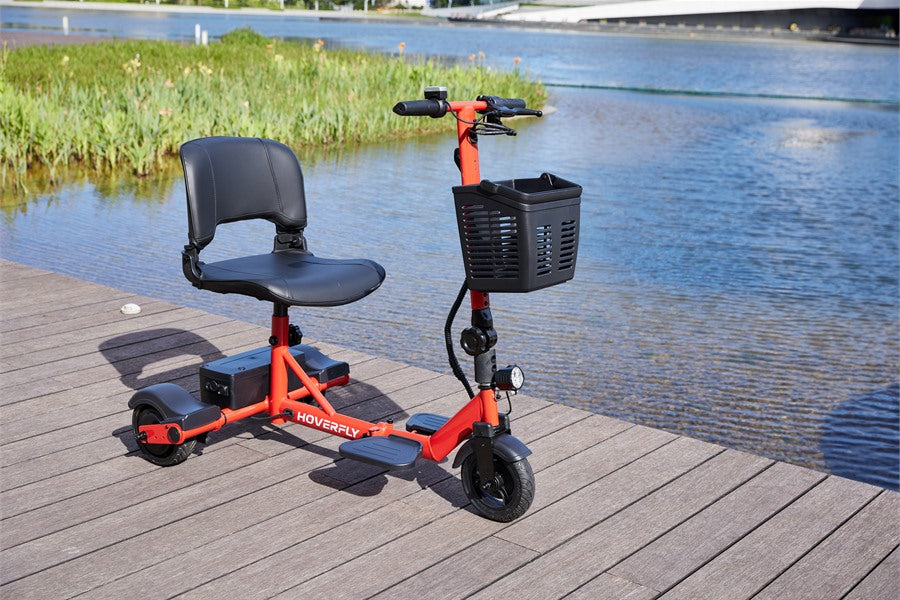
Mobility scooters for seniors have become increasingly travel-friendly in 2026, and at Hoverfly, we're seeing that trend reflected in the questions families ask us. The questions are practical: Will the scooter fit in the trunk after a grocery run? Will the battery last through an afternoon at the park? Is it easy to store in an apartment? And does it feel stable when getting on and off? For everyday use, comfort, battery range, folding design, safety, and storage are what set one model apart from another. Choosing the right scooter can give riders the confidence to go out on their own again. The models compared below can be sorted by the need that matters most in a given household, whether that is folding storage, indoor maneuvering, transfer comfort, or dependable range for errands and appointments.
Recommended Models Compared
The models below are ranked by the situations they fit best, so families can choose a mobility scooter according to the rider's daily needs, storage space, travel plans, loading support, and usual routes.
| Model | Typical Use Scenario | Key Specifications | Storage and Loading Method |
|---|---|---|---|
| TravelScoot Escape | Air travel, cruises, and outings where one person needs to lift the scooter | 22 lb heaviest component, 22.5 lb frame weight, 33 lb complete with the AirSafe battery, 450 lb warranty weight limit, AirSafe range listed as up to 16 miles at a 150 lb rider weight and about 6 miles at 450 lb | Single-pin fold with a quick-release seat clamp, folding to 29" or 34" long with the front wheel |
| SmartScoot | Travel and trunk loading in separate sections | 39.5 lb total weight, 27 lb heaviest piece, about 12 mile range, 26" turning radius, 250 lb capacity on most retailer listings | Folds and separates into three pieces without tools |
| EV Rider Transport AF+ | Storage and travel where fewer manual steps are preferred | 49 lb with battery and 44 lb without, 250 lb capacity, up to 10 mile range, 31" turning radius | Remote-operated automatic folding, lifted as one complete unit |
| Hoverfly T3 | Daily errands, shopping trips, appointments, apartment storage, and car transport | 61 lb item weight, 50 lb heaviest part, 330 lb capacity, 13 mile range, 3.75 mph, 18.1" x 16.9" seat, 3-level adjustable tiller, 8.5" solid tires, front basket included | Folds about 20 seconds to 39.37" x 26.97" x 17.91", and also separates into basket, seat, and main frame |
| Pride Go-Go Elite Traveller 2 (4-Wheel) | Indoor and outdoor use with dealer service support | 300 lb capacity, 102.5 lb with batteries, 35 lb heaviest piece, 37" turning radius, 8.8 miles on the 12 Ah pack and up to 13.8 miles on the 18 Ah pack at a 220 lb rider weight | Feather-touch disassembly into five pieces |
| Drive Medical Scout LT (4-Wheel) | Errands and travel on a value-focused budget | 300 lb capacity, around 100 lb assembled, 38 to 39 lb heaviest piece, 9 miles on the 12 Ah battery and up to 14 miles on the 20 Ah option, swivel seat with flip-up armrests, front basket | Tool-free disassembly into five pieces |
Why Everyday Convenience Matters for Elderly Women

For many elderly women, convenience is about removing small daily frustrations. A scooter should be easy to approach, easy to sit on, simple to steer at a calm pace, and practical enough for errands, appointments, and short trips without making the rider feel rushed or dependent on constant help.
Different models support those needs in different ways. With our Hoverfly T3, we designed flexibility into everyday storage for everyday use by combining a foldable frame, 3-level adjustable tiller, front basket, up to 13 miles of range, and 330 lb capacity, so riders have support for shopping bags, comfortable reach, and repeated daily outings. EV Rider Transport AF+ is useful for riders or caregivers who want automatic folding to reduce bending and setup steps. Pride Go-Go Elite Traveller 2 is worth comparing for families who prefer a 4-wheel layout, tighter indoor turning, and multi-piece disassembly for transport.
These needs are common among older adults. The CDC reported from 2022 BRFSS data that 28.7% of U.S. adults reported a functional disability, with the highest prevalence among adults age 65 and older. That is why comfort, storage, turning space, carrying space, and a repeatable routine deserve close attention.
Folding, Disassembly, and Storage Convenience
For elderly women and caregivers, storage convenience usually comes down to one question: what makes the scooter easier to handle after the ride? Some families want quick folding because the scooter needs to be parked in a small home space. Others prefer disassembly because lifting smaller parts into a vehicle can feel more manageable.
The models in this comparison take different approaches to that problem. EV Rider Transport AF+ uses automatic folding, which can help when bending, latch handling, or repeated setup steps are tiring. SmartScoot folds and separates into three pieces, making it useful for compact storage and vehicle loading. Pride Go-Go Elite Traveller 2 uses five-piece disassembly for families who want smaller sections to handle. With our Hoverfly T3, we focus on flexible daily storage by combining a foldable frame with removable parts, so families have more than one way to store or load the scooter.
Before choosing, check the scooter's folded size, heaviest lifted section, trunk opening, and usual parking spot at home. The best option is the one the rider or caregiver can manage comfortably more than once, not just the one that looks compact in product photos. Our guide to foldable scooter features that affect lifting and storage goes deeper into those comparisons.
Turning, Transfers, and Seat Access
A scooter may feel fine on an open sidewalk but become harder to use in tighter spaces. Doorways, elevators, clinic halls, and store aisles can all require careful turning, especially if the rider does not want to keep backing up and repositioning. Our 3-wheel mobility scooter turning radius guide explains how to check turning space before choosing a model.
Getting on and off the scooter matters just as much. For riders with stiff hips, sore knees, weaker hands, or balance concerns, the seat should feel easy to approach and steady to sit on. Seat height, armrest design, foot space, and tiller position can all change how comfortable the scooter feels in daily use.
Wheel layout is only one part of the decision. A 3-wheel scooter may be easier to steer in tighter indoor areas, while a 4-wheel scooter may feel steadier on sidewalks, ramps, or mild outdoor surfaces. The better choice depends on the rider's home, balance needs, and usual routes.
Battery Range, Rider Fit, and Everyday Carrying Needs
Range matters because most riders do not want to think about the battery every time they leave home. For everyday use, it is enough to ask whether the scooter can handle a normal round trip with some power left. Real-world distance can change with rider weight, road surface, speed, temperature, battery age, and how often the scooter stops and starts.
Capacity and seat fit should be checked together. A higher weight capacity can add confidence for regular use, but the rider should also feel comfortable with the seat size, armrest position, foot space, and overall sitting posture.
Carrying space is easy to overlook until the rider needs it. A front basket or accessory storage can hold a purse, small shopping items, medication, or water instead of leaving those items on the rider's lap.
Cost, Medicare, and Insurance
Convenience features usually explain the difference between price tiers. Automatic folding, lithium battery chemistry, tool-free disassembly, cushioned seating, warranty length, service support, return policy, and accessory options can all affect the final cost.
In the United States, Medicare Part B durable medical equipment coverage may apply when equipment is medically necessary and ordered for use in the home. A scooter bought mainly for errands, outdoor recreation, or travel convenience may not fit those coverage conditions. Private insurance, Medicaid, and veterans' benefits vary by plan.
Before buying, families should confirm the total cost, including batteries, charger, accessories, delivery, warranty coverage, service options, and return shipping rules.
What to Check Before Choosing a Model
Confirm whether the scooter's controls feel simple enough for the rider to use without confusion.
Check that the throttle, brake, and speed settings match the rider's hand strength and reaction time.
Review the warranty, return policy, and service options before ordering.
Make sure replacement parts, batteries, and chargers are easy to purchase later.
Check whether useful accessories, such as a basket, cup holder, or weather cover, are included or sold separately.
Confirm the delivery method, assembly needs, and whether someone will be available to help set it up.
Read recent buyer reviews for comments about comfort, folding, loading, battery life, and customer support.
FAQs
What should elderly women compare first in a mobility scooter?
Start with storage, turning space, seat access, range, capacity, and the heaviest section that must be lifted. These details affect everyday convenience more than one headline number.
Is a portable mobility scooter always easier to use?
Not always. A portable scooter may be easier to store or transport, but the rider should still compare seat comfort, posture, capacity, range, and transfer stability.
Is folding better than disassembly?
Folding is usually faster for storage, while disassembly can make individual lifted sections smaller. The better choice depends on who loads the scooter and where it is stored.
What matters most for daily errands?
Daily errands usually require enough range, comfortable seating, practical carrying space, easy storage, and a loading routine the family can repeat comfortably.
Can mobility scooters go on planes or cruises?
Often yes, with preparation. Approval depends on battery chemistry, watt-hour rating, protection, the airline's own policy, and whether the battery must be removed.
Does Medicare pay for mobility scooters?
Medicare may cover a power mobility device when it is medically necessary for use in the home and the required process is followed. Decisions are made case by case.
Conclusion
The most convenient mobility scooter for an elderly woman is the one that fits her daily routine without adding extra work. Storage, turning space, seat access, range, carrying space, and loading support should all be considered together.
The models in this comparison show different ways to solve those needs, from compact folding and automatic folding to multi-piece disassembly and daily errand support. There is no single feature that decides everything; the better choice is the scooter that feels easiest to use, store, and repeat in real life.
Before choosing, families should measure the storage area, check the vehicle loading height, review the rider's transfer needs, and confirm battery, warranty, and service details. For help comparing options around a rider's daily routine, please contact us.
Medical disclaimer: This article is for general information only and is not medical advice. A licensed physician, physical therapist, or occupational therapist can help confirm whether a scooter suits the rider's medical condition, balance, cognition, transfer ability, and daily routine.



Leave a comment
All comments are moderated before being published.
This site is protected by hCaptcha and the hCaptcha Privacy Policy and Terms of Service apply.