
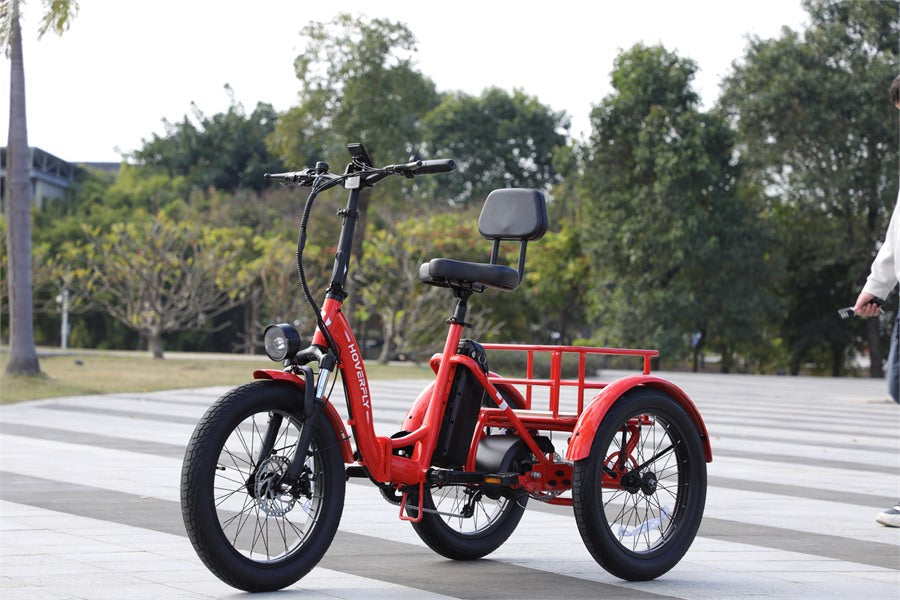
The best electric trike for a heavier rider is the one whose stated payload rating covers body weight plus cargo with room to spare, built on a frame, brake set, and tire package sized for that same load. In our own lineup, that trike is the Hoverfly ET1 Folding Electric Trike, a 400 lb capacity electric trike with a low step-through frame. Because this 400 lb rating applies specifically to the ET1, it should not be treated as an industry benchmark; payload ratings differ widely between brands and even between models from the same brand.
We build and sell three-wheel e trikes and mobility products every day, and weight capacity is the single question our support team answers most often. It also happens to be the question buyers get the least straight information about, so we want to walk through what actually changes when a heavier rider is on board.
Payload Rating Is the First Number to Check
Payload rating tells a rider whether the trike was engineered for their weight, and everything else on the spec sheet is secondary until that box is ticked. A payload figure is not a marketing claim pulled out of the thin air. It is the manufacturer's stated use limit for the rider and cargo load, and exceeding it increases structural and braking risks beyond the conditions the product is meant to handle.
Two details get missed here. The rating covers the rider plus everything carried, so a 260 lb rider with 25 lbs of groceries in the rear basket is closer to a limit than the raw body weight suggests. And a rating close to a rider's weight leaves no margin for the extra load that hits the frame every time a wheel drops into a pothole. As a conservative Hoverfly buying guideline, we suggest looking for a rating at least 60 to 80 lbs above a rider's own weight, while also counting cargo, road conditions, hills, and how often the trike will be used. That is why the ET1's 400 lb figure works for a broad range of adults.
Frame Geometry Does More for Heavy Riders Than Motor Watts
Frame design affects a heavy rider's day-to-day experience more than motor power does, because mounting, dismounting, and cornering are where the extra weight is felt first. Motor power matters on hills, though a strong motor bolted to a frame that flexes under load is a poor trade.
Step-through height is the detail we point to most often. A high top tube forces a rider to swing a leg up and over while balancing on one foot, and that motion is harder and riskier for larger riders and for anyone with knee or hip limitations. We designed the ET1 around our lowest step-through frame, so getting on means stepping through and sitting down.
Center of gravity also matters. Heavier riders sit with more mass higher above the road, and in a turn that mass wants to keep travelling straight while the wheels pull the trike around the corner. A low frame and a low-mounted battery keep that mass closer to the ground. We wrote about the mechanics of this in more depth in our guide on whether an electric trike will tip over. In brief, no trike is completely tip-proof, though design choices and slower cornering make a real difference.
Brakes Carry the Extra Weight Too
Braking distance grows with total system weight, so brake quality moves up the priority list for heavier riders. A loaded trike carrying 350 lbs of rider and cargo has considerably more momentum to shed than a light rider on the same machine, and basic mechanical brakes that feel adequate at 150 lbs can feel vague at double that.
Our ET1 is equipped with dual hydraulic disc brakes, a power cut-off function, and an integrated parking brake. When a rider pulls the brake lever, the power cut-off stops motor assist as braking begins. The parking brake helps hold the trike in place while a rider loads bags or gets seated on a slope. That feature gets more useful, not less, as rider weight goes up, since a heavy trike that starts rolling on an incline is difficult to stop by hand.
Tires and Suspension Change How Long a Ride Stays Comfortable
Wider tires and front suspension keep longer rides tolerable for heavier riders, because more of the road shock gets absorbed before it reaches the seat. Narrow high-pressure tires transmit every seam and crack straight up through the frame, and that fatigue accumulates faster when there is more body mass being jolted.
Our ET1 runs 20 by 3.0 inch fat tires with an 80mm travel front suspension fork. The wider contact patch also helps with grip on gravel and damp pavement, which matters because a heavier trike takes longer to recover from a slide. The seat itself is wide and cushioned with a backrest, and we chose that specification after hearing from owners who wanted to ride for an hour without back strain.
The ET1 Specifications That Matter Most to Heavier Riders
The table below pulls the figures from our ET1 product page that relate directly to carrying weight. Every number applies to this model only, and shoppers cross-shopping other heavy-duty electric trikes for adults should compare against each maker's own published sheet.
Specification |
ET1 figure |
Why it matters under load |
|---|---|---|
Maximum user weight |
400 lbs |
Covers rider plus cargo. This rating is specific to the ET1 and is not a general standard across e trikes. |
Motor |
500W |
Motor output matters most when pulling away from a stop, carrying cargo, or climbing under load. Shoppers should compare this figure against each manufacturer's published specification. |
Battery |
48V 13.5Ah, removable, UL 2271 certified |
Comes off the frame for indoor charging, so no cord runs out to a garage or shed. |
Range |
Up to 60 miles |
A best-case figure. Heavier loads, hills, and throttle-only riding all reduce it. |
Tires |
20" x 3.0" fat tires |
Wider footprint spreads load and softens rough surfaces. |
Top speed |
15.5 mph (Class 2) |
A moderate cap that keeps cornering forces manageable. |
Trike weight |
90 lbs |
Worth knowing before planning to lift or load it alone. |
Folded dimensions |
43.3 x 33.1 x 30.7 in |
Fits many SUV trunks, though the 90 lb weight makes loading a two-person job. |
Expect Range to Drop, and Plan Around It
Real-world range lands below any manufacturer's headline number for a heavier rider. Range figures across the industry come from favourable conditions, meaning flat ground, mild temperatures, and a moderate rider weight. More mass means the motor draws more current to reach and hold speed, and hills amplify the effect.
Our practical suggestion is to treat the 60 mile figure as an upper bound and size the battery around a typical week of riding with margin built in. The removable 48V 13.5Ah pack on the ET1 charges in roughly four to six hours, so an overnight charge covers most daily patterns.
Certification and Local Rules Deserve a Look
Battery certification is worth verifying on any e trike, and it carries some extra weight for higher-payload models that draw more current. The ET1 battery is certified to UL 2271, the standard covering batteries in light electric vehicle applications, and UL Solutions publishes the details of the related e-bike standards for anyone who wants to read further. Federal rules are also moving. The Consumer Product Safety Commission published a proposed safety standard for lithium-ion batteries in micromobility products in June 2026, which would make several of these voluntary standards mandatory.
Road classification works differently from the motor figure quoted in a spec table. We sell the ET1 as a Class 2 e-bike with a 500W motor and assist capped at 15.5 mph. In many US states a Class 2 machine is treated much like a bicycle, with no license, registration, or insurance required for ordinary riding. State definitions vary, several states word their power and speed limits their own way, and PeopleForBikes tracks how the three-class system is written into state law. Checking state code and local trail rules before a first ride is the safer approach.
What We Hear From ET1 Riders

Because we designed and sell the ET1 ourselves, the questions we get about it are usually very practical. Users often ask whether the rear axle has a differential. That is exactly the kind of detail we want riders to check. We build the ET1 with a rear differential, so each rear wheel can follow a turn at the speed its side needs. Riders feel that most when turning into a driveway, moving through a parking lot, or guiding the trike into a garage.
We hear similar questions about pedaling. Some riders want the option to take a full trip by throttle, especially when knees, hips, or fatigue make pedaling difficult. The ET1 supports that style of riding with a hand throttle and a flat floorboard where both feet can rest. Pedal assist remains available for riders who want light exercise. That is how many owners use the ET1 in daily life: grocery runs, short neighborhood trips, and relaxed rides where stability, cargo space, and smooth low-speed control make the difference.
Finding the Right Fit
For heavier riders comparing electric trikes, the ET1 is built around the details that affect daily use most: a 400 lb weight rating, a low step-through frame, disc brakes with a parking brake, 20" x 3.0" fat tires, and a removable UL 2271-certified battery. For complete dimensions, color options, battery details, current availability, and package choices, visit the ET1 product detail page. If you are still comparing three wheels with two, our guide to the pros and cons of 3-wheel ebikes may help, and our broader buyer’s guide to electric trikes for adults compares the ET1 with other models and their own payload ratings.
If you are unsure whether the ET1 fits your height, weight, storage space, or riding needs, please contact us anytime. Our team can walk through the fit with you before you order and help with questions after purchase. The ET1 also comes with a 30-day return policy and a 1-year limited warranty covering eligible defects in materials and workmanship under normal use.
FAQ
Can I add a passenger seat or child seat to the ET1?
No, the ET1 is designed for one rider. The rear basket is for cargo, and adding a passenger changes the trike's balance, braking demand, and frame load. If you need to carry another person, contact us before making any modification.
Can the ET1 be ridden in light rain?
Yes, light wet roads are usually fine. The ET1 has an IPX5 water-resistance rating, but it should not be ridden through deep water or washed with high-pressure water. After a wet ride, dry the trike and charging area before plugging in the battery.
Will the ET1 fit through a doorway or apartment hallway?
Measure first. The ET1 folds for storage, but it is still a three-wheel vehicle and weighs about 90 lbs, so narrow doorways, tight elevators, and stairs can be difficult. Check your doorway, hallway, elevator, and storage space before ordering.
What maintenance should heavier riders check more often?
Start with tires and brakes. Higher total load puts more stress on tire pressure, brake pads, wheel spokes, axle hardware, and folding joints. If braking feels soft, steering feels loose, or the trike starts making new sounds, stop riding and contact Hoverfly support or a qualified bike shop.
Is the ET1 a good fit if I am tall as well as heavy?
It depends on your body fit. The ET1 has a low step-through frame, but tall riders should still check seat position, handlebar reach, and knee comfort. If you are unsure, send us your height, inseam, weight, and riding plans, and our team can help you decide before ordering.
Sources
Hoverfly: ET1 Folding Electric Trike Product Page
UL Solutions: E-Bikes Certification: Evaluating and Testing to UL 2849



Leave a comment
All comments are moderated before being published.
This site is protected by hCaptcha and the hCaptcha Privacy Policy and Terms of Service apply.