
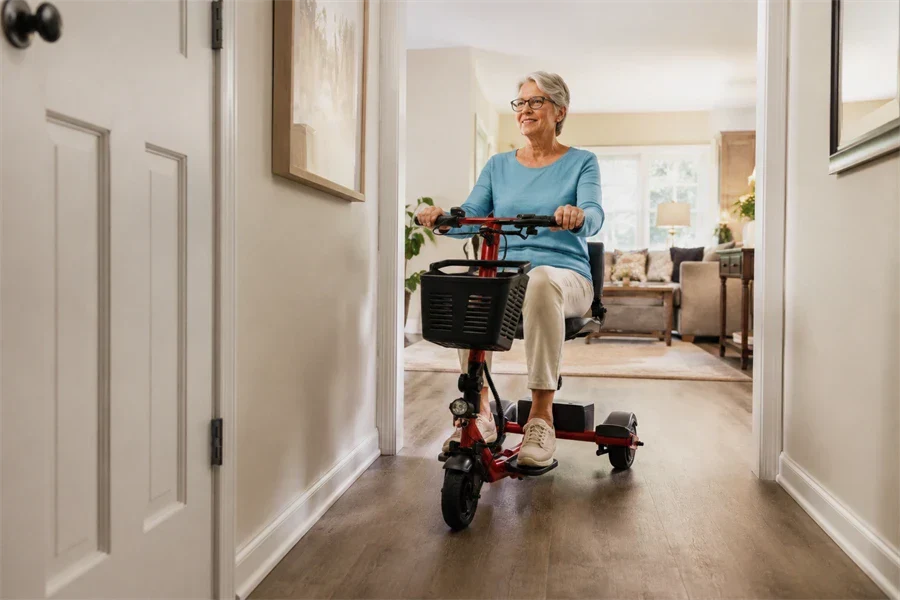
Are you worried that a 3-wheel mobility scooter will feel hard to turn in narrow indoor spaces? For many users, the real concern is not speed or battery range, but whether the scooter can move smoothly through daily areas like hallways, doorways, and small rooms.
With 15 years of experience in the electric mobility industry, we know that turning radius is a key detail buyers should understand before choosing a scooter. This guide explains what a turning radius is, why it matters indoors, how to check your daily route, and how to choose a scooter that feels easier and more comfortable to use.
What Turning Radius Means for a 3-Wheel Mobility Scooter

Turning radius is the radius of the smallest circle a scooter can follow when making a tight turn. To estimate the open floor area needed for a U-turn, double the listed turning radius to picture the turning circle diameter.
A 3-wheel design uses a single front wheel that pivots through a sharper angle, so the scooter rotates around a tighter pivot point.
Why Turning Radius Matters More Indoors Than Range or Speed
Indoors, what matters most is not how fast a scooter can go or how far it can travel on one charge. It is whether the scooter can turn easily in the spaces the rider uses every day. A long battery range will not help much if the scooter feels difficult to handle in a narrow hallway or small room.
That is why turning radius often becomes one of the first things to consider when choosing an indoor mobility scooter. Along with overall width, overall length, and ground clearance, it helps determine whether the scooter can move comfortably through the home, not just look good on a specification sheet.
How to Measure Your Home Before You Buy

Before you buy a scooter, measure the tightest places in your home. Check the bathroom doorway, bedroom doorway, and kitchen corner. Use a tape measure to measure the open floor space where the scooter needs to turn. Measure from the wall to anything the scooter may hit, such as a door, baseboard, or doorstop. A scooter needs about twice its turning radius to make a full turn. For example, if the turning radius is 36 inches, you should have about 72 inches of open space. Choose a scooter with a little extra room, so turning feels easier and safer.
What Turning Radius Should You Target?
A smaller turning radius can help in tight spaces, but smaller is not always better. If a scooter has a turning radius under 30 inches, it may turn more easily in small spaces, but you should also check its wheelbase, seat height, and anti-tip design. These details help show whether the scooter will feel stable and safe during daily use.
Recommended Turning Radius by Home Type
| Where you'll use the scooter | Target listed turning radius |
|---|---|
| Studio apartment, condo, or older home with narrow halls | ≤ 33 in |
| Average single-family home with 36 in hallways | 33 – 36 in |
| Open-plan home or assisted living facility | 36 – 42 in |
| Primarily outdoors, occasional indoor errands | 42 – 50 in |
| Outdoor-only use, no indoor maneuvering | Less critical |
For a reference point against an established standard, the 2010 ADA Standards for Accessible Design, adopted by the U.S. Department of Justice, include a 32-inch minimum clear doorway opening and a 60-inch minimum circular turning space for accessible routes and rooms; the U.S. Access Board provides the underlying technical guidance. ADA standards apply to covered public and commercial spaces, not most private single-family homes, and many older residences have narrower halls and door clearances than the ADA minimums, so the ADA numbers are best used as a reference point rather than a guarantee of home fit.
The Safety Trade-Off Behind Tight Turning
From our experience in the mobility scooter industry, many 3-wheel scooters share the same challenge: they are easy to turn, but a 3-wheel design is more prone to tipping than a 4-wheel scooter, especially if the rider turns too quickly or rides close to the weight limit. Some users have also told us their scooter feels uncertain in tight indoor turns, especially when moving through doorways or small rooms.
Based on this feedback, our team designed the Hoverfly T3 3-wheel mobility scooter to make indoor movement feel easier and more controlled. It combines a compact 3-wheel frame with rear anti-tip wheels, a low-positioned LiFePO₄ battery, and a 15° maximum turn angle. The low-positioned battery lowers the center of gravity, the rear anti-tip wheels add steadiness through turns, and the controlled steering angle helps prevent overly sharp turns that can feel sudden or unstable.
The T3 mobility scooter also uses a 25.6V 8Ah LiFePO₄ battery, a 200W brushless motor, 8.5-inch PU solid tires, and a 330 lbs weight capacity. These design details help support smoother starts, steadier low-speed movement, and better everyday control for indoor routes, short errands, and compact living spaces.
Safe riding habits still matter. Riders should slow down before turning and avoid sharp turns on slopes. For more practical advice, you can also read Hoverfly's 3-wheel mobility scooter safety tips.
Turning Radius Is Not the Only Fit Check

Turning radius matters, but it should be checked together with overall width, overall length, and ground clearance. These specs decide whether the scooter can pass through doorways, turn comfortably, and clear small indoor obstacles.
| Spec | Why it matters | What to look for |
|---|---|---|
| Overall width | Helps decide whether the scooter fits through doorways. | At least 4 inches narrower than the narrowest doorway. |
| Overall length | Affects parking and setup before a turn. | Many compact scooters are about 38-46 inches long. |
| Ground clearance | Helps with rugs, thresholds, and small floor changes. | About 2 inches for smooth indoor floors; 3 inches or more for frequent transitions. |
FAQs
Does a smaller turning radius always mean the scooter will fit better indoors?
Not always. A smaller turning radius helps, but the scooter's width, length, tiller position, and the rider's turning style also affect how easily it moves indoors.
Why can a scooter feel harder to turn at home than the spec sheet suggests?
Because real homes have walls, furniture, door frames, rugs, and tight approach angles. The listed turning radius is measured in open space, so daily routes often need extra clearance.
Can a 3-wheel mobility scooter turn in a hallway without a full turning circle?
Yes, in many cases. Riders can often use a small forward-and-reverse movement instead of one full circle, but this depends on hallway width, scooter length, and available floor space.
How much extra space should I leave beyond the listed turning radius?
Leave more room than the exact number. A few extra inches of clearance can make turns feel smoother and reduce the chance of hitting walls, door frames, or furniture.
Should I choose a foldable 3-wheel mobility scooter for indoor use?
Yes, if you also need easy storage or car transport. A foldable 3-wheel mobility scooter can be helpful for apartments, small homes, and short errands, but you should still check its turning radius, folded size, weight capacity, and stability features before buying. For a broader checklist, read Hoverfly's mobility scooter buying guide.
Conclusion
Turning radius is one of the most important details to check when choosing a 3-wheel mobility scooter for indoor use. It affects how easily the scooter moves through daily spaces, but it should always be considered together with width, length, ground clearance, and stability features.
Before buying, measure the tightest areas in your home and compare them with the scooter's real turning space. The right scooter should not only fit on paper, but also feel smooth, stable, and comfortable in everyday use.



Leave a comment
All comments are moderated before being published.
This site is protected by hCaptcha and the hCaptcha Privacy Policy and Terms of Service apply.