
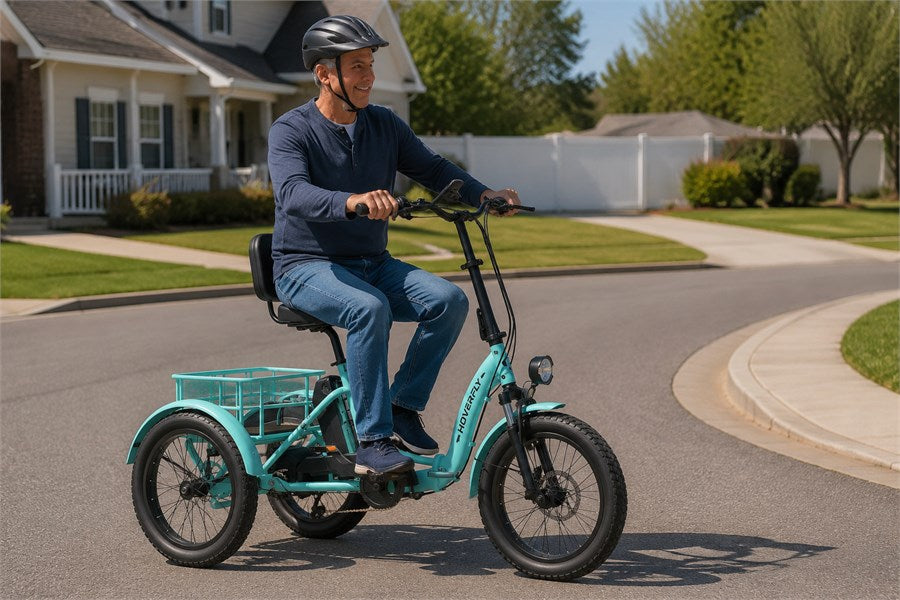
As a team that designs, builds, and supports 3 wheel electric bicycles, we hear the same buying questions again and again: Will it fit in my vehicle? Is it stable in turns? How far will it really go? How much motor power do I need? Those questions matter because they decide whether a 3 wheel electric bicycle feels useful after delivery. The right choice is usually the one that fits your storage space, route, body, and long-term service needs, not just the one with the strongest spec sheet.
1. Three Wheels Feel Steady at Stops, but Turns Need Slower Entry
A 3 wheel electric bicycle feels steadier than a two wheel bike when stopped, starting, or moving at walking pace. The main adjustment is cornering. A bicycle leans into a turn, while a trike stays more upright. If a corner is taken too quickly, weight shifts toward the outside wheels, especially on a downhill, sloped driveway, or curb cut. Slowing before the turn usually solves the problem.
Rear axle design also changes the ride. Some simpler trikes use a locked rear axle, which forces both rear wheels to spin at the same speed. In a turn, the outside wheel needs to travel farther than the inside wheel. When both wheels move together, one tire can scrub across the ground, creating a dragging or hopping sensation.
That is why our Hoverfly ET1 uses a rear differential system. It lets the outside rear wheel rotate faster through a turn, which helps reduce tire scrub and makes low-speed turns smoother and easier to control. This is useful in parking lots, on neighborhood corners, and when the rear basket is loaded. For more everyday buying considerations, see our guide to the pros and cons of 3 wheel electric bicycles.
2. Measure the Folded Trike Against Your Cargo Opening

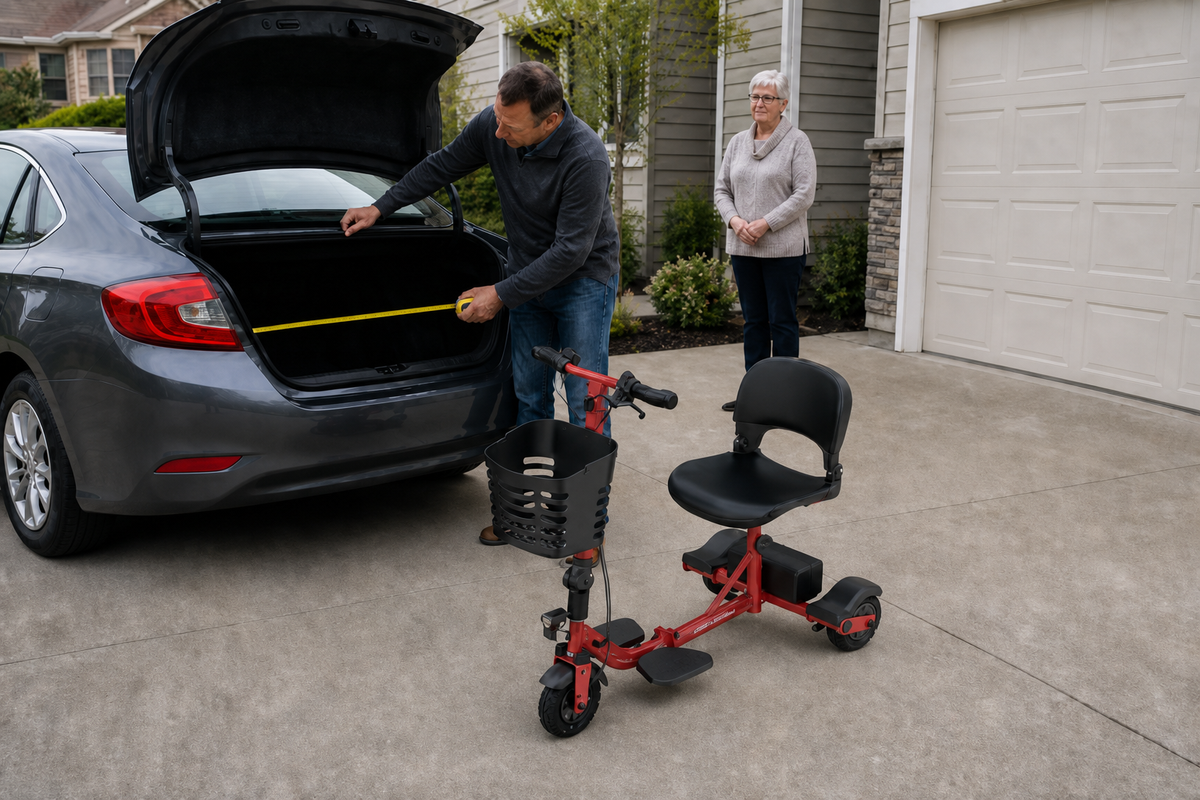
Folded length, width, and height decide whether a trike can travel with you. A foldable frame is useful only when the folded size works with your vehicle, doorway, RV storage bay, or garage space.
This is one of the reasons we designed the Hoverfly ET1 Folding Electric Trike as a folding electric trike for shoppers comparing 3 wheel electric bicycle options. It gives riders the stability and cargo capacity of an electric trike while folding down for easier storage and transport. The ET1’s official folded dimensions are 43.3 × 33.1 × 30.7 in. Hoverfly’s product page Q&A lists the expanded dimensions as 63.5 × 30.5 × 43.0 in., so buyers can check the numbers against their actual storage space or vehicle opening before ordering.
The key is to measure the cargo opening, not just the cargo floor. Many vehicles have enough floor space but not enough hatch height. The ET1 weighs 90 lbs, so it is still a full-size electric trike, but the folding frame gives riders more options for home storage, RV travel, and vehicle transport than a non-folding design.
3. Plan Around a Range Band, Not the Headline Number
Advertised maximum range usually comes from favorable test conditions: a light rider, low assist, flat pavement, mild weather, and few stops. Those figures are useful for comparison, but they are not the number most riders should use for route planning.
A practical rule is to plan around the lower end of the published range band. For the ET1, the listed range is 30 to 60 miles on a single charge. We would treat the lower end as the safer planning figure for everyday errands.
| Variable | Effect on range | Why it matters |
|---|---|---|
| Higher rider and cargo load | Shorter range | More mass requires more energy to accelerate and climb. |
| Throttle-heavy riding | Often much shorter range | The motor supplies propulsion without pedal input. |
| Rolling hills | Shorter range | Climbing draws sustained current. |
| Headwind | Shorter range | Drag rises as relative wind increases. |
| Cold weather | Temporarily shorter range | Lithium cells deliver less usable capacity in low temperatures. |
4. Match Motor Power to Rider Weight and Terrain
For most trike buyers, climbing ability under load matters more than top speed. Rated wattage is the motor number to check because it describes what the motor is designed to sustain. Peak wattage is usually a short burst figure and should not be treated as the everyday climbing number.
| Rated output | Best fit | Worth checking |
|---|---|---|
| 250W | Lighter riders on flat routes | Hill starts may feel slow with loaded baskets. |
| 500W | Mixed errands and moderate terrain | Torque, controller output, and gearing still affect feel. |
| 750W | Heavier riders, steeper routes, and cargo use | Confirm state and local rules before ordering. |
Wattage also connects to classification. Federal product law defines a low-speed electric bicycle as a two or three-wheeled vehicle with fully operable pedals, a motor under 750 watts, and a top motor-powered speed under 20 mph with a 170 lb operator. That definition applies to low-speed electric bicycles with fully operable pedals. The ET1 is a pedal-free electric trike controlled by hand throttle, so buyers should confirm classification and riding rules based on the product’s actual design and their state and local regulations.
For the Hoverfly ET1, the motor is listed as Motor 500W, which helps with starts, hills, and heavier loads. For pedal-equipped electric bikes, it can also be useful to compare throttle and pedal assist behavior. Our guide to how gears and pedal assist work together on an electric bike explains how assist levels affect that type of ride.
5. Step-Through Height and Seat Design Decide Daily Comfort

For many 3 wheel electric bicycle riders, the hardest part is not speed. It is getting on, getting off, and staying comfortable through a full errand run. A low step-through frame matters for riders with hip, knee, balance, or mobility concerns because it reduces how high the leg needs to lift over the frame. That becomes more important when a ride includes several stops at stores, mailboxes, parks, or neighborhood visits.
Seat comfort matters for the same reason. On a trike, the rider usually sits more upright and stays in one seated position longer, so a narrow performance saddle can become uncomfortable quickly. The Hoverfly ET1 is designed around a wide cushioned seat, supportive backrest, and upright riding posture to make everyday rides feel easier, especially for older riders or anyone who wants a more relaxed position. Riders comparing seat options can also review our guide to comfortable saddle seats for tricycles and upright bikes.
Cargo capacity also affects daily comfort. Many riders choose a 3 wheel electric bicycle because they want to carry groceries, bags, or personal items without balancing everything on a two wheel bike. The ET1 includes an oversized rear basket and supports up to 400 lbs total payload including the rider, giving it the capacity needed for short errands and practical neighborhood trips.
6. Check Battery Certification, Warranty Scope, and Parts Support
A 3 wheel electric bicycle should be easy to evaluate beyond speed and range. For the Hoverfly ET1, buyers can check whether key replacement parts such as the battery pack, controller, charger, throttle, and brake-related electronic components are covered by warranty or available through Hoverfly support. Battery certification, warranty coverage, and parts access all affect long-term ownership.
The ET1 uses a UL 2271-certified battery pack, the standard commonly used for light electric vehicle battery packs. This matters for riders who charge at home, in apartments, or in shared buildings where battery safety is a real concern. The CPSC has urged micromobility manufacturers to follow relevant safety standards, and some apartment communities or property managers may ask about battery certification before indoor charging.
Warranty should also be checked by component, not by headline. Hoverfly’s 1-year limited warranty covers the vehicle body and select electronic components, including the battery pack, charger, throttle, and electronic brake. Wear items and consumables have different terms, so buyers should read the coverage list before comparing one trike against another.
Parts support is the final ownership test. Before buying any 3 wheel electric bicycle, ask whether replacement batteries, controllers, motors, and chargers are available for that exact model. A trike is easier to own when the brand can answer those questions clearly and support the product after the sale.
Conclusion
Choosing a 3 wheel electric bicycle is easier when you focus on the details that affect daily use: turning control, folded size, real-world range, motor power, step-through height, seat comfort, battery certification, warranty, and parts support. These details decide whether a trike feels practical after delivery, not just attractive on a spec sheet.
If you are comparing models or want help deciding whether the Hoverfly ET1 fits your riding needs, storage space, or local terrain, contact us. You can also browse Hoverfly electric trikes to compare folded dimensions, payload, battery specifications, and range bands.
FAQs
How much does a 3 wheel electric bicycle weigh?
Many full-size folding trikes are heavy enough that lifting alone can be difficult. For reference, the Hoverfly ET1 weighs 90 lbs. If you need to load a trike into a vehicle, measure the opening and plan for a ramp, hitch rack, or help lifting.
What motor wattage do I need for a 3 wheel electric bicycle?
It depends on rider weight, cargo, terrain, and local rules. Flat routes may suit lower wattage. Mixed errands often point toward 500W. Heavier riders and hillier routes may need 500W to 750W where permitted.
Does a 3 wheel electric bicycle need a rear differential?
A differential is not mandatory, but it helps the two rear wheels rotate at different speeds through a turn. That reduces tire scrub and can make low-speed turns feel smoother and more predictable, especially with cargo in the basket.



Leave a comment
All comments are moderated before being published.
This site is protected by hCaptcha and the hCaptcha Privacy Policy and Terms of Service apply.