
If the motor already helps you pedal, why does your e-bike still have gears? It’s a common question for new riders. The truth is: gears and the motor do two completely different jobs。 Once you understand that, every ride gets smoother, faster, and easier on the battery.
This guide explains exactly what the gears on an electric bike do, what each gear is for, and how to shift without thinking about it.
Why E-Bikes Still Need Gears
Most e-bikes have gears because the motor helps with power, but only gears change how hard your legs work.
- The motor decides how much help you get (pedal assist level).
- The gears decide how hard you pedal at any given speed.
- Without gears, you'd be pedaling air on flats and grinding to a stop on hills.
- Single-speed e-bikes exist, but they only suit flat terrain and short rides.
Think of it this way: pedal assist is like cruise control, while gears are like the gears in a car. You need both to ride efficiently.
The 4 Types of Gear Systems on E-Bikes
E-bikes use one of four gear systems: single-speed, derailleur, internal hub, or CVT. Each suits a different rider and terrain.

Single-Speed (One Fixed Gear)
The simplest setup possible. There's one chainring, one rear cog, and nothing to shift. Single-speed e-bikes are light, low-maintenance, and ideal for flat city rides, short commutes, or beach cruisers.
Derailleur Gears (7–9 Speeds, Most Common)
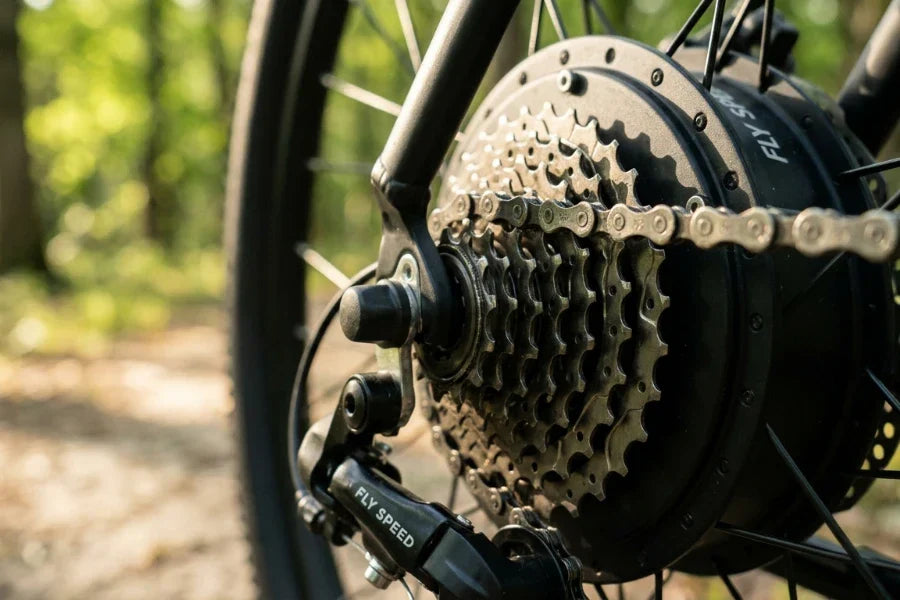
Derailleur gears are the most common system on e-bikes. They use an external chain that moves across a rear cassette of sprockets. They're lightweight, efficient, and inexpensive to repair, but exposed to dirt and weather.
Internal Hub Gears (Low Maintenance)
Hub gears hide the entire mechanism inside the rear wheel hub. You can shift while stopped, they last longer, and they pair well with belt drives instead of chains. The trade-off is added weight and a higher price.
Continuously Variable Transmission (CVT)
CVT systems have no fixed gear numbers. You twist a grip and the resistance changes smoothly across the full range. They're easy to use but heavier and slightly less efficient.
Quick Comparison of Gear Systems
| System | Best For | Gears | Maintenance | Weight |
|---|---|---|---|---|
| Single-speed | Flat terrain, short rides | 1 | Very low | Lightest |
| Derailleur | All-purpose, hills, sport | 7–11 | Medium | Light |
| Internal hub | Commuting, all-weather | 3–8 | Low | Heavier |
| CVT | Easy riding, no shifting effort | Variable | Low | Heaviest |
Note: These are general guidelines. Actual performance varies by brand, motor type, and rider weight, so check the spec sheet on the model you're considering.
What Each Gear Actually Does (Low / Mid / High)
Gears are grouped into three useful zones: low, mid, and high. Each zone matches a specific kind of riding.
- Low gears (1–2 or 3): easier pedaling, more torque. Best for starting from a stop, climbing hills, or hauling cargo.
- Mid gears (3–5): balanced effort and speed. Best for flat roads, gentle slopes, and everyday commuting.
- High gears (6–7+): harder pedaling, more distance per stroke. Best for descents, tailwinds, and flat-road sprints.
| Riding Situation | Suggested Gear | Suggested Pedal Assist |
|---|---|---|
| Starting from a stop | Low (1–2) | Low–Medium |
| Climbing a steep hill | Low (1–3) | Medium–High |
| Flat road commuting | Mid (3–5) | Low–Medium |
| Long descent | High (6–7+) | Off or Eco |
| Cruising with cargo | Low–Mid (2–4) | Medium |
When to Shift (Real-World Scenarios)
Shift before the terrain changes, not during it. Anticipating the road is the single biggest skill in e-bike riding.
- Approaching a hill: downshift to a low gear before you start climbing, then bump up pedal assist if needed.
- Stopping at a red light: shift down so you can start easily on green.
- Cruising flat ground: stay in a mid gear with low assist to save battery.
- Going downhill: shift up to a higher gear to keep your legs spinning instead of pedaling air.
This habit alone separates confident riders from struggling ones.
How the Right Gear Saves Your Battery
Choosing the right gear directly extends your range. When you pedal in too high a gear on a hill, the motor strains, runs hot, and burns through the battery much faster than necessary.
| Habit | Effect on Battery |
|---|---|
| Shift to a low gear before climbing | Motor stays in efficient RPM range |
| Hold a steady 60–80 RPM cadence | Less strain on motor, drivetrain, and knees |
| Avoid grinding in too high a gear | Prevents overheating and energy waste |
| Match assist level to terrain | Stretches range on a single charge |
A 2022 peer-reviewed study by Kamba et al. in Sports found that pedaling efficiency improves measurably when gear ratio matches pedal force. In short, the rider who shifts well almost always rides farther on the same charge.
*RPM cadence: how fast your legs spin per minute
How Many Gears Does Your E-Bike Need?
The right number of gears depends entirely on where you ride. There's no universal best answer, but the patterns are clear.
- Single-speed: flat city streets, short commutes, simplest upkeep.
- 5-7 speed: the sweet spot for most commuters and casual riders.
- 9–11 speed: hilly terrain, off-road trails, or hauling cargo.

For longer daily commutes on mixed terrain, the Hoverfly Ourea is a solid 7-speed option that handles hills and flats without complication. It also features a clear display showing the gear indicator, battery level, and light status, so you always know what gear you're in at a glance.
5 Tips for Smooth Shifting on an E-Bike
Good shifting is about timing, not strength. Follow these five habits and your drivetrain will last longer.
- Ease off the pedals while shifting, and never shift under hard pressure.
- Anticipate the terrain and shift before the hill, not on it.
- Hold a steady cadence of 60–80 RPM.
- Don't cross-chain (smallest front cog and smallest rear cog at the same time).
- Get the drivetrain checked after roughly the first 600 miles, then every 1,000.
Final Thoughts
The gears on an electric bike give you control over how hard you pedal, while the motor controls how much help you get. Use them together, with low gears for hills and starts, mid gears for cruising, and high gears for descents, and your ride becomes smoother, your battery lasts longer, and your e-bike does exactly what it was designed to do.
FAQs
Do electric bikes have gears, or does the motor replace them?
Most e-bikes have gears. The motor adds power, but gears still control how hard your legs work, which keeps you efficient on hills and flats alike.
What's the difference between the left and right shifter on my e-bike?
The right shifter changes mechanical gears. The left shifter or control pad changes pedal assist level (motor power). Two different jobs, two different controls.
What gear should I use for going uphill on an e-bike?
Use a low gear (1–3) and increase pedal assist if needed. Shift before you reach the climb, not while you're already struggling.
Is a 7-speed enough for daily commuting?
Yes, it is enough for most riders on mixed urban terrain. A 7-speed setup handles flats, mild hills, and stops without complication.
Will using the right gear actually extend my battery range?
Yes, matching gear to terrain keeps the motor in its efficient range, reduces heat, and noticeably extends how far one charge will take you.




Leave a comment
All comments are moderated before being published.
This site is protected by hCaptcha and the hCaptcha Privacy Policy and Terms of Service apply.