
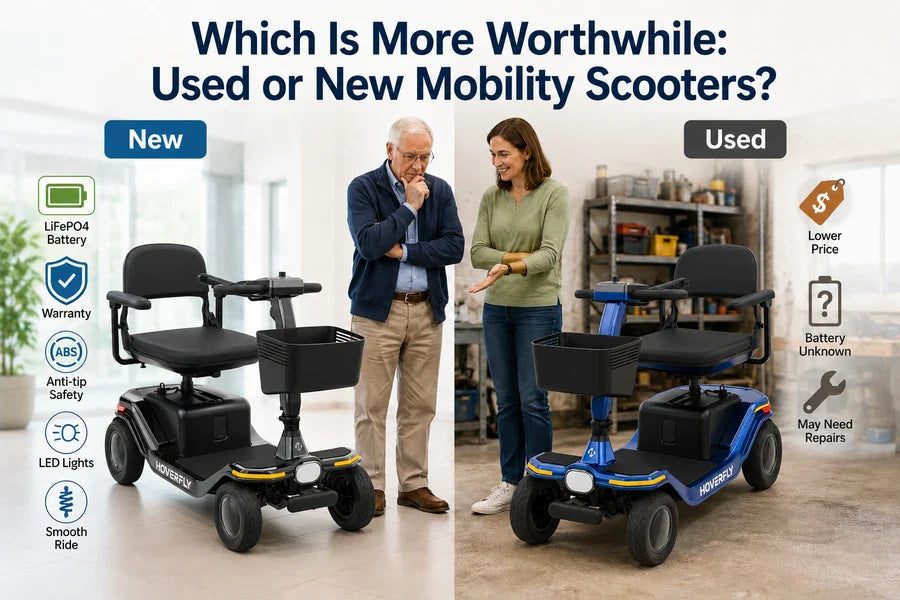
A new mobility scooter is the more worthwhile choice for most American buyers in 2026, while a used mobility scooter only pays off in a narrow set of cases where the battery is fresh and the seller is verified. The decision affects daily independence for an aging parent, a family member recovering from surgery, or anyone planning to use the device for years, so it deserves a closer look than the sticker price suggests.
The stakes keep rising in step with the aging U.S. population. The CDC reports that more than 1 in 7 U.S. adults live with a mobility disability, and roughly 2 in 5 adults 65 and older have a disability that affects daily life. Reading the trade-offs below will save you from the most expensive mistakes.
Quick Decision Guide for Used vs. New Mobility Scooters
The matrix below sums up the most common buyer situations. Read it first, then dig into the sections that match your case.
| Your situation | Better choice |
|---|---|
| Daily use, 3+ years expected | New |
| Battery older than 2 years on the used listing | New |
| Short-term need under 6 months | Used, if inspected |
| Frequent air travel | New with LiFePO4 |
| First-time buyer testing the fit | Used, from a certified reseller |
| Tight indoor turns and ramps | New, for current safety geometry |
| Tight budget with no warranty needed | Used |
The pattern is consistent. Used wins when the use is short, and the unit is recent, while new wins are on multi-year ownership, safety, and travel. The sections below explain why.
The Real Cost Gap Between Used and New Mobility Scooters
While a brand-new medical scooter from traditional legacy brands can cost thousands, modern direct-to-consumer models (like the Hoverfly T4, retailing under $500) completely disrupt this math, making a brand-new vehicle significantly cheaper than many heavily used secondhand listings. The catch is that the listed price is only one of four cost lines you carry over time.
Battery replacement, repair labor, warranty coverage, and depreciation also move the math. A used scooter with an aging battery often needs a new pack within months, which closes most of the initial gap. A buyer can browse current models in this adult mobility scooter overview before deciding.
| Cost factor | New scooter | Used scooter |
|---|---|---|
| Battery installed | Current generation, full cycle life | Often original, age unverified |
| Manufacturer warranty | Active | Usually expired |
| Medicare Part B eligibility | Yes, if medically necessary | No, in most cases |
| Service records | Documented from the factory | Often missing |
| FAA travel readiness | Built to current battery standards | Depends on the existing battery |
Battery Life Decides Whether Used Mobility Scooters Save Money
Batteries are the single largest hidden cost in any used mobility scooter. Most scooters sold in the U.S. before 2022 shipped with sealed lead-acid (SLA) packs. The U.S. Department of Energy and NREL note that lead-acid grid storage has a relatively short life span of about 3 to 6 years, and the same chemistry-driven wear shows up in mobility scooters used daily.
Lithium iron phosphate (LiFePO4) packs have become the standard on newer foldable models. The DOE’s Technology Strategy Assessment for Lithium-Ion lists LFP as a long-cycle-life chemistry well suited to repeat charge-discharge applications, and a current three-wheel foldable model uses this chemistry as a baseline rather than a premium feature.

Replacement Cost Reality
The pair-of-batteries-required design means a single battery swap is rarely $50. Quotes from U.S. mobility dealers run from $150 for budget SLA pairs to $600 for premium lithium replacements, plus labor when a technician is involved.
A secondhand scooter bought “as-is” for $400 might seem like a steal—until month three, when it requires a $250 replacement battery and $150 in mechanic labor, instantly turning it into an $800 liability with zero warranty.
Travel and Airline Use
Battery age also limits where you can take the scooter. The FAA’s PackSafe rules for wheelchairs and mobility devices allow lithium-ion packs up to 300 watt hours, with one spare up to 300 Wh or two spares up to 160 Wh each carried in the cabin. Older lead-acid setups can be heavier and may need extra handling at the gate. For buyers who fly, a recent guide to travel-friendly mobility scooters walks through the specs that matter.
Safety Features Modern New Mobility Scooters Include
The gap between a 2019 used scooter and a 2026 new one is widest in the safety package. Anti-tip wheels, automatic downhill speed control, paddle throttles for users with limited grip strength, and audible reverse alerts now appear on entry- and mid-range models.
Three-wheel and four-wheel layouts have also been refined. A modern four-wheel design distributes weight more evenly and resists tipping in tight turns, while updated three-wheel frames keep the small turning radius without the historical stability trade-off.
Why Older Scooters Fall Short Here
Retrofitting safety hardware onto a used scooter is rarely realistic. Controllers, brakes, and motor electronics are tuned together at the factory, so adding aftermarket parts can void what little warranty remains and may interfere with handling. Buyers who care about a stable indoor ride and predictable braking on inclines usually find that hardware only in current production units, including newer four-wheel models with detachable batteries.

Warranty and Service Risk With Used Mobility Scooters
Warranty coverage is the second factor that flips the math in favor of new. Most major U.S. manufacturers cover the frame and battery for a defined period from the original purchase date. Used units sold privately rarely transfer that coverage, and third-party reseller warranties tend to be short.
A buyer paying for a used scooter without active coverage takes on the full repair risk. Replacing a damaged controller board or motor can cost several hundred dollars, and finding a technician willing to service an unfamiliar resale unit is a separate problem. Confirming warranty terms before purchase is one of the few protections you cannot retrofit later.
Medicare adds another layer worth checking. The CMS Power Mobility Devices fact sheet explains that Medicare Part B covers power-operated vehicles only when medically necessary and supplied by an enrolled provider, which effectively rules out most resale units.
Which One Is Better for You
Buyer situations rarely look like a textbook chart. The cases below cover the most common scenarios real shoppers describe.
Daily Errands and Park Visits
If you plan to ride almost every day, to the grocery store, around the local park, or to visit friends, a new mobility scooter pays back the higher price faster than people expect. Battery wear is the main reason. A daily rider on an aging used pack typically faces a replacement within the first twelve months, and the labor plus parts often equals the original “discount.” A new unit also keeps you on its full warranty for the years of heaviest use.
Recovering From Surgery or a Short-Term Injury
A used mobility scooter often makes sense here. The window of need is six to twelve weeks. A working secondhand unit from a certified reseller covers the recovery period at a fraction of the cost, then resells again with little extra loss. Verify two things before paying. The battery should hold a full charge through one round trip. The brake and tiller should respond cleanly on a short test ride.
Flying Several Times a Year
For frequent flyers, a new mobility scooter is the clearer answer, and the deciding factor is the battery. Lithium-ion packs that meet current FAA limits travel more predictably than older sealed lead-acid packs, which can be flagged at the gate. A lighter folding model also reduces lift-and-load strain at the curb. Buyers in this group often end up with a foldable model under 60 pounds, because the airline experience is easier to repeat without help.
First Time Trying a Mobility Aid
Cost-cautious first-timers can start with a used scooter from a verified reseller. The goal is to test the routine before committing to a long-term purchase. After a few weeks of real use, the next step usually becomes clear, whether that is keeping the unit, upgrading to a new model, or trying a different aid such as a rolling walker. A practical walker versus mobility scooter comparison helps refine the choice once daily routines reveal themselves.
When Replacing a Used Mobility Scooter With a New One Makes Sense
A used mobility scooter is rarely worth keeping once its daily costs start outrunning the price of a new replacement. The three signs below show up most often when riders cross the threshold from “worth fixing” to “time to switch.”
When the Battery No Longer Holds a Full Charge
Range loss is usually the first symptom. If your used scooter now covers less than half the distance it once did between charges, the pack is close to the end of its life. A pair of replacement lead-acid batteries plus labor often costs more than what the older scooter would resell for, which means the money goes into a unit with declining value.
When Safety Features Have Fallen Behind
Older scooters lack anti-tip wheels, paddle throttles for limited grip strength, and automatic downhill speed control. Once a rider has had a single close call on a curb or an incline, replacement stops being optional.
When Repair Bills Outrun the Resale Value
Watch what happens after the second major repair. Controllers, motors, and chargers can each run several hundred dollars to replace, and the cumulative bill quickly passes what the used scooter is worth on a resale listing. At that point, the spending is not worth it.
If your scooter shows one or more of the patterns above, a new one is worth considering. Hoverfly’s 30-day return policy makes that switch low-risk, since you can run a new scooter alongside your current used one for a few weeks and judge the difference in real conditions rather than on paper. Combined with the included 1-year warranty and free U.S. shipping, comparing old and new becomes a side-by-side test instead of a leap of faith.
FAQ
Are used mobility scooters worth buying in 2026?
Sometimes. A used mobility scooter is worth it when it is under two years old, has a verified battery, and comes with at least a short warranty. Outside those conditions, savings tend to disappear within the first year through replacement parts and lost coverage.
How long does a new mobility scooter battery last?
Most new mobility scooters with lithium iron phosphate packs run for several years of daily use. Older sealed lead-acid packs typically last 3 to 6 years in similar applications, per NREL grid-storage data, and wear faster under heavy use.
Can I fly with a used mobility scooter?
Yes, if the battery meets FAA limits. The FAA PackSafe guidance allows lithium-ion packs up to 300 Wh in the cabin. Older heavy lead-acid packs may need to be removed at the gate or refused on some carriers.
Does Medicare cover used mobility scooters?
Not in most cases. The Medicare wheelchair and scooter coverage page requires a prescription and a Medicare-enrolled supplier, and used resale units generally do not qualify. A new prescribed scooter from an approved supplier is the normal path.
What is the cost difference between used and new mobility scooters?
Used listings price below new retail, sometimes considerably. The gap narrows over a few years once you account for battery replacement, missing warranty, and repair work, which can erase most of the early savings for daily users.
Are new mobility scooters safer than used ones?
Usually yes. New mobility scooters include current anti-tip designs, automatic speed control on slopes, and updated brake controllers. Older used units often lack these and cannot be easily upgraded.
Conclusion
A new mobility scooter is the more worthwhile choice for daily users planning multi-year ownership, because current battery chemistry, modern safety features, and active warranty coverage outweigh the higher up-front price. Used mobility scooters work in narrower cases, such as short-term recovery, first-time testing, or a verified resale under two years old. The most reliable way to avoid hidden costs is to confirm battery age, service history, warranty terms, and FAA travel readiness before any purchase, and to match the choice to how often and how long you actually plan to ride.



Leave a comment
All comments are moderated before being published.
This site is protected by hCaptcha and the hCaptcha Privacy Policy and Terms of Service apply.