
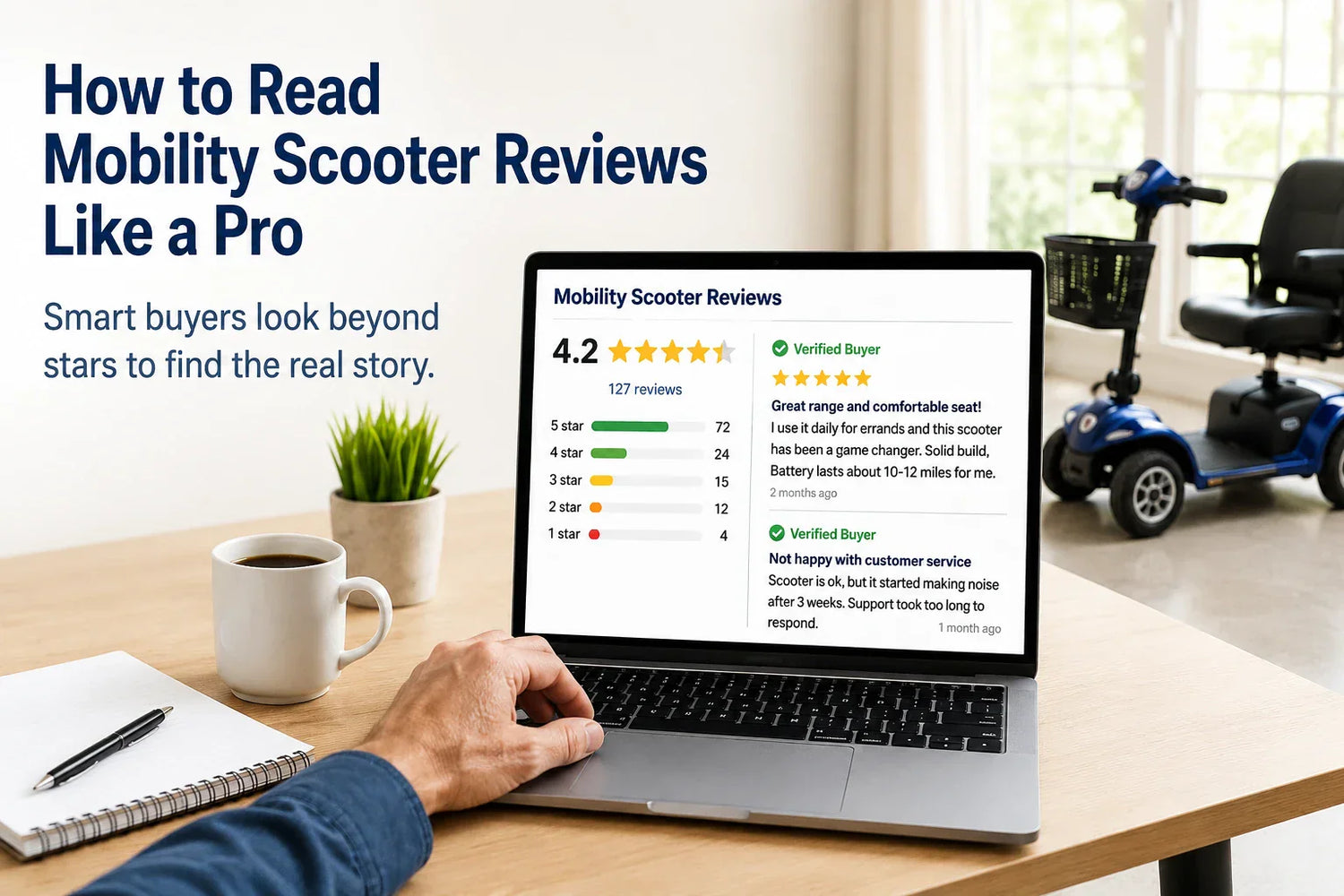
Reading mobility scooter reviews like a pro comes down to where you read them, who wrote them, and whether the praise survives a second look. The best mobility scooter reviews come from verified buyers on independent platforms, not from the rotating carousel on a product page. Anyone working through electric mobility scooter reviews for a first purchase, or assembling a mobility scooter buying guide for parents, tends to trust those star averages too quickly. Knowing how the review ecosystem works changes which scooters end up in the cart.
Quick-Reference Scoring Table
Run any review past this matrix before reading it in detail. Six signals consistently separate useful feedback from filler.
| Review Factor | Why It Matters | Red Flag |
|---|---|---|
| Source independence | Independent platforms resist seller editing | Reviews live only on the seller's own page |
| Verified-buyer status | Confirms the reviewer owns the unit | No verified tag on a 5-star post |
| Real-world battery range | Predicts daily usability against brochure claims | The reviewer quotes only the manufacturer's figure |
| Long-term feedback (3 to 6 months in) | Shows durability, not first-week glow | Positive posts cluster in one launch month |
| Reviewer history | Real accounts review more than one product | Account created to post a single review |
| Specific usage detail | Real experience names conditions and quirks | Vague "works great," nothing concrete |
Which Mobility Scooter Reviews Can You Trust?
A 4.8 average looks reassuring until you sort by date and read the 2-star ones. Popular models collect tens of thousands of reviews now, and platforms still let manufacturers reply, request edits, or remove unflattering posts.
Trustworthy mobility scooter reviews share five traits.
- They come from verified buyers.
- They mention rider height, weight, and use case.
- They describe specific terrain or weather.
- They include follow-up notes months after purchase.
- They balance praise with at least one drawback.
If you're at the start of the process and not yet sure which scooter category fits your routine, Hoverfly's mobility scooter collection and buying guidance maps everyday use patterns to scooter types. Doing that mapping first makes the review-filtering step far more efficient afterwards.
How to Spot Fake or Manipulated Reviews
Since October 2024, the FTC Consumer Reviews and Testimonials Rule, codified at 16 CFR Part 465, has prohibited businesses from selling, buying, or disseminating fake or AI-generated reviews, suppressing negative reviews, or using insider testimonials without disclosing the connection.
Common manipulation patterns include batch-uploaded dates, such as 50 perfect reviews posted on the same Tuesday, near-identical robotic phrasing, and product descriptions that sound suspiciously like an SEO-optimized sales brochure. Honest reviewers almost always mention at least one drawback alongside the praise.
Don't Trust the Star Rating Alone
A high average tells you almost nothing on its own. Star ratings get inflated by review invitations sent only to happy customers and by sellers filtering which posts appear.
The number that matters is the spread. A 4.5 from twelve hundred reviews carries far more weight than a 4.9 from twelve. Open the rating breakdown and read the 1- and 2-star buckets directly, because that is where the real defects live.
Watch the date curve too. A wall of 5-star posts in the launch month, followed by complaints later, usually signals a promotion push rather than a great scooter.
Read Negative Reviews First
Sort by lowest rating before anything else. The bottom of the list is where you learn what actually breaks.
One angry review proves nothing. The job is to find whether the same complaint repeats across unrelated buyers. Two people calling the tiller wobbly is a coincidence worth noting. Eight people saying it is a design flaw you can count on.
Pay attention to how the seller responds to negative reviews. A clear, specific reply suggests real support. Silence or a copy-paste apology suggests you will be on your own after purchase.
Compare Details in Real Reviews
Good reviews rarely stop at "love it" or "hated it." They name the conditions, the quirks, and the small frustrations that only show up after weeks of use, and that texture is the strongest sign a review is genuine.
What Specific Detail Looks Like
As a brand, we welcome this scrutiny. Take the Hoverfly T4 4-Wheel Mobility Scooter as an example: our product page clearly states a 12.4-mile range and a 330 lb capacity. When you read our verified customer reviews, you will see real riders confirming these exact metrics in their daily neighborhood loops.

Cross-Check Details Against the Spec Sheet
Line up the recurring details in reviews against the manufacturer numbers. A small gap between claimed and reported range suggests an honest spec sheet. A large gap means plan for surprises.

Which Review Platforms Are Actually Reliable?
Where a review lives matters as much as what it says. The FTC advises checking a variety of sources rather than relying on star ratings alone, since fake reviews come in both positive and negative forms and rarely look obviously fake.
Independent Platforms Beat Seller Pages
Trustpilot is a strong starting point for electric mobility scooter reviews because it runs as an open platform where consumers, not businesses, control what stays posted. According to Trustpilot's explanation of how it works, companies cannot pay to delete or hide genuine negative reviews, and every review passes automated fraud screening before publication. Reviews tied to a confirmed transaction carry a green verified checkmark.
Google Reviews and the Better Business Bureau fill out the independent tier. Their shared value is simple. A seller cannot quietly erase the complaints that matter most.
What a Verified Label Really Means
Verified confirms the purchase happened, not that the opinion is correct. A green checkmark tells you the reviewer owns the scooter, not that their range estimate holds up.
It is better to read verified and unverified reviews together. The verified ones prove ownership; the problem in both shows whether a complaint is widespread or isolated. Cross-check two or three platforms before drawing any conclusion.

Are Blog and Expert Mobility Scooter Reviews Trustworthy?
Sometimes, the source decides it. The FTC has long pointed people toward well-known sites that publish trustworthy and impartial expert reviews as a good place to start. A blog review is only as reliable as the testing and disclosure behind it.
Signs of a Credible Expert Review
Credible expert reviews explain how the scooter was tested, name the reviewer, and disclose any affiliate or sponsorship ties. They report measured numbers instead of adjectives, and they cover the same unit across several conditions rather than over a short time.
Weak blog reviews read like rewritten spec sheets. No hands-on detail, no named tester, no disclosure, a buy button on every line. Those pages exist to rank, not to help you choose.
Reading Brand-Published Guides
Manufacturer blogs still help when they explain trade-offs honestly. Hoverfly's breakdown of 3-wheel scooter benefits and safety tips is a fair example because it covers the tipping risk that most retailer reviews skip. Read brand content for the engineering logic, then confirm it against independent reviews.
FAQ
Which mobility scooter reviews can you actually trust?
Verified-buyer reviews that include rider weight, terrain, and follow-up notes from three to six months in. Reviews that disclose paid or insider status under FTC rules also rank as more honest by default.
How do you spot a fake mobility scooter review?
Look for missing rider details, identical phrasing across reviewers, batch-upload dates, and praise without a single drawback. FTC 16 CFR Part 465, effective since October 2024, prohibits most of these practices, but they still appear.
Are Trustpilot mobility scooter reviews reliable?
Mostly. Trustpilot screens reviews for fraud and bars sellers from deleting genuine negative posts. Favor verified green-checkmark reviews, and cross-check the pattern against Google or BBB.
Can you trust blog mobility scooter reviews?
Only from high-authority sites that test units, name the reviewer, and disclose sponsorships. Blog reviews that read like rewritten spec sheets with buy buttons everywhere exist to rank, not to inform.
Why read negative mobility scooter reviews first?
They reveal what breaks. One complaint means little, but the same issue repeated across many buyers is a reliable defect signal worth more than any star average.
Conclusion
Reading mobility scooter reviews well is mostly a discipline. Start on independent platforms like Trustpilot, where sellers can't bury complaints. Trust high-authority blog reviews only when they test and disclose. Don't trust the star average only, and read the negative reviews before the positive ones. Most of all, weigh the detailed reviews that name conditions and quirks, then cross-check those details against the spec sheet. With those filters running, the gap between a marketing claim and a real scooter becomes obvious within minutes.





Leave a comment
All comments are moderated before being published.
This site is protected by hCaptcha and the hCaptcha Privacy Policy and Terms of Service apply.