
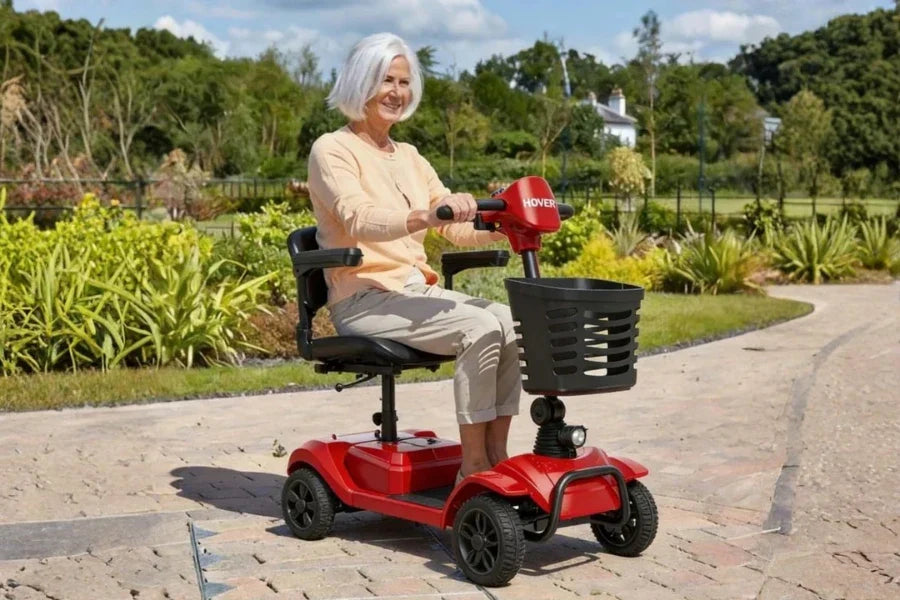
Many seniors still get around the house. The trouble shows up the moment they step outside. They can't finish outdoor activities or walk for a long time. This guide explains which mobility aids for seniors fit that exact problem, how a rollator, a folding three-wheel scooter, and a four-wheel model differ, what Medicare will and won't pay for, and the mistakes that cost families a second purchase.
Mobility Aids for Seniors at a Glance
Five categories cover the main walking limitations. Picking among them comes down to two things: distance needed and support remaining.
| Aid Type | Practical Range | Support Level | Best Use Case |
|---|---|---|---|
| Standard or quad cane | Indoor + short trips | Light balance | Mild unsteadiness |
| Rollator with seat | A few blocks with breaks | Frame, brakes, seat | Endurance loss |
| 3-wheel folding scooter | 10-13 miles per charge | Full ride, tight turns | Errands, travel |
| 4-wheel scooter | 12-17 miles per charge | Full ride, wide base | Outdoor, uneven ground |
| Power wheelchair | 8-15 miles per charge | Full ride, postural support | Severe mobility loss |
When Walking Distance Outpaces What the Legs Can Give
The elder's endurance, balance, and joint comfort decline on separate timelines. A senior may move through the kitchen with no trouble and still tire halfway down the driveway. Stamina usually fails before the will to keep going does.
Such walking limitations cause a higher rate of falling. The CDC's data shows that more than one in four adults age 65 and older falls each year, and falling once doubles the chance of falling again. The unintentional fall death rate reached 69.9 per 100,000 older adults in 2023, with rates climbing at every age band above 65.
Fall-related healthcare spending hit $80 billion in 2020 and is projected to top $101 billion by 2030, the National Council on Aging reports. A single hip fracture often spends the savings a family had set aside for in-home care.
Mobility Scooters for Seniors Who Can't Walk Far
A wheeled seat is the strongest answer for seniors with poor endurance whose hips, knees, or stamina limit them to walking only a hundred feet. Senior mobility devices for short-distance walking issues are not always about replacing walking entirely. In practice, the goal is to extend it. Mobility aids for seniors succeed when they bring back the outings that had quietly fallen off the calendar.
Two things settle most buying decisions. The first is the longest single trip the user actually needs in a typical week. The second is the tightest door, elevator, or aisle the device has to clear at home.
Three-Wheel Models for Tight Spaces and Travel
Three-wheel scooters turn more sharply than four-wheel models. That tighter radius matters in grocery aisles, hallways, and apartment elevators. If your home has limited storage space, or your daily route runs through narrow sidewalks, packed stores, and crowded elevators, a three-wheel model is usually the right call. The smaller footprint folds into a closet or a sedan trunk without rearranging the garage.

Foldable Designs for Cars, RVs, and Apartments
Roughly 55 lbs per piece is the upper limit on what one adult can lift into a car trunk. Folding models typically break into three or four pieces with main frames between 50 and 77 lbs, and the heavier ones quietly require two people to load.
The deciding factor for independent use is the weight of the single heaviest piece, since that number determines whether one person can move it from the garage to the trunk without help.
This is where the Hoverfly T3 Folding 3-Wheel Scooter excels. Through modular disassembly, its heaviest liftable piece is reduced to a highly manageable 51 lbs, bypassing the 77-lb heavy-lifting anxiety and allowing a solo senior to load it independently.
It is worth checking which folding scooters stay light enough to handle solo and which ones don't.
Also, folding matters most when storage is tight. Choose a folding model if the scooter has to fit in a trunk next to luggage, slide behind a closet door, or load into a rental car when family visits. The same goes for apartment renters with no parking spot and for RV travelers who have little room to spare.
Four-Wheel Models for Outdoor Distance and Stability
Four-wheel models travel 12 to 17 miles on a single charge, far more than a compact indoor scooter. The wider base is what makes that distance safe to use. Stability becomes critical at curb cuts and ramp transitions, where a narrow wheelbase can shift weight faster than a senior rider can compensate.
For superior outdoor stability, models like the Hoverfly T4 4-Wheel Scooter provide a wider, anti-tip chassis. It rolls safely over sidewalk cracks and ramps, utilizing a heavy-duty battery system to lower the center of gravity and keep you firmly planted.
It rolls over sidewalk cracks, curb cuts, and ramps without tipping, and handles gravel or short grass. A stable platform also makes it easier to carry groceries, an oxygen tank, or a small dog.
A Quick Decision Path
Start with the longest walk the senior actually needs to make in a week. Being under 100 feet on one level usually indicates a rollator. Several blocks of errands point to a folding scooter. Daily outdoor use across uneven ground points to a four-wheel model.
If the difference between the categories still feels blurry, this walkthrough on picking the right mobility scooter breaks the choice down by daily use.
Medicare and the Real Cost of Mobility Aids
Medicare Part B covers power scooters and power wheelchairs as durable medical equipment when a doctor performs a face-to-face exam and provides a written prescription documenting medical necessity for use inside the home.
If the supplier accepts the assignment, the patient pays the Part B deductible plus 20% of the Medicare-approved amount.
Most mobility aids for seniors fall under the same DME category. Travel scooters, outdoor-only models, and knee scooters often fall outside Medicare's definition of medically necessary in-home equipment.
Mobility aids for the elderly with limited walking ability who travel frequently are usually paid for out of pocket, and a side-by-side comparison of mobility scooters for seniors helps families weigh what insurance will cover against what the household will pay out of pocket.
Common Mistakes When Buying Mobility Aids for Seniors
Sizing the Aid to Today Only
Mobility usually gets worse over time. A device that fits during a stable stretch often falls short within three to six months, especially after surgery, an illness, or a fall. Buy for where the person is heading, not just where they are today.
Comparing Specs Without Measuring the Home
Top speed, battery range, and price are the easy numbers to compare online. But the decisive data is the width of your house. A scooter that needs 32 inches of clearance fails in a home with a 30-inch hallway. Measure every doorway, elevator, and turn the device has to handle before lining up any two models for comparison.

Ignoring Trunk and Lifting Limits
A scooter rated at 100 lbs total may still be split into a 77-lb main frame. That single piece has to go into the trunk every time you travel, and most caregivers, especially older spouses, cannot manage that weight repeatedly.
Skipping the Battery Conversation
The cheapest battery on a spec sheet rarely turns out cheapest over the life of the scooter. A lead-acid pack typically lasts 2 to 3 years under daily use, while LiFePO4 holds capacity for 5 to 8 years at roughly 60% of the weight. That gap shows up most clearly when the battery needs to be lifted out of a trunk several times a week.
Forgetting About Air Travel
Most US airlines accept mobility scooters at no extra charge under the Air Carrier Access Act, but battery rules vary widely. Onboard lithium batteries usually cap at 300 watt-hours, and many carriers require the battery to be removed and carried into the cabin separately. Cruise lines impose their own size and stateroom storage limits on top of that.
FAQ
1. What is the best mobility aid for a senior who tires after short walks?
A scooter with a seat. A folding three-wheel model handles indoor stores and short outdoor trips while removing the weight load from the legs.
2. Does Medicare pay for a mobility scooter?
Yes, when a doctor documents medical necessity for use inside the home. The user still owes the Part B deductible plus 20% of the approved cost.
3. How far can a folding mobility scooter travel on one charge?
Most folding scooters cover 10 to 17 miles per charge. Actual range depends on rider weight, terrain, tire pressure, and battery size.
4. Is a rollator safer than a cane?
For seniors with endurance loss or balance issues, yes. A rollator adds a wider base, hand brakes, and a built-in seat for rest stops.
5. Can a senior travel by car with a mobility scooter?
Yes. Folding scooters break into three or four pieces that fit standard car trunks. The heaviest single piece typically weighs 50 to 77 lbs.
6. How quickly does Medicare approve a power scooter request?
Under the updated CMS prior authorization rules that took effect on January 1, 2026, affected Medicare plans are now required to decide standard requests within 7 calendar days.
Conclusion
The best mobility aid for seniors with poor endurance is the one sized to the actual distance the day demands. A rollator extends short walks with seating built in. A folding three-wheel scooter restores store visits and neighborhood errands. A four-wheel model handles outdoor terrain and longer days. Medicare offsets the cost of medically necessary models, while travel and outdoor scooters usually come out of pocket. Picking by walking distance, doorway width, and trunk capacity beats picking by brand.
A short clinician check and a careful side-by-side review at Hoverfly fill in the rest. Every Hoverfly Order ships free in the continental US and is backed by a 1-year warranty plus a 30-day return window. Checkout supports TD Bank, major credit cards, PayPal, and Affirm or Shop Pay installments, so the upfront cost can be spread across months when that fits the household budget better. Orders ship from the Hoverfly's Dallas, Texas, warehouse and typically arrive in 2 to 5 business days.



Leave a comment
All comments are moderated before being published.
This site is protected by hCaptcha and the hCaptcha Privacy Policy and Terms of Service apply.