

| Model | Best for | Specs and price |
|---|---|---|
| Hoverfly T4 | All-purpose indoor and outdoor daily use | 4 wheels; 3.7 mph; 330 lbs capacity; up to 12.4 miles; folds / separates; $539.99 |
| Golden Buzzaround EX 3-Wheel | Comfort on longer rides | 3 wheels; 5 mph; 350 lbs capacity; 18 miles; disassembles; about $1,934 |
| Hoverfly T3 | Travel and small apartments | 3 wheels; 3.75 mph; 264 lbs capacity; up to 13 miles; folds with no tools; $467.49 |
| Drive Medical Scout Spitfire | Tight budgets | 4 wheels; 4.25 mph; 300 lbs capacity; 9 miles; 5 pieces; about $750-$1,000 |
Specifications are manufacturer figures. Real-world range is usually lower — see what actually changes your range below.
Best Mobility Scooters for Seniors (Top Picks for 2026)
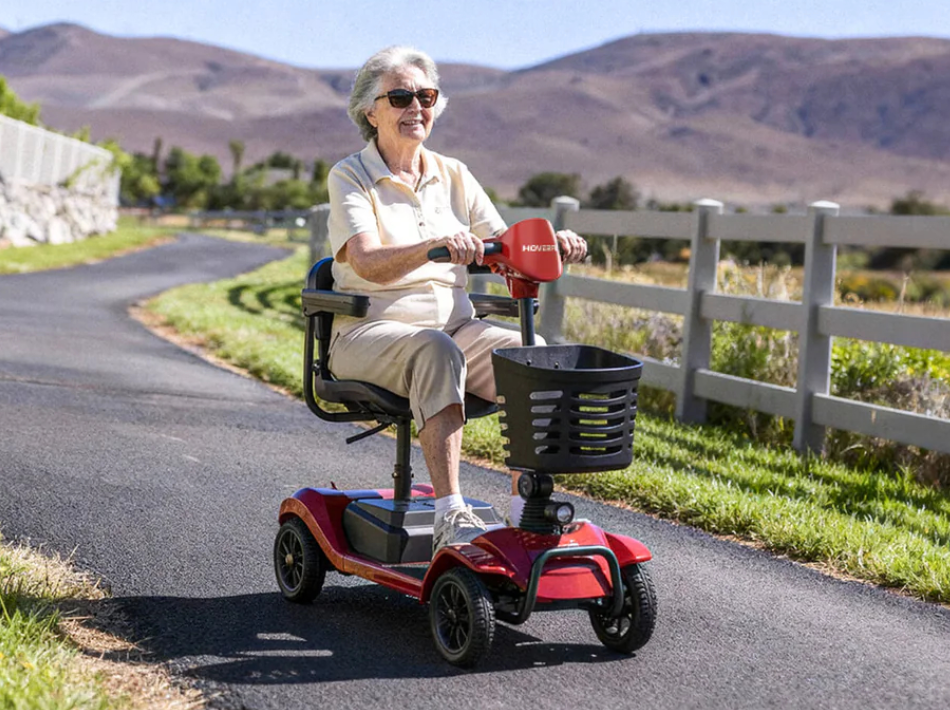
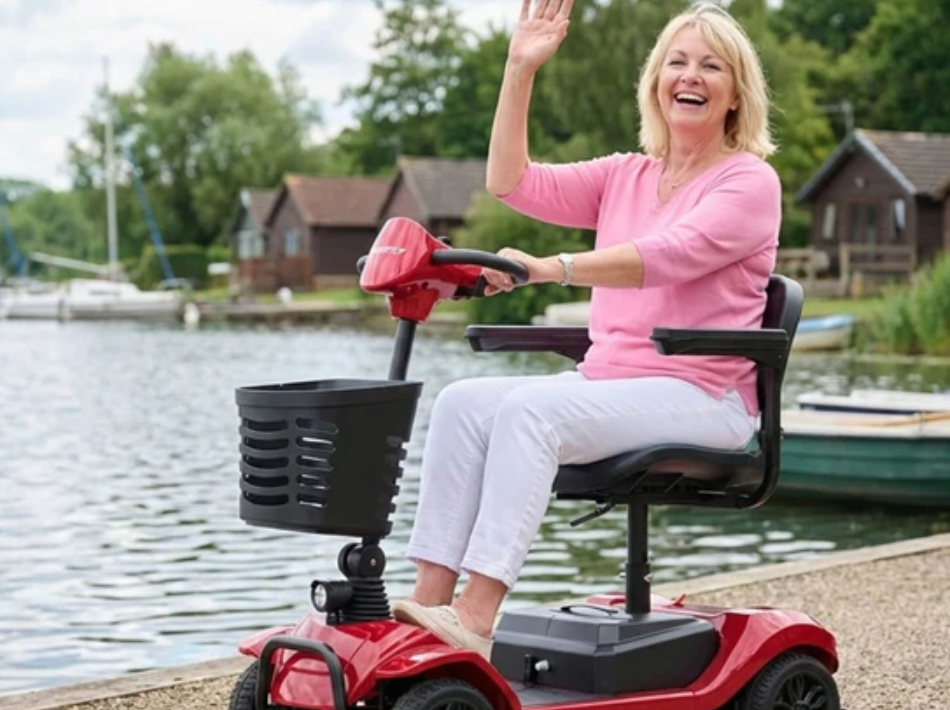
Best All-Purpose Mobility Scooter – Hoverfly T4 Foldable Mobility Scooter

The Hoverfly T4 is the best all-around mobility scooter for seniors who want reliable performance indoors and outdoors. You’ll get a scooter that fits through doorways, handles uneven sidewalks, and still feels steady on longer trips.
Key Features and Benefits:
- Maximum Speed: 3.7 mph – controlled for errands, sidewalks, and neighborhood rides.
- Weight Capacity: 330 lbs – sturdy for most seniors, plus a basket of groceries.
- Range: up to 12.4 miles per charge – enough for many daily trips.
- Compact Design: Fits tight hallways and elevators without fuss.
- Colors: Red, Blue – with a convenient front basket for groceries or personal items.
Why we love it:
100+ customer reviews praise the T4’s ease of use and long-term reliability. One reviewer shared: “I can run errands without worrying about tipping or running out of battery halfway home.”
The T4 gives you stability, versatility, and affordability—perfect for seniors who need one scooter for most situations.
Who it’s not for: riders over 330 lbs, riders who need lateral trunk support to sit upright, or anyone whose main routes are gravel, grass, or steep hills — look at a heavy-duty four-wheel model or a power wheelchair instead.
Best Comfort Mobility Scooter – Golden Technologies Buzzaround EX 3-Wheel

For seniors prioritizing comfort during longer journeys, the Buzzaround EX delivers.
The captain's seat features adjustable armrests and generous cushioning. Its suspension system absorbs bumps smoothly, making uneven sidewalks feel manageable. The LED lighting package adds safety for evening use.
Key Specs:
- Maximum speed: 5 mph
- Weight capacity: 350 lbs
- Range: 18 miles per charge
- Seat width: 20 inches
Why it's the best: Superior comfort for all-day use.
Who it’s not for: this is a three-wheel scooter, so it trades outdoor stability for a tighter turning circle. If the rider has balance concerns or rides mostly on broken sidewalks, choose a four-wheel model.
Best Lightweight Mobility Scooter – Hoverfly T3 3-Wheel Foldable Mobility Scooter

The Hoverfly T3 is the top choice for seniors who travel often or need easy storage. It folds quickly into a compact shape, making car transport and small apartment storage a breeze.
Key Specs:
- Weight: Under 100 lbs – light enough for most seniors to lift or carry.
- Maximum Speed: 3.75 mph – safe for indoor spaces and casual outdoor rides.
- Range: up to 13 miles per charge – covers short trips reliably.
- Weight capacity: 264 lbs – best for riders comfortably under that limit after counting bags and cargo.
- Folding Mechanism: Quick and easy, no tools required.
Why it's the best:
100+ reviews highlight the folding convenience and portability. One reviewer shared: “I can fold it and pack it in my SUV for weekend trips. Perfect for travel.”
The T3 proves that a small scooter can make a big difference in independence.
Who it’s not for: daily outdoor use on rough pavement. A light, narrow frame is what makes it portable — and it is also what makes it feel less planted outdoors.
Best Value Mobility Scooter – Drive Medical Scout Spitfire

The Scout Spitfire proves that the best mobility scooter for seniors doesn't require premium pricing.
Weighing just 116 pounds when fully assembled, this scooter offers solid construction and reliable performance. The quick-disconnect battery system means you can charge it indoors without moving the entire unit.
Key Specs:
- Weight: 116 lbs
- Maximum speed: 4.25 mph
- Disassembles into 5 pieces
- Heaviest piece: 38 lbs
Why it's the best: Quality construction at a budget-friendly price.
Who it’s not for: anyone who cannot repeatedly lift a 38 lb piece into a car. Five pieces sounds portable on paper; it is a real workout twice per trip.
Which Scooter Fits You? A 5-Minute Self-Check
Most bad scooter purchases are not caused by a bad scooter. They are caused by a mismatch between the scooter and the rider’s daily routes. Answer these four questions before you compare any specs.
1. Where will it be used most?
- Mostly indoors — apartment hallways, elevators, shops: prioritize turning radius, overall width, and smooth low-speed control. A three-wheel model usually wins.
- Mixed indoor and outdoor — sidewalks, parking lots, the pharmacy two blocks away: prioritize stability, tire size, and confident braking. A four-wheel model usually wins.
- Mostly outdoors — uneven sidewalks, curb cuts, mild slopes: prioritize ground clearance, larger wheels, and a generous stability margin.
2. What is the rider’s balance like?
If the rider has balance problems, slower reflexes, or difficulty holding an upright seated posture, treat a stable four-wheel platform and predictable braking as non-negotiable — not as an upgrade to consider later.
3. How far is a typical trip?
Add up the longest round trip you actually make in a week, then choose a scooter rated for at least 50% more than that. Advertised range is measured under ideal conditions.
4. Does it need to be transported or stored?
If it has to go in a car trunk, someone has to lift it — every single trip, twice. Measure the trunk opening, then check the folded dimensions and the heaviest single piece. Be honest about who is doing the lifting and how often. Lighter scooters are easier to transport, but a very light, narrow scooter can feel unsteady outdoors. That trade-off is real; make it deliberately.
How We Evaluated the Best Mobility Scooters?

Finding the right mobility scooter isn’t about specs—it’s about daily use.
We evaluated scooters for home, store, outdoor, and travel scenarios to see which models actually make life easier for seniors.
When evaluating, we focused on the features that matter most for everyday comfort, safety, and reliability:
Indoor and Travel Use
Scooters should be nimble and easy to maneuver in homes, elevators, and stores. Look for a tight turning radius (under 40 inches), smooth low-speed control, and compact width.
Three-wheel models usually shine indoors because they turn sharply and take up less space. Portability matters too—easy disassembly or folding designs make car trips and storage hassle-free.
Outdoor and All-Terrain Use
Stability is key on sidewalks, ramps, or uneven ground. Bigger wheels (9–12 inches), at least 3 inches of ground clearance, suspension, and weather-resistant parts help scooters handle rough terrain.
Four-wheel scooters are better for seniors who need extra balance and control outdoors. We go deeper into why in why 4-wheel mobility scooters are safer for seniors.
Battery Life & Range
Choose a scooter that comfortably exceeds your typical daily trips. Check real-world range (10–15 miles minimum), battery type, charging time, and potential performance drops in cold weather.
A simple rule: pick a scooter with at least 50% more range than your longest usual outing.
What actually eats into your advertised range:
| Condition | Typical effect on range |
|---|---|
| Cold weather (near or below freezing) | Noticeably reduced — commonly 20–30% less |
| Rider near the stated weight limit | Reduced, plus more strain on motor and battery |
| Hills and repeated inclines | Reduced — the steeper and longer, the more |
| Frequent stop-and-start (shops, crossings) | Reduced compared with steady cruising |
| Grass, gravel, soft or broken surfaces | Reduced — rolling resistance rises sharply |
| Battery age (after several years of cycles) | Gradually reduced until the pack is replaced |
Manufacturers measure range on flat, smooth ground at moderate temperature with a set rider weight. Treat the advertised figure as a ceiling, not an expectation.
Weight Capacity & Fit
Safety and comfort depend on the right fit. Ensure the scooter supports at least 50 lbs above your body weight, offers an appropriately sized seat, and has a strong frame and motor for your needs.
Overloading reduces range, increases wear, and shortens lifespan. Remember to count cargo too — groceries, an oxygen concentrator, a bag on the tiller. It all counts against the same limit.
How Much Does a Mobility Scooter Cost in 2026?
Price is the question most guides skip. Here is the honest shape of the market, and what the extra money actually buys you.
| Price band | What you generally get | Best suited to |
|---|---|---|
| Under $600 | Compact folding frame, lithium battery, 250–300 lb capacity, 10–15 mile claimed range, basic seat, no suspension | Indoor use, short errands, occasional travel |
| $600 – $1,200 | Bigger wheels, better ride quality, longer range, adjustable seat and tiller, lights, stronger motor | Daily mixed indoor and outdoor use |
| $1,200 – $2,500 | Full-size frame, suspension, captain’s seat, 18–25 mile range, established dealer service network | All-day outdoor use, longer rides, comfort priority |
| $2,500 and up | Heavy-duty and bariatric builds, 350–500 lb capacity, all-terrain tires, extended warranty options | Higher rider weight, rough terrain, heavy daily mileage |
Typical U.S. street prices as of the update date above. Renting is also an option in many areas and is usually billed monthly — worth considering if the need is temporary, for example while recovering from surgery.
Costs people forget to budget for
- Replacement battery: the single biggest recurring cost. Ask for the part number and price before you buy, not three years later.
- Shipping and returns: a scooter is heavy freight. Check who pays return shipping if it doesn’t fit your home.
- Ramp or threshold ramps for a front step.
- A car lift or carrier if lifting isn’t realistic.
- Accessories — a rain cover, a cane holder, a second basket.
3-Wheel vs 4-Wheel Mobility Scooters: Which Is Best for Seniors?

Three-Wheel Mobility Scooters
Three-wheel scooters turn on a dime, making them perfect for indoor spaces like apartments, stores, or clinics. They’re lighter and often more affordable than four-wheel scooters, and the compact design helps you navigate tight hallways and doorways.
Advantages:
- Tighter turning radius (typically 30-40 inches)
- Lighter weight for easier transport
- Lower price point
- Better for indoor use in small spaces
Limitations:
- Reduced stability on uneven ground
- Lower weight capacities
- Less suitable for outdoor terrain
- Not ideal for users with balance concerns
The Hoverfly T3 exemplifies three-wheel design done right—foldable, affordable, and perfect for seniors who primarily need indoor mobility.
Four-Wheel Mobility Scooters
Four-wheel scooters give extra stability outdoors and on uneven terrain. They handle heavier loads, provide longer ranges, and offer more comfort for extended trips. The trade-off is a wider turning radius, heavier weight, and higher price.
Advantages:
- Superior stability on all terrain
- Higher weight capacities — heavy-duty and bariatric models reach 350–500 lbs
- Better for outdoor use
- More comfortable for extended trips
Limitations:
- Wider turning radius (typically 50-60 inches)
- Heavier and harder to transport
- Higher price point
- Requires more storage space
The Hoverfly T4 offers four-wheel stability at an affordable price, making it accessible for seniors who need outdoor capability without premium costs.
Choosing the Right Type:
- 3-wheel: Best for indoor use, small spaces, and easy transport.
- 4-wheel: Best for outdoor use, balance concerns, or longer trips.
Scooter, Power Wheelchair, or Rollator — Which Device Do You Actually Need?
A mobility scooter is not the right answer for everyone, and buying the wrong category is far more expensive than buying the wrong model. Use this as a first filter.
| Device | The rider needs to be able to… | Typically best when |
|---|---|---|
| Rollator / walker | Walk short distances and bear weight through the legs | Walking is possible but tiring or unsteady |
| Mobility scooter | Sit upright unsupported, grip and turn a tiller with both hands, see and judge traffic, and transfer on and off the seat | Walking distance is the limitation, not upper-body function |
| Power wheelchair | Operate a joystick with one hand; seating can provide trunk, head and leg support | Trunk control, stamina, or hand function rules out a tiller |
Signs a scooter is the wrong choice: the rider cannot hold themselves upright without side support; cannot steer with both hands for the length of a trip; has significant vision loss or memory problems that affect judgement in traffic; or cannot get on and off the seat safely without help. In any of these cases, talk to a physical or occupational therapist before spending money.
Will Medicare or Insurance Pay for a Mobility Scooter?
Sometimes — but the rules are stricter than most buyers expect, and “it would make life easier” is not enough on its own.
Under Medicare, a power scooter is treated as durable medical equipment under Part B. Coverage depends on medical necessity in the home, and it generally requires:
- A face-to-face examination with your treating doctor;
- A written order or prescription from that doctor;
- Both the doctor and the equipment supplier to be enrolled in Medicare;
- Documentation that a cane, walker, or manual wheelchair will not meet your needs inside your home.
If you are approved, you normally still pay a share of the cost — typically 20% of the Medicare-approved amount after your Part B deductible. Some devices also require prior authorization.
The point most buyers miss: Medicare’s test is whether you need the device to move around inside your home. A scooter bought mainly for outdoor convenience, shopping trips, or travel is usually not covered. If outdoor independence is your goal, plan to pay out of pocket — and factor that into the budget from the start.
Medicaid rules vary by state, and some Medicare Advantage plans, veterans’ benefits, and long-term care policies have their own pathways. Always confirm before you buy, not after. Start with the official guidance on Medicare coverage for wheelchairs and scooters.
Measure Your Home Before You Buy (10 Minutes, Saves a Return)
The most common reason a scooter goes back is not performance. It is that it does not fit the home, the elevator, or the car. Take a tape measure and write these down before you order.
| Measure this | Compare it against | Your number |
|---|---|---|
| Narrowest doorway, clear opening with the door open | Scooter overall width + about 2 inches | ______ in |
| Tightest hallway corner you must turn | Turning radius | ______ in |
| Highest threshold or door sill | Ground clearance | ______ in |
| Elevator car depth and door width | Scooter overall length and width | ______ in |
| Car trunk opening (width × height) and floor depth | Folded dimensions | ______ in |
| Rise of the front step, and length available for a ramp | A gentle ramp needs roughly 12 inches of run per inch of rise | ______ in |
| Storage spot — is there a power outlet within reach? | Charger cable length, or removable battery | Yes / No |
| Heaviest single piece someone must lift | What the lifter can safely manage, twice per trip | ______ lbs |
Still unsure about dimensions? Our size guide for indoor, outdoor and travel use walks through each measurement in more detail.
Traveling With a Mobility Scooter: Cars, Planes and Cruises
By car
Two options: fold or disassemble it into the trunk, or fit a vehicle lift or hitch carrier. Folding is cheaper; a lift is far easier on the caregiver’s back and is worth pricing out if trips are frequent. Measure the trunk before you assume it fits.
By air
Airlines carry mobility devices free of charge, and battery type is the thing that decides whether the trip goes smoothly. The FAA’s rules for wheelchairs and mobility devices set the baseline that U.S. airlines follow:
- A lithium-ion battery may stay installed if the device protects it from damage and accidental activation; otherwise it must be removed and carried into the cabin with the terminals protected against short circuit.
- For a removed battery, the limit is 300 watt-hours. You may carry one spare up to 300 Wh, or two spares up to 160 Wh each — in carry-on baggage only, never in checked baggage.
- Lithium metal (non-rechargeable) batteries are not permitted with these devices.
- Individual airlines may apply stricter procedures, request battery documentation, or ask for advance notice. Call your airline before the day of travel and allow extra time at check-in.
Find the watt-hour rating on the battery label or in your user manual; if it lists volts and amp-hours instead, multiply them. Full details are on the FAA’s PackSafe page for wheelchairs and mobility devices, and our own guide to flying with a lightweight mobility scooter covers the gate-check routine step by step.
On cruises and public transport
Cruise lines generally require you to declare a mobility device at booking and to store it inside your cabin rather than in a corridor — which makes cabin doorway width and folded size the deciding specs. Buses and trains vary by operator; check the device size and weight limits published by the operator before you rely on them.
What Common Mistakes Do Seniors Make When Buying a Mobility Scooter?
Choosing Based on Price Alone
The cheapest scooter often costs more over time due to repairs and poor durability.
Ignoring Weight Capacity
Overloading strains the motor and battery, shortening the scooter’s lifespan. Choose a model rated at least 50 lbs above your weight.
Not Testing Before Buying
Specs don’t show real comfort or control. Test in person whenever possible.
Buying the Wrong Type for Your Environment
Indoor scooters struggle outdoors, and bulky outdoor models may not fit inside. Buy for where you’ll ride most.
Overlooking Seat Comfort
You’ll sit for hours. Test the seat for at least 15 minutes to confirm comfort and fit.
Forgetting About Storage and Transport
Some scooters are too heavy or too large to store or lift easily. Measure space and check component weight first.
Red Flags When You Compare Listings
Product pages are written to sell. These are the specific signals that a scooter will disappoint you later — use them as a checklist while you shop.
- A range figure with no conditions attached. “Up to 25 miles” means nothing without a rider weight, a surface, and a temperature. A seller who states the conditions is telling you they measured it.
- “All-terrain” on a narrow, very light frame. Portability and outdoor stability pull in opposite directions. A listing that claims both without explaining the trade-off is claiming something physics doesn’t allow.
- No replacement battery listed anywhere. If you cannot find the battery part number and price today, you will not find them in year three either. This is the single most useful pre-purchase check.
- A warranty that doesn’t say what counts as a wear item. Tires, batteries and upholstery are usually excluded. If the page doesn’t say so, ask in writing before ordering.
- No phone number or service address in your country. A heavy device that needs repair is not something you want to negotiate over email across time zones.
- Weight capacity quoted without mentioning cargo. Your groceries, oxygen tank and bag are part of the load.
- Every photo taken on a smooth showroom floor. Ask to see it on a cracked sidewalk, a curb cut, or a ramp — the surfaces you actually use.
- Vague return terms on a freight-sized item. Check who pays return shipping, and what happens if the scooter simply doesn’t fit through your door. Ours are set out in our return policy and warranty policy.
How Do You Maintain Your Mobility Scooter?

Regular maintenance keeps your scooter safe, reliable, and long-lasting. Just a few simple steps can prevent costly repairs.
Weekly
- Clean: Wipe frame, seat, controls, wheels, and battery terminals.
- Check Tires: Inflate to recommended pressure and inspect for damage.
- Test Brakes: Ensure smooth engagement and predictable stopping.
Monthly
- Battery Care: Charge after each use; inspect terminals for corrosion.
- Inspect Connections: Tighten seat mounts, armrests, and basket attachments.
- Air Filters: Clean or replace if your model has them.
Annual
- Professional Service: Have a technician check brakes, motor, wiring, and lubricate parts.
- Battery Replacement: Replace lead-acid (1–2 yrs) or lithium (3–5 yrs) batteries before failure.
Storage Tips
- Store indoors, away from extreme temperatures and sunlight.
- Charge fully before long-term storage; check every 4–6 weeks.
Quick Dos and Don’ts
- Do: Clean, charge, inspect, test brakes.
- Don’t: Power-wash, ignore warning signs, attempt complex repairs, or use automotive products.
Tip: 15 minutes of weekly care can extend your scooter’s life to 5–7 years. Model-specific steps are in the user manuals.
If You’re Buying This for a Parent
Often the person researching the scooter is not the person who will ride it. Two things make that go better.
Lead with what it gives back, not what it replaces. Many older adults resist a scooter because it feels like an admission of decline. It usually lands better framed around the specific things it makes possible again — the farmers’ market, the grandchild’s ball game, walking the dog to the end of the block.
Plan the first week deliberately. Set the speed dial to its lowest setting. Practice in an empty parking lot or a quiet indoor space before any street riding. Practice reversing and tight turns — that is where new riders clip door frames. Ride the intended route together once before they do it alone. And agree on a charging routine on day one; a flat battery a mile from home is the experience that puts a scooter in the garage for good.
Closing Ideas
Choosing the best mobility scooter is an investment in your independence and daily comfort.
Take time to consider where you’ll ride most, how often you’ll transport your scooter, and what level of stability you need. Whenever possible, test a scooter in your real living environment.
Models like the Hoverfly T4 and T3 show that you don’t need to overspend to get reliability, comfort, and long-term value. You can also put them side by side on our product comparison page.
The right mobility scooter should feel like a natural extension of your lifestyle—not something you have to work around. Choose the one that protects your independence.
FAQs
1. What is the best mobility scooter for heavy adults?
The best mobility scooters for heavy adults are bariatric models rated for 350–500 lbs.
These scooters feature reinforced frames, wider seats (20–22 inches), stronger motors, and higher-capacity batteries designed to handle extra load safely and reliably.
2. What size scooter should a senior choose?
A senior should choose a scooter size based on where it will be used most.
Compact 3-wheel scooters work best for indoor use and tight spaces, while full-size 4-wheel scooters offer better comfort, stability, and range for outdoor use.
The right size depends on the daily riding environment, storage space, and physical comfort.
3. Do mobility scooters need a lot of maintenance?
No. Mobility scooters require minimal maintenance. Basic care includes weekly cleaning, monthly battery checks, and annual professional servicing.
With proper battery care and indoor storage, most scooters operate reliably for 5–7 years.
4. Do mobility scooters require a driver’s license?
No. Mobility scooters are classified as medical mobility devices, not motor vehicles, so a driver’s license is not required.
Local rules may vary on where scooters can be used (sidewalks vs. roads), so checking local regulations is recommended.
5. How far can most mobility scooters travel on a single charge?
Most mobility scooters travel 8–15 miles per charge, while extended-range models can reach 18–25 miles.
Actual range depends on rider weight, terrain, speed, and weather. Cold temperatures can reduce battery range by 20–30%.
6. Does Medicare pay for a mobility scooter?
Sometimes. Medicare Part B may cover a power scooter as durable medical equipment when it is medically necessary for moving around inside your home, and it requires a face-to-face exam, a written order from your doctor, and both the doctor and supplier to be enrolled in Medicare. If approved, you typically still pay 20% of the approved amount after your Part B deductible. Scooters bought mainly for outdoor convenience are usually not covered.
7. Can I take a mobility scooter on a plane?
Yes. Airlines carry mobility devices at no charge. The battery decides the process: a lithium-ion battery may stay installed if it is protected by the device, otherwise it must be removed and carried in the cabin. Removed and spare batteries are limited to 300 watt-hours, or two spares of up to 160 watt-hours each, and spares can never go in checked baggage. Lithium metal batteries are not allowed. Confirm the details with your airline before you travel.
8. How much does a mobility scooter cost?
Compact folding models generally start under $600, mid-range scooters for daily indoor and outdoor use run roughly $600–$1,200, full-size comfort models run about $1,200–$2,500, and heavy-duty or bariatric models start around $2,500. Budget separately for a replacement battery, which is the main recurring cost.
9. Should I get a mobility scooter or a power wheelchair?
Choose a scooter if walking distance is the limitation but the rider can sit upright unsupported, steer a tiller with both hands, and transfer on and off the seat. Choose a power wheelchair if the rider needs trunk or head support, has limited hand function, or would struggle to operate a tiller for the length of a trip. An occupational or physical therapist can settle this quickly.
10. How long does a mobility scooter battery last?
Lead-acid batteries typically need replacing after one to two years, and lithium batteries after three to five, depending on how often the scooter is used and how it is charged. Charging after each use and storing the scooter indoors both extend battery life. Find the replacement part number before you buy, so you know what it will cost later.
11. Can a mobility scooter go on grass or gravel?
A four-wheel model with larger tires and adequate ground clearance can handle short stretches of firm grass or packed gravel, but soft ground, loose gravel, and sand cut your range sharply and increase the risk of getting stuck. If your regular routes include these surfaces, look specifically at all-terrain models rather than assuming a standard scooter will cope.



Leave a comment
All comments are moderated before being published.
This site is protected by hCaptcha and the hCaptcha Privacy Policy and Terms of Service apply.