
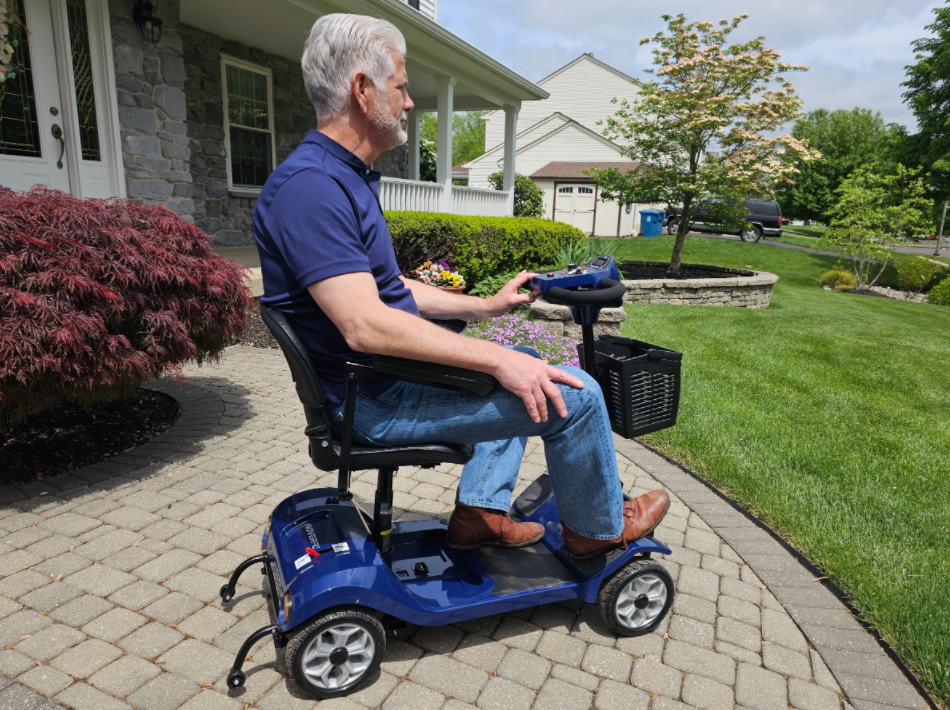
The right mobility scooter helps you move freely, safely, and confidently.
A good scooter makes daily life easier by supporting your independence and allowing you to travel comfortably and conveniently.
Understanding how to choose the right mobility scooter ensures your purchase fits your lifestyle and personal needs.
How to Choose the Right Mobility Scooter?
Choosing the right mobility scooter comes down to understanding your daily routine, your body, and where you plan to ride.
Use these steps like a checklist—you’ll quickly see which model fits your life.
1. Consider Your Daily Needs
Choose a mobility scooter based on where you ride most often and how far you need to travel.
If you ride mainly indoors, a lightweight or compact scooter turns easily and fits into tight spaces.
If you spend more time outdoors, a 4-wheel or heavy-duty scooter gives you better stability on sidewalks, in parks, and on neighborhood roads.
Think about how you actually live:
-
Need to run errands? → Choose a scooter with good storage and comfort.
-
Commute between places? → Look for a longer range.
-
Travel often? → Folding or travel scooters keep life simple.
Your daily habits tell you more about the right scooter than the specs alone.
Be Realistic to Save Money:
If you are a daily rider who only flies once a year, don't overspend on an expensive travel model.
A standard scooter will fit your budget better and offer more comfort for your everyday rides. Buy for your daily life, not your vacation.
2. Check Weight Capacity
Choose a scooter with a weight capacity that supports your body weight plus at least 20% extra.
That buffer protects the motor, improves stability, and keeps your battery working efficiently.
Typical capacity ranges:
-
Travel scooters: up to 250 lbs
-
Lightweight scooters: up to 275 lbs
-
Heavy-duty scooters: 400–500 lbs
If you often carry groceries or bags, include that weight as well.
3. Look at Battery Life and Range
Pick your scooter based on how far you need to travel on one charge. Most scooters cover 10–30 miles per charge.
General ranges:
- Travel models: 10–15 miles
- Lightweight models: 12–18 miles
- 4-wheel models: 15–25 miles
- Heavy-duty models: 25–35 miles
For short indoor trips, a standard battery is enough. However, if you plan to ride longer distances outdoors, you should choose a scooter with a stronger battery and an extended range.
Tip: Charge regularly and avoid running the battery to zero to extend its lifespan.

4. Assess Speed and Power
Choose your scooter’s speed based on where you’ll ride it.
Most models go 4–8 mph:
-
Indoor riders → slower speeds feel safer
-
Outdoor riders → faster speeds help on open paths
Motor power also matters. Stronger motors handle slopes, rough sidewalks, and hills more smoothly. If your area has steep roads, pick a higher-watt motor so you don’t slow down halfway up the incline (we’ve seen this happen—it’s not fun).
5. Comfort and Seating Options
Pick a scooter with comfortable seating, especially if you ride longer than 15–20 minutes at a time.
Look for:
- A padded, adjustable seat
-
Swivel design for easy boarding
-
Supportive armrests and backrest
-
Suspension or shock absorbers
If you have back pain or ride on uneven sidewalks, suspension makes a noticeable difference—it reduces vibration and keeps your body relaxed during the ride.
6. Portability and Storage
Choose a lightweight or folding scooter if you need to lift it, store it in a trunk, or take it on public transport.
Check:
-
Folding method (manual or automatic)
-
Whether one person can lift the scooter
-
If the seat, battery, and base separate for easy storage
-
Whether the battery can be removed for charging indoors
Small apartments and frequent travelers benefit the most from foldable designs.
7. Safety Features
Choose a mobility scooter with strong safety features, especially if you ride outdoors.
Look for:
-
Anti-tip wheels
-
Reliable braking system
-
LED headlights and taillights
-
Reflectors or indicators
-
Wide, stable tires
Good safety features aren’t just “nice to have”—they give you confidence every time you ride, especially when crossing streets or traveling at dusk.
8. Ease of Controls and Steering
Choose a scooter with controls that feel natural and easy to use.
Look for:
-
A clear, simple control panel
-
Smooth throttle response
-
Ergonomic tiller for comfortable steering
-
Adjustable handle height
-
Small turning radius for indoor use
If you have limited hand strength, a lightweight steering system makes a huge difference in comfort.
When your scooter is easy to handle, every ride feels smoother and stress-free.
Types of Mobility Scooters
The various scooters are tailor-made to suit needs. The knowing of each type provides you the chance to align your scooter with your life and your surroundings.
1. Travel Mobility Scooters
The travel scooters are portable and can be folded to suit the purposes of individuals who travel a lot. They break down easily into parts to be carried as baggage in the air. They are ideal to use indoors and to travel over a short distance.
- Best use: people who travel frequently or need compact storage.
2. Lightweight Mobility Scooters
Lightweight mobility scooter is an upcoming popular scooter with a small design and weightless handling. They are best suited to day-to-day activities, small apartments and expeditions outdoors.
They are easy to fold or lift, and therefore, they are convenient to the users who do not want to be assisted. Many of the models are a good source of reliable power and comfort despite a light frame.
- Most suitable: seniors, travelers, and everyday home use.
3. 3-Wheel Mobility Scooters

Scooters with three wheels are created to perform very well in the indoor environment. They have a low turning radius that makes them move easily even in small hallways or over tight corners.
They are typically small in size and light in weight and therefore suitable for shopping malls or indoor areas.
- Best for: indoor navigation and small spaces.
4. 4-Wheel Mobility Scooters

Scooters on four wheels are the most stable and balanced. They are ideal in outdoor and rocky environments. This broader base eliminates the possibility of tipping and is more beneficial on slopes or uneven surfaces.
- Best for: outdoor riding, long distances, and uneven surfaces.
5. Heavy-Duty Mobility Scooters
Heavy scooters are designed with high motors and bigger tires. They are able to compensate for increased weight loads and extended battery charges.
These scooters come in handy when a person wants to make an outdoor adventure over rugged roads or he require more stability and power.
- Best for: outdoor adventurers and users who need maximum stability and power.
6. Folding Mobility Scooters

Scooters can be folded without using any tools in a few seconds. They can be kept in a car, bus or train and are very portable for travelers.
The new folding scooters are equipped with sophisticated lithium batteries and automatic folding facilities.
-
Best for: travelers and people with limited storage space.
Comparing Mobility Scooter Features
To make it simple to select the correct mobility scooter, I have provided the following comparison of features to be considered essential:
| Feature | Travel Scooter | Lightweight Scooter | 4-Wheel Scooter | Heavy-Duty Scooter |
| Weight Capacity | Up to 250 lbs | Up to 275 lbs | Up to 350 lbs | Up to 500 lbs |
| Battery Range | 10-15 miles | 12-18 miles | 15-25 miles | 25-35 miles |
| Top Speed | 4 mph | 4-5 mph | 5-6 mph | 7-10 mph |
| Portability | Excellent |
Excellent |
Moderate | Low |
| Terrain Use | Indoor |
Indoor/Outdoor |
Outdoor | Rough Terrain |
| Comfort Level | Good |
Good |
Very Good | Excellent |
| Best For | Travel |
Everyday Use |
Outdoor Use | Long Rides |
This chart helps you quickly eliminate scooters that won’t fit your routine.
Mobility Scooter Safety Tips
You should always have safety first when riding your mobility scooter. The following are the key safety measures:
- Wear the seatbelt on any occasion possible.
- Do not use your scooter on wet and steep surfaces.
- Check brakes and tire pressure.
- When driving at low light, use reflectors or lights.
- Always hold on to the handle with both hands in order to be in control and in balance.
Safe habits make every ride more comfortable and predictable.
Common Mistakes to Avoid
Avoid these common buying mistakes:
-
Choosing a scooter without enough comfort or range
-
Ignoring weight limits
-
Overlooking terrain compatibility
-
Skipping a test ride
-
Buying without warranty or after-sales support
A little research goes a long way toward finding the right scooter.

Where to Buy Reliable Mobility Scooters
If you’re looking for a reliable supplier, Hoverfly is one of the most trusted manufacturers of electric mobility scooters.
We specialize in high technology engineering, comfort, and design of international standards.
We have a great selection of scooters, such as lightweight, foldable, and heavy-duty ones that come in handy when one wants to have a smooth ride and a long battery life.
Hoverfly offers the best after-sales support, quality control and value, thus becoming a brand that people all over the world can rely on.
Last Words: How to Choose the Right Mobility Scooter
Knowing how to choose the right mobility scooter can make you decide in the best way to be safe, comfortable and free. Right scooter will be essential to improve your way of life and also give you the confidence to move anywhere.
At Hoverfly, we boast of advanced, comfortable and long-life mobility scooters which are being trusted the world over. You can find the model that best suits your mobility requirements in our huge range of models. Buy Hoverfly now and ride comfortably and confidently on your own.
FAQs About How to Choose the Right Mobility Scooter
1. What is the best mobility scooter for daily use?
Lightweight or 4-wheel scooters are best for daily use because they offer a good balance of comfort, stability, and easy handling.
2. How do I know which scooter size fits me?
Check your height, weight, and how comfortable the seat feels. A short test ride helps you choose the best fit.
3. Are mobility scooters allowed on roads?
Most scooters are meant for sidewalks. Certain heavy-duty or faster models may be road-legal depending on local rules.
4. How long does a mobility scooter battery last?
Most mobility scooter batteries last 2–4 years, depending on how often you ride and how you charge them.
5. Can I travel with my mobility scooter?
Yes. Many lightweight and folding scooters come with airline-approved batteries. Always check the battery type before booking a flight.



Leave a comment
All comments are moderated before being published.
This site is protected by hCaptcha and the hCaptcha Privacy Policy and Terms of Service apply.