
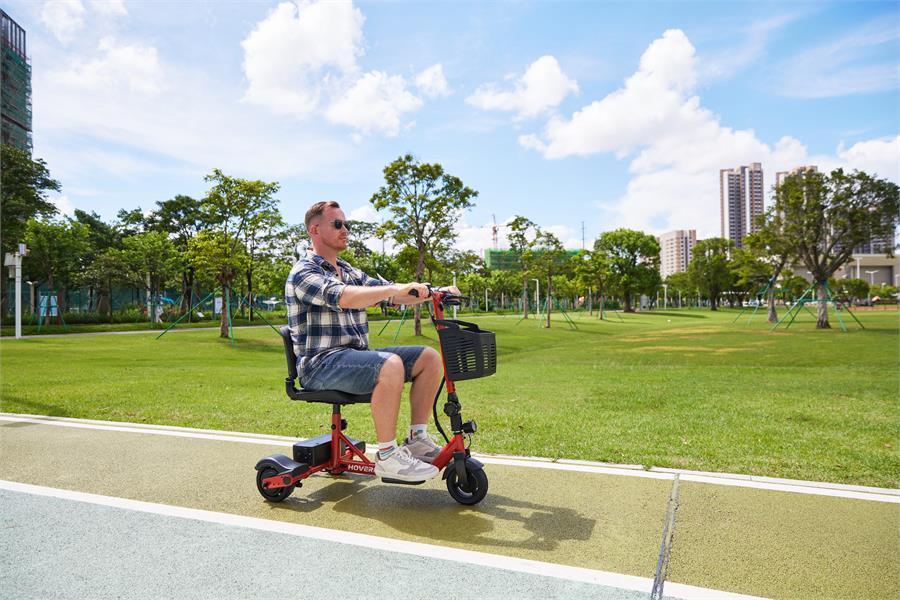
The right mobility scooter depends on what happens after the ride starts. If the scooter must move through narrow rooms, fit into a car, and be lifted regularly, a lightweight design usually makes more sense. If the route includes grass, gravel, slopes, or longer outdoor trips, a heavier four-wheel scooter can provide a more settled ride.
In our range, the Hoverfly T3 is the practical lightweight choice, while the Hoverfly T5 is built for riders who place more value on outdoor comfort, battery capacity, and four-wheel support. Neither model is the universal answer. The better choice comes from the route, the vehicle, the storage space, and the person who will handle the scooter.
Heavy-duty is a useful description, not a universal standard
“Heavy-duty” does not describe one universal class with the same weight, speed, capacity, or terrain rating everywhere. We use the term here as a practical comparison for a heavier four-wheel design that offers more outdoor support. That distinction matters because a scooter can have a high weight capacity and still be inconvenient to transport, while a lighter scooter can be easier to use every day but less comfortable on rough surfaces.
Weight capacity should also be read carefully. Both the T3 and T5 are listed with a 330 lb capacity. That number does not decide the full buying decision. Rider weight, carried items, surface conditions, slope, turning space, and loading ability all affect how useful the scooter will feel in daily life.
What the lightweight choice saves in daily use
Our T3 is designed for people who need mobility support without turning every trip into a loading project. It has a three-wheel layout and a listed total weight of 61 lb. Its heaviest handled part is listed at 50 lb, which is the number that matters when the scooter goes into a trunk or needs to be moved across a home.
It is rated for a maximum range of 13 miles, a top speed of 3.75 mph, and a 200W brushless motor. Its 25.6V 8Ah battery supports the compact format, while the folding frame helps with storage in smaller rooms, apartments, and vehicles.
The benefit is clear when most trips involve smooth flooring, paved sidewalks, stores, clinics, or short errands. Three wheels can also make tight indoor turns feel more manageable. The compromise appears when the route becomes rougher. The current T3 product page lists gravel use and slopes of up to 10 degrees. Because grass conditions and route surfaces can vary, buyers should assess the actual route rather than choose the T3 solely because its range or capacity looks attractive on paper.
For a closer look at how three-wheel designs behave in tight spaces, the three-wheel mobility scooter comparison explains the handling trade-offs in more detail.
What our T5’s heavier design adds

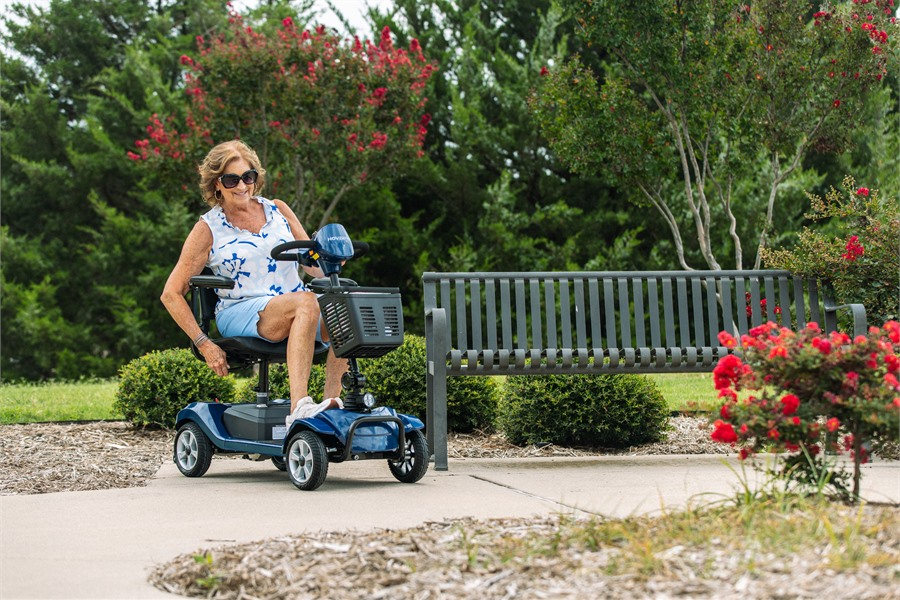
We designed the T5 for riders who want more support on longer outdoor trips.This four-wheel mobility scooter combines a 350W brushless motor, a 25.6V 15Ah LFP battery, a maximum range of 16.78 miles, and a top speed of 5 mph.
It is equipped with 9-inch solid tires, double shock absorption, rear suspension, and an electronic brake to support a smoother ride across grass, gravel, cracked pavement, and sloped driveways. It supports inclines of up to 10 degrees under suitable riding conditions. Surface type, rider weight, carried items, and route layout can all affect the riding experience.
Comfort is also central to the T5 design. Its swivel seat supports easier boarding, while the adjustable seating position and generous legroom help riders stay comfortable during longer outings. The four-wheel layout gives the scooter a more settled feel when the route changes from smooth pavement to uneven outdoor ground.
It weighs 125 lb in total, with a 76 lb main chassis. The folding, four-piece design gives riders several transport options, including a larger SUV, ramp, vehicle lift, or assisted loading. We recommend planning the loading method around the main chassis so the T5 fits naturally into the daily routine.
T3 and T5 compared by the numbers
The figures below are the current model-specific specifications we use for this comparison. Maximum range depends on rider weight, surface, tire condition, temperature, and riding habits.
| Feature | Hoverfly T3 | Hoverfly T5 |
|---|---|---|
| Layout | Three-wheel folding mobility scooter | Four-wheel mobility scooter |
| Listed item weight | 61 lb | 125 lb |
| Heaviest handled part | 50 lb | 76 lb |
| Maximum listed range | 13 miles | 16.78 miles |
| Top speed | 3.75 mph | 5 mph |
| Motor | 200W brushless motor | 350W brushless motor |
| Battery | 25.6V 8Ah | 25.6V 15Ah LFP |
| Best fit | Indoor use, paved routes, compact storage, frequent car transport | Longer outdoor trips, grass, gravel, slopes, and ride comfort |
Choose from the route, not the label
Choose the T3 when transport is the main challenge. It makes sense when the scooter must be lifted into a compact car, stored in a small home, or used mainly on smooth indoor and paved routes. The 50 lb heaviest part still needs to be manageable, so the realistic lifting ability of the rider or caregiver should be checked first.
Choose the T5 when the ride itself is the main challenge. It is the stronger fit when the route regularly includes grass, gravel, uneven pavement, longer distances, or slopes. The larger battery, four-wheel layout, suspension, and stronger motor add comfort and control, but the 76 lb main chassis means that transport needs planning.
The mobility scooter collection lets buyers compare the two models against current product details. We recommend measuring the vehicle opening and storage area before focusing on color, accessories, or advertised range.
Battery size changes the travel conversation
Battery capacity affects both riding range and travel planning. The T3 uses a 25.6V 8Ah battery, which equals approximately 204.8Wh. The T5 uses a 25.6V 15Ah LFP battery, which equals approximately 384Wh. The larger T5 battery supports its longer range, while the T3 battery offers a simpler profile for riders who prioritize portability and occasional air travel.
The FAA PackSafe guidance for wheelchairs and mobility devices applies specific handling requirements to lithium-ion batteries used with mobility scooters, including a 300Wh limit in the relevant categories. Airlines may also set their own conditions. Since the T3 battery is below that reference point and the T5 battery is above it, we recommend confirming the battery rules with the airline before booking any flight.
The IATA guidance for battery-powered mobility aids recommends requesting operator approval in advance so the airline can review the battery and handling arrangements. For frequent air travel, the T3 may offer a more convenient starting point. For longer outdoor rides, the T5 provides the larger battery and greater range, with airline requirements checked before departure.
Three checks that prevent the wrong purchase
First, measure the narrowest doorway, elevator entry, vehicle opening, and storage area. Folded dimensions do not tell the entire story if the scooter has to pass through an angled trunk opening or over a high cargo lip.
Second, test the heaviest handled part. A scooter that cannot be loaded safely will spend too much time parked. The T3 is easier to manage in this respect, while the T5 is better suited to a ramp, lift, larger vehicle, or reliable assistance.
Third, map the real route. Count the surfaces used most often, including the driveway, sidewalk, store entrance, and parking area. The model that feels comfortable on the living room floor may not be the model that feels right on gravel or a sloped path.
This mobility scooter transport guide covers vehicle openings, folded dimensions, loading methods, and securement points. It is useful to read before choosing between a lightweight scooter and a heavier outdoor model.
Choose the scooter that fits your everyday route
The T3 suits riders who value portability and easy storage, while the T5 adds more outdoor comfort, range, and four-wheel support. We also provide a 1-year warranty for mobility scooters and a 30-day return policy for eligible products that remain unused and in their original packaging.
Review our warranty policy and return policy before ordering. If you need help comparing the T3 and T5, please contact our team. We are happy to help match the scooter, transport plan, and daily route.
FAQ
Can a mobility scooter be used in the rain?
A mobility scooter should be kept as dry as possible. Light exposure may happen during everyday travel, but prolonged rain can affect the control panel, battery area, charging port, and electrical connections. We recommend using covered storage, drying the scooter after wet trips, and never charging it while the charging connections are damp.
Can I take a mobility scooter on public transportation?
Sometimes, but the transport operator decides. Each bus, train, or local transit system may have its own rules for scooter dimensions, weight, boarding access, securement, and available space. Check with the operator before traveling, especially when using a heavier four-wheel model.
How much space does a mobility scooter need at home?
Plan for more space than the folded footprint alone. The storage area should allow the scooter to enter through the doorway, turn safely, remain protected from moisture, and sit near a suitable charging point. A compact T3 usually fits smaller storage areas more easily, while the T5 needs a larger, clear space for storage and charging.
How often should a mobility scooter be checked?
Check the scooter regularly before routine trips. Battery condition, tire wear, brakes, lights, controls, charging connections, and loose fasteners all deserve attention, while the user manual should guide model-specific servicing. If the scooter develops unusual noise, reduced braking, steering changes, or charging problems, stop using it until the issue has been assessed.



Leave a comment
All comments are moderated before being published.
This site is protected by hCaptcha and the hCaptcha Privacy Policy and Terms of Service apply.