
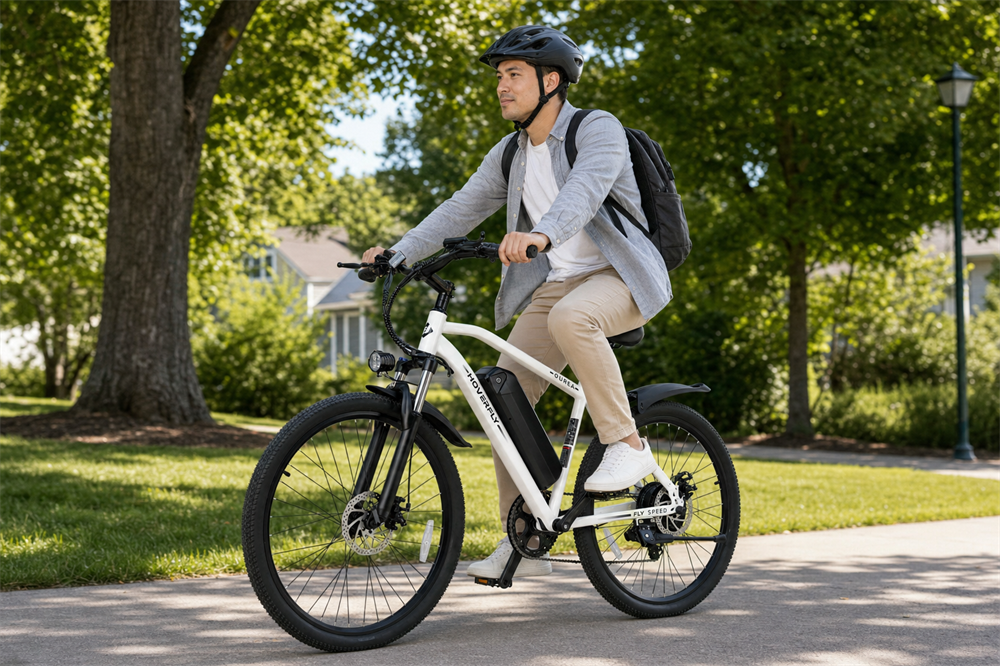
Want fewer battery surprises on your next ride? This e-bike battery voltage chart helps you compare common 36V and 48V readings before a ride, after charging, and when your display drops under load. The battery bars on your display are helpful for a quick glance, but they can miss the details. Voltage gives you a clearer view of what is happening inside the battery, especially when you are riding farther, climbing hills, carrying extra weight, or heading out in cooler weather.
We often hear from riders who see a 48V battery show about 54.6V after a full charge, then drop toward 49V during a climb. In normal use, that loaded reading is usually voltage sag from higher current demand, not a standalone sign of battery damage. Riders often worry that one missing display bar on a hill means the pack has failed, or that a full battery settling slightly after charging means it was not charged properly. A more useful sign is whether the voltage recovers after the load is removed and whether the resting reading still matches the normal range for a 36V or 48V battery.
What E-Bike Battery Voltage Actually Tells You
Voltage is like the "push" from your battery to the motor. A higher voltage can help the bike feel stronger when you speed up or climb a hill.
For most riders, voltage is useful because it helps show how much battery is left. When the battery is full, the voltage is high. As you ride and use power, the voltage slowly goes down. That is why voltage can be more helpful than the battery bars on the screen.
Battery size is a different thing. You may see it written as Ah or Wh. A 48V 15Ah battery is about 720Wh. In simple words, voltage is the push, and Ah or Wh tells you how much energy the battery can store.
E-Bike Battery Voltage Chart for 36V, 48V
We list battery voltage and capacity by model so riders can match the display reading, charger, and replacement battery to the right e-bike. The Hoverfly H3 and Nephele foldable e-bikes use a 36V 7.8Ah removable battery, while the Hoverfly Ourea commuter e-bike uses a 48V 7.8Ah removable battery. For riders comparing a 36V foldable e-bike with a 48V commuter e-bike, the table below gives a general resting-voltage reference before a ride.
| Model | Official battery spec | Battery energy | Model type |
|---|---|---|---|
| Hoverfly H3 foldable e-bike | 36V 7.8Ah | 280.8Wh | Foldable commuter e-bike |
| Hoverfly Nephele foldable e-bike | 36V 7.8Ah | 280.8Wh | Foldable commuter e-bike |
| Hoverfly Ourea commuter e-bike | 48V 7.8Ah | 374.4Wh | Commuter e-bike with removable battery |
For riders comparing a 36V foldable e-bike with a 48V commuter e-bike, the table below gives a general resting-voltage reference before a ride.
| Battery status | 36V battery, common 10S pack | 48V battery, common 13S pack | How to read it |
|---|---|---|---|
| Full charge, right off the charger | About 42.0V | About 54.6V | Normal full-charge reading for many lithium-ion e-bike packs. |
| Normal riding range | About 41V-36V | About 54V-48V | The battery is being used normally. Voltage slowly falls as you ride. |
| Recharge soon | About 35V-33V | About 47V-43V | Plan to recharge, especially before hills, cold-weather rides, or longer routes. |
| Low / near cutoff range | About 32V-30V | About 42V-39V | Stop pushing the battery and recharge. Some bikes may cut power earlier to protect the pack. |
| Temporary drop under load | Can dip below the resting number | Can dip below the resting number | A short dip during a climb or hard acceleration is usually voltage sag; check whether it recovers after the load eases. |
When riders check compatibility or read a display, the numbers we stand behind are the ones on the product page, the battery label, the charger, and the owner's manual. Resting voltage, hill-climb drop, and low-voltage cutoff all shift with battery condition, temperature, load, and BMS behavior. We don't publish a percentage-based state-of-charge table for every model, and we'd rather riders treat any such figure as general battery guidance than as an official Hoverfly specification.
A Real Example: What a 48V Pack Shows Through a Ride
Our Ourea e-bike pairs a 48V 7.8Ah removable lithium-ion battery with a 54.6V charger. That 54.6V is the full-charge figure for a common 13-cell (13S) lithium-ion pack, since 13 cells at 4.2V each add up to 54.6V, so a healthy battery usually reads close to it right off the charger. This illustrative example is not from a published Hoverfly range test. It shows the general direction a voltage reading may move as a rider watches the display, rather than lab-measured absolutes.
| Moment in the ride | Example voltage | How to read it |
|---|---|---|
| Right off the charger | Around 54.6V | Matches the Ourea charger output for a full 48V system |
| After resting briefly | Slightly lower than the charger reading | Normal settling after charging |
| During flat riding | Gradually lower | Battery energy is being used |
| During a steep climb | Briefly lower under load | Voltage sag from higher motor demand |
| Back on easier ground | Partly recovers | Load has eased and the display reading rises again |
The pattern above fits a 48V lithium-ion e-bike ridden in moderate conditions. Rider weight, assist level, throttle use, hill grade, wind, tire pressure, temperature, battery age, controller settings, and BMS behavior all move the numbers. What you see on your own bike is the same pattern, not these exact figures.
How to Check Your E-Bike Battery Voltage

There are two simple ways to check e-bike battery voltage: use the bike display or use a multimeter.
The easiest way is to check the display. Many e-bikes can show voltage if you change the screen from battery bars or percentage to voltage. For a more accurate reading, riders can use a multimeter, but only test at accessible terminals or test points identified in your manual. Do not let the probes bridge the positive and negative contacts, and do not open or take apart a sealed battery pack. If the terminals are unclear, damaged, wet, or hard to reach, stop and contact the bike brand or battery service team instead.
- Set the multimeter to DC voltage. It is usually marked with a "V" and a straight line.
- Let the battery rest off the charger for a few minutes before testing.
- Touch the red probe to the positive terminal and the black probe to the negative terminal.
- Read the number on the screen and compare it with the voltage chart for your battery size.
If a fully charged battery reads much lower than the normal full voltage, the battery may be aging or need service. One unusual reading is not always a problem, but if the number keeps dropping over time, the cells may be wearing out.
Why Your Voltage Drops on a Hill, Then Recovers

If your voltage drops while climbing a hill and rises again afterward, that is usually normal. This is called voltage sag.
When you climb, accelerate hard, or carry extra weight, the motor asks the battery for more power. During that moment, the voltage may dip and the display may lose one or two bars. Once the road flattens out or the motor works less hard, the voltage usually goes back up.
This does not mean your battery suddenly lost capacity. It is a short-term drop under heavy load. Cold weather can make voltage sag more noticeable, so the reading may look lower on chilly rides.
Battery Bars or Voltage: Which Should You Trust?
Battery bars are easy to read, but they are only an estimate and can drop quickly near the end of a ride. Voltage gives a clearer picture of the battery's actual charge, especially on long rides, cold days, or when carrying extra weight. For short rides, the bars are usually enough. For better range planning, check your voltage after a full charge and again after a few normal rides so you learn what "plenty left" and "time to recharge" look like on your own bike.
Quick pre-ride voltage check: Before a longer ride, check the voltage after the battery has rested for a few minutes. If a 48V pack is already near the mid-40s, you can plan a shorter loop or bring the charger. If it reads in the low 40s before you leave, recharge first.
Simple Habits That Protect Your Battery
A few small habits keep the pack healthy and the readings reliable. Avoid draining to the low-voltage cutoff every ride, since repeated deep discharges shorten lithium-ion life. If the bike will sit for a few weeks, leave the battery around half charge rather than full or flat.
Safe charging starts with the battery and charger instructions that came with your bike. For riders charging indoors, especially overnight or in an apartment hallway, the NFPA's e-bike safety page gives the same practical warning points: use the correct charger, unplug after charging, and stop using a battery that shows heat, odor, swelling, color change, or poor charge retention.
A UL 2849 reference matters because battery safety is not only about the cells inside the pack. UL Standards & Engagement treats the e-bike electrical system as a whole, including the battery, charger, controller, and related parts, which helps explain why charger compatibility and system-level design should be checked together.
Charging and storage habits affect how quickly the pack loses usable capacity over time. Battery University explains that lithium-ion batteries age faster under repeated deep discharge, high charge stress, and poor storage conditions.
36V, 48V: Which Voltage Suits Your Riding?
A 36V e-bike suits lighter city rides on flatter routes. A 48V system gives more support for commuting, errands, moderate hills, and weekend rides, which is why it works well as an everyday middle ground.
For our Hoverfly Ourea eBike, the 48V 7.8Ah removable battery works out to about 374.4Wh. After a full charge, its resting voltage should sit near the full-charge range in the 48V column, then move down as distance, assist level, throttle use, hills, rider weight, wind, temperature, and tire pressure add load. A brief dip during a climb is a loaded reading; the resting number after the load is removed gives a clearer recharge signal.
Ourea is built for riders who want a practical commuter e-bike rather than a high-voltage performance setup. It pairs a peak 750W brushless motor with an advertised range of up to 40 miles, depending on riding conditions. Fast free U.S. shipping, a 30-day money-back guarantee, a 1-year warranty, and lifetime customer support cover the purchase and after-sales side.
Conclusion
A 48V pack that drops during a climb is showing loaded voltage, and the recovery after the road flattens out tells more than the lowest number seen under motor demand.
For a common 13S lithium-ion 48V pack, about 54.6V at rest is the normal full-charge reading. Riders recharge before the pack reaches the low range, especially before longer routes, cold-weather rides, or repeated hill climbs.
In our support conversations, the most useful pattern is to check voltage at rest, match it with the correct 36V or 48V range, and follow the owner's manual or battery label when those limits differ. The chart values are approximate because chemistry, BMS cutoff, controller settings, temperature, and battery age can all shift the reading.
FAQs
How long does an e-bike battery last?
Most e-bike batteries last about 3 to 5 years. Lifespan depends on riding habits, charging routine, storage temperature, and how often the battery is deeply drained. Learn more in the guidance on how long electric bike batteries last.
Why is my real range lower than the listed range?
Real range is often lower because hills, cold weather, rider weight, speed, wind, tire pressure, and high assist levels all use more power. Listed range is usually tested in ideal conditions.
Can I use a different charger for my e-bike battery?
No, unless it is approved for your exact battery. The wrong charger can damage the battery or create a safety risk, so use the original charger or an official replacement.
How can I choose the right e-bike for my riding style?
Match the bike to where you ride most. City riders may care more about comfort and storage, while rough-road riders may need better grip and stability. We explain this in our fat tire eBike buying guide.



Leave a comment
All comments are moderated before being published.
This site is protected by hCaptcha and the hCaptcha Privacy Policy and Terms of Service apply.