
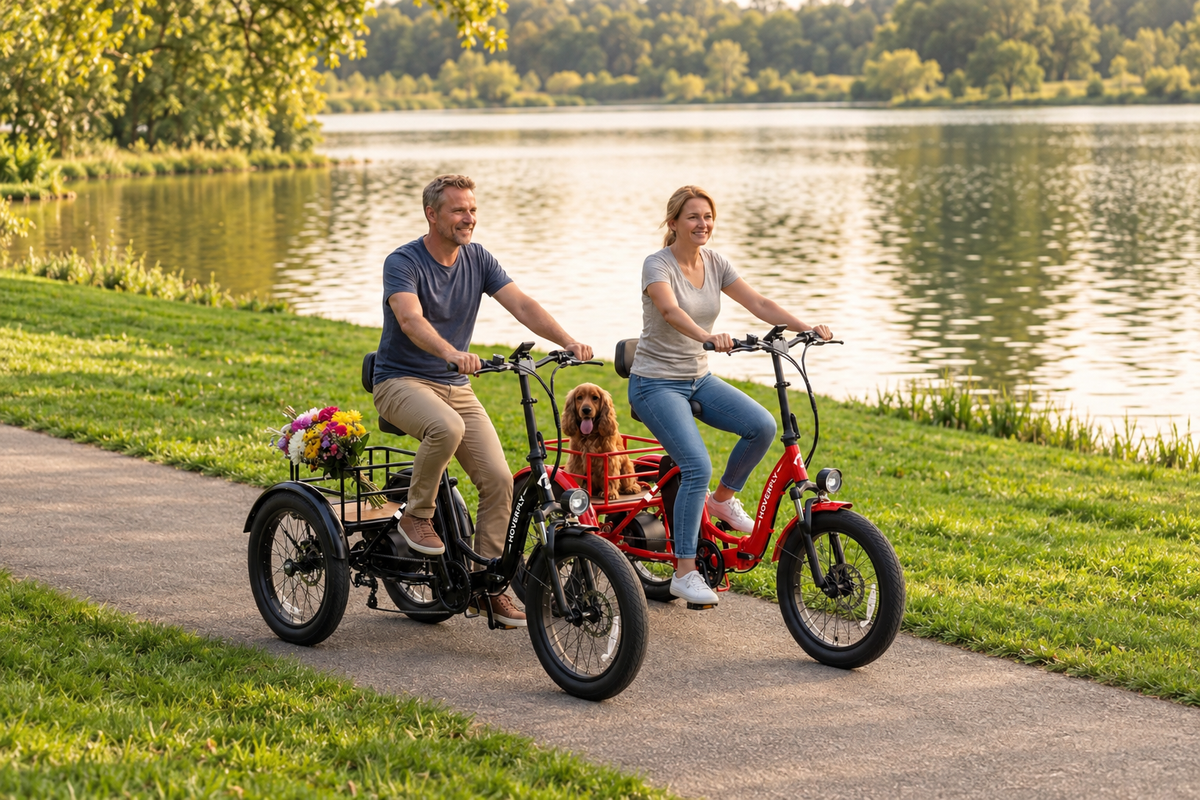
For many seniors, an electric trike may be a better fit when hills, longer distances, cargo, or reduced pedaling effort are important. A non-electric trike can still be a practical choice for short, flat rides when you prefer a lighter, simpler, and more affordable option. A non-electric trike can still be a smart fit for short, flat rides when you want every mile powered by your own legs and prefer the simplest possible machine. Both trikes have three wheels, but they can feel very different once the route includes hills, headwinds, or a full cargo basket.
We recommend choosing around the ride you will actually take: how far you go, how often you stop, where you store the trike, and how much effort you want to supply.
What Is an Electric Trike and How Does It Differ from a Non-Electric Trike?
An electric trike is a three-wheeled cycle powered by a battery and motor. Most models offer pedal assist, which adds power as you pedal. Some also include a throttle for riding with little or no pedaling. Riders can use a lower assist level for exercise and increase the support on hills, against headwinds, or when carrying groceries.
A non-electric trike relies entirely on pedals and gears. It is usually lighter, more affordable, and easier to maintain. This makes it a practical option for short rides on flat neighborhood roads. Longer distances, hills, and heavy cargo require more physical effort because the rider provides all the power.
Electric vs. Non-Electric Trikes: Key Differences for Senior Riders
The main differences appear in the effort required, the routes each trike can handle, and the level of maintenance involved.
What to Compare |
Electric Trike |
Non-Electric Trike |
|---|---|---|
Pedaling effort |
The motor assists while you pedal; some models also have a throttle |
The rider provides all the pedaling power. |
Hills and headwinds |
Motor assistance makes climbing hills and riding against the wind easier |
Hills and headwinds require more leg strength |
Ride distance |
Better suited to longer trips and routes with changing terrain |
Better suited to short, flat routes |
Weight and handling |
Heavier because of the battery and motor |
Usually lighter and easier to push by hand |
Charging and maintenance |
Requires battery charging and care for both electrical and bicycle parts |
Requires standard care for the tires, brakes, chain, and gears |
Purchase price |
Usually costs more because of the motor and battery |
Usually has a lower purchase price |
Exercise level |
The rider can adjust the effort by changing the assistance level |
The rider must pedal throughout the ride |
Stability also affects the riding experience. Unlike a two-wheel bicycle, a trike does not require the rider to balance on two wheels when coming to a stop. However, three wheels do not make a trike tip-proof. Sharp turns, side slopes, uneven surfaces, high speeds, and unbalanced cargo can still affect stability. During a turn, a trike follows the steering direction instead of leaning like a two-wheel bike. High speeds, sloped surfaces, sharp turns, and uneven cargo can reduce stability. Slower cornering and balanced cargo help keep all three wheels firmly on the ground. Our guide to electric trike stability and tip-over risk offers more practical safety advice.
Benefits and Drawbacks of an Electric Trike for Seniors
An electric trike gives senior riders extra support when the route becomes demanding. Pedal assist reduces the effort needed on hills, against headwinds, and near the end of a long ride. A throttle can provide additional help when starting with a loaded basket. Available controls vary by model.
An electric trike may suit you if you want:
- Easier riding on hills and windy days
- Adjustable assistance based on your energy level
- More comfortable travel over longer distances
- Motor support when carrying groceries or other cargo
- Greater flexibility for errands and recreational rides
Electric models also come with a few tradeoffs. The battery and motor increase the purchase price and overall weight. Charging becomes part of the routine, and the battery will eventually need replacement. The added weight can make the trike harder to lift into a vehicle or push without power.
New riders also need time to learn the controls and three-wheel handling. Smooth assistance, predictable braking, and a parking brake can make that process easier. A low step-through frame supports safer mounting, while a rear differential helps the trike turn more smoothly. Our guide to the Hoverfly ET1 electric trike for seniors explains how these features support everyday riding.
Benefits and Drawbacks of a Non-Electric Trike for Seniors
A non-electric trike offers a simple riding experience. It is usually lighter and more affordable than an electric model. With no battery or motor, daily use and maintenance are also easier. This type of trike works well for short rides on flat neighborhood roads.
Every trip requires continuous pedaling, which provides steady physical activity. The CDC includes cycling as an aerobic activity for older adults. Its physical activity guidelines for older adults recommend combining aerobic exercise with muscle-strengthening and balance activities each week.
The extra effort can become challenging on hills, against the wind, or when carrying groceries. Longer routes may also cause fatigue before the rider returns home. A non-electric trike is best suited to riders who can comfortably pedal their usual route in both directions.
Key Factors Seniors Should Consider When Choosing a Trike
The right trike should match the rider’s usual route, physical needs, and available storage space. Flat neighborhood roads require less power, while hills and longer distances often make electric assistance more useful. Frame access, braking, turning, range, and charging should also feel manageable in daily use.
A low step-through frame makes mounting easier by reducing how high the rider must lift a leg. The seat and handlebars should also be within comfortable reach. Upright trikes provide a familiar riding position and usually require less storage space. Semi-recumbent models offer additional back support and a more relaxed seating position. Our comparison of semi-recumbent and upright electric trikes explains the main differences.
Braking and turning have a direct effect on rider confidence. A parking brake holds the trike in place during mounting and cargo loading. Disc brakes provide dependable stopping power for heavier electric models. A rear differential allows the rear wheels to rotate at different speeds, which helps the trike move more smoothly through turns. Slow, wide turns also improve stability.
Storage and transport are equally important. The full dimensions show how much space the trike needs at home. Folded dimensions indicate whether it will fit inside a vehicle or smaller storage area. The total weight determines how difficult it will be to lift or move. A removable battery also allows indoor charging while the trike remains in a garage.
How the Hoverfly ET1 Brings These Features Together
The Hoverfly ET1 Folding Electric Trike combines practical power, rider support, and convenient storage. It reaches up to 15.5 mph and offers a published range of up to 61 miles. It supports a total load of up to 400 pounds, including the rider and cargo.
The ET1 also includes 20 x 3.0-inch tires, a rear differential, hydraulic disc brakes, and a parking brake. Its removable battery is UL 2271 certified. When folded, the trike measures 43.3 x 33.1 x 30.7 inches. Actual range depends on terrain, cargo weight, weather, tire pressure, and the selected assistance level.

Susan R. chose the ET1 so her mother could visit friends within her retirement community without waiting for the shuttle. George P. wanted electric assistance after knee surgery made regular cycling difficult.
Our 3-wheel electric bicycle buying checklist covers the main features worth comparing. The NHTSA bicycle safety guidance also provides useful information about proper fit, working brakes, visibility, helmets, route planning, and safe road behavior.

Electric or Non-Electric Trike: Which One Is Right for You?
- Short, flat neighborhood rides: A non-electric trike is a practical option. It provides steady exercise and is usually lighter, more affordable, and easier to maintain.
- Long rides or changing terrain: An electric trike offers helpful support on hills, in headwinds, and during the ride home. You can adjust the assistance level to match your energy.
- Regular errands and heavy cargo: Groceries and other supplies add weight. Motor assistance makes it easier to start, climb slopes, and travel with a loaded basket.
- Limited storage or frequent transport: Check the trike’s full size, folded size, and weight before buying. Non-electric trikes are often easier to move by hand. A folding electric model may suit smaller storage areas, but it will still be heavier and require a convenient charging space.
If you can comfortably complete the full route while carrying what you need, a non-electric trike may be enough. If extra support would make the trip easier and give you more confidence for the return journey, an electric trike is likely the better fit.
FAQ
Do You Need a License to Ride an Electric Trike?
License and registration requirements depend on the state and locality; check the current rules for the ET1’s Class 2 configuration before riding.
How Long Does an Electric Trike Battery Last?
A well-maintained lithium-ion battery commonly lasts several years before its capacity begins to decline noticeably. Battery life depends on charging habits, storage temperature, ride frequency, and overall use. Keeping the battery dry and using the correct charger can help extend its service life.
What Happens If an Electric Trike Runs Out of Battery?
Most electric trikes can still be pedaled after the battery runs out. The motor and battery add weight, so pedaling may require more effort than it would on a non-electric trike. Keeping track of the battery display helps riders maintain enough power for the return trip.
Can You Ride an Electric Trike in the Rain?
The Hoverfly ET1 has an official IPX5 water-resistance rating, which means its electrical components are designed to withstand low-pressure water jets from different directions. It can handle light rain and damp roads during normal rides.
IPX5 does not mean the trike is waterproof or suitable for every weather condition. Avoid deep water, flooding, heavy downpours, and high-pressure water sprays. After riding in wet conditions, dry the trike and store it in a covered area. Keep the battery, display, and charging connection dry, and follow the manufacturer’s care instructions.
Conclusion
The right trike should fit naturally into your daily routine. A non-electric trike is a simple choice for short, flat rides and regular exercise. An electric trike provides extra support for hills, longer trips, grocery runs, and days when you want to use less energy. A comfortable trike that suits your needs is more likely to become part of everyday life.
If you would like help choosing an electric trike, contact our specialists with a few details about your routine: the type of roads you ride, your usual one-way distance, your available storage space, and the cargo you plan to carry. These details will help our team recommend features that match your everyday needs.



Leave a comment
All comments are moderated before being published.
This site is protected by hCaptcha and the hCaptcha Privacy Policy and Terms of Service apply.