
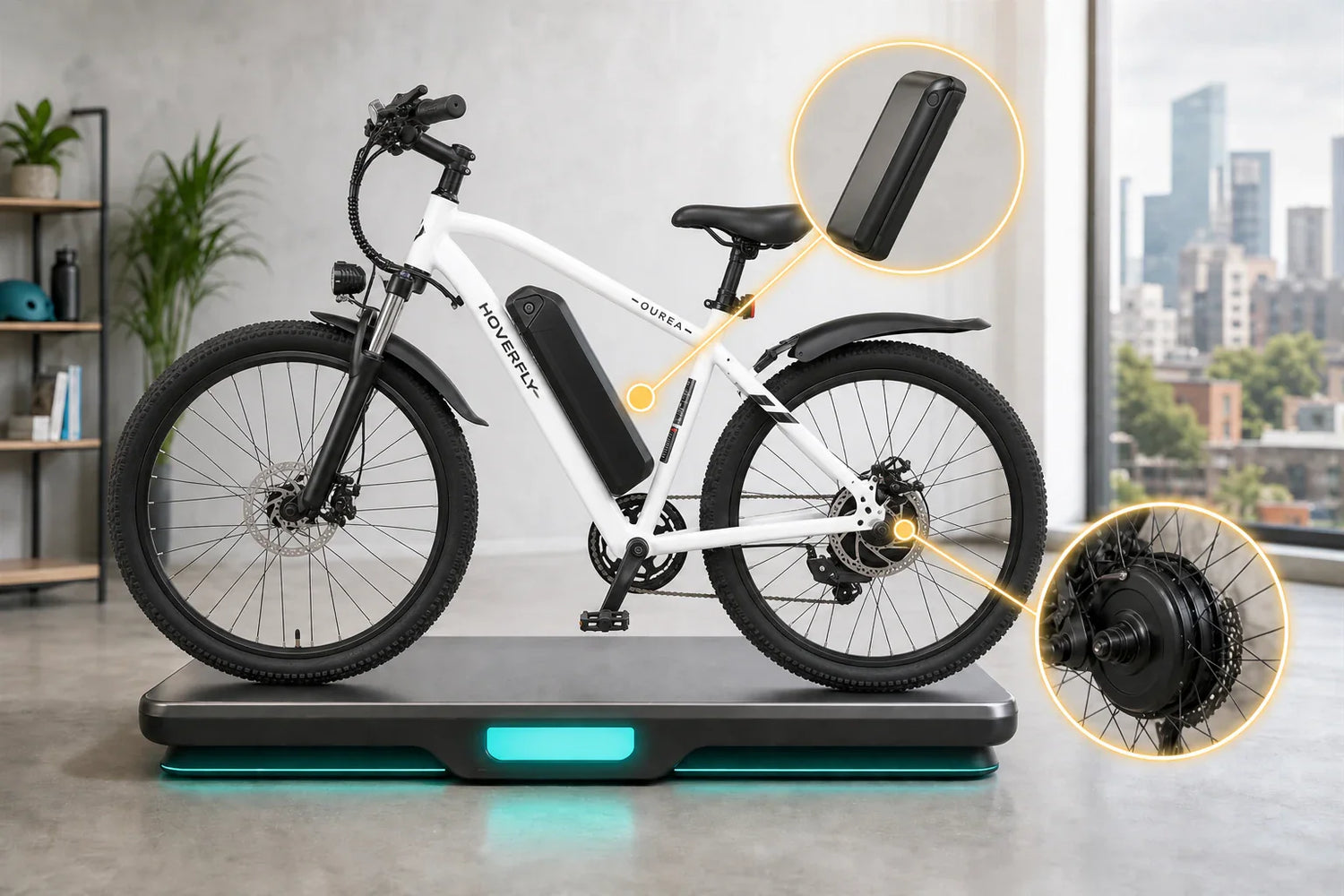
Most electric bikes weigh between 40 and 75 pounds. Folding commuters cluster at the lighter end, and full-suspension, fat-tire, or cargo models stretch past 70 pounds. That extra mass comes from three components a regular bicycle does not carry, including plus tires, accessories, and reinforcement work that adds up quickly. It shapes nearly every shopping decision, from lifting the bike to apartment stairs to picking a car rack that can actually hold it.
Average Electric Bike Weight by Category
Different categories sit in noticeably different weight bands. The table below uses 2025 and 2026 published retail data from major U.S. manufacturers, with the battery installed.
| E-Bike Type | Typical Weight (lbs) |
|---|---|
| Folding e-bike | 40–55 |
| Urban commuter | 45–60 |
| Cruiser/step-thru | 50–65 |
| Hardtail eMTB | 50–65 |
| Full-suspension eMTB | 55–75 |
| Fat-tire e-bike | 60–75 |
| Cargo/utility e-bike | 70–95 |
Note: Pulling the battery typically subtracts 6 to 12 lbs from each figure above.
Folding and Commuter Models
Folding e-bikes are the lightest mainstream segment. Compact 16-inch or 20-inch wheels, trim frame, metal and tire mass, saving 5 to 15 lbs versus a full-size commuter.
A typical 16-inch foldable one running a 36V 7.8Ah battery weighs around 55 lbs, including the pack. Larger 26-inch or 700c commuters usually add another 5 to 10 lbs because of bigger frames, taller wheels, and wider tires.
Mountain, Cargo, and Specialty Models
Hardtail electric mountain bikes land in the 50 to 65 lb range once stronger forks and bigger tires are factored in.
Full-suspension eMTBs add another 5 to 10 lbs for the rear shock and pivots.
Cargo e-bikes are the heaviest mainstream category, and long-tail or front-loader models routinely cross 80 lbs unloaded.
A 26-inch commuter-mountain hybrid with a 48V battery and a slim aluminum frame can come in as low as 54 lbs, which is light for the segment.
What Adds Weight to an Electric Bike
A regular bicycle is engineered to weigh as little as possible. An electric bike layers new systems and accessories on top of that, and every one of them shows up on the scale.
Battery
The battery is almost always the heaviest single part. A 36V 7.8Ah pack on a folding commuter weighs around 6 lbs. A 48V 14Ah pack on a long-range hardtail can reach 10 to 12 lbs. Long-range cargo packs above 700Wh cross 14 lbs.
Bigger packs hold more energy, but pack weight grows nearly in proportion to capacity. Cell chemistry also matters. Most U.S. e-bikes use NMC (nickel-manganese-cobalt) cells because they offer the highest energy density per pound. LFP (lithium iron phosphate) cells are safer and longer-lived but weigh 15 to 20 percent more for the same watt-hour rating.
Riders who want lighter daily handling can detach the pack before lifting and keep the battery indoors between rides. That single move can drop the lifted weight by roughly 10 percent.
Pack construction also adds mass to certified bikes. The voluntary UL 2849 standard for e-bike electrical systems is now required by major retailers and several state and city ordinances after a wave of lithium battery fires. Certified packs add small but worthwhile weight from heavier-gauge wiring, sturdier enclosures, and tested battery-management hardware.
Motor
E-bike motors fall into two main groups. Hub motors mount inside the rear (or sometimes front) wheel and add 5 to 10 lbs at one end of the bike. Mid-drive motors sit at the bottom bracket and weigh 6 to 9 lbs, with mass centered low and between the wheels.
Mid-drives feel more balanced because their weight is closer to the rider. Hub motors are cheaper to manufacture and easier to service, which is why most direct-to-consumer models under $1,000 use them.
A 500W-rated motor adds about 6 to 8 lbs of total bike weight, and a 750W-rated unit adds 8 to 11 lbs.
Torque rating drives motor weight more than wattage. A 60 Nm mid-drive can weigh the same as an 85 Nm one within a model family, but the higher-torque unit has larger internal gears and a heavier housing.
U.S. federal law caps low-speed e-bike motors at 750 watts under 15 U.S.C. § 2085. That ceiling keeps motor weight from creeping past about 11 lbs even on the highest-output models sold in the country, and it is the main reason average e-bike weight has held steady for years.
Frame and Reinforcement
An e-bike frame must handle higher torque, higher average speeds, and the cantilevered mass of the battery. Manufacturers compensate with thicker-gauge tubing, bigger welds, and beefier dropouts. Aluminum (6061-T6 is the most common alloy) offers the best strength per ounce at affordable prices and dominates the under-$2,000 market.
Carbon steel and chromoly frames are heavier but absorb road shock well, which is why some budget commuters still use steel for the main triangle.
Step-through geometries add roughly 1 to 2 lbs over comparable diamond frames of the same length, because the lower top tube has to be compensated for elsewhere in the structure.
Wheels, Tires, and Accessories
A pair of 700x40c commuter tires weighs about 1.6 lbs combined. A pair of 26x4-inch fat tires can run 6 to 8 lbs. Rim depth and spoke count push wheel weight up further.
Accessories pile up faster than most buyers expect. A rear rack adds 2 to 4 lbs. Fenders add 1 to 2 lbs. Integrated lights, kickstands, a sturdy lock, and a phone mount can quietly add another 3 to 5 lbs to the loaded weight. Pannier bags or a child seat shift the calculus further.
What Electric Bike Weight Means for Riders
Weight is not an abstract spec. It influences four real decisions every buyer faces.
Lifting, Storing, and Transporting
If the bike has to come up stairs, fit in a car trunk, or hang on a rack, weight is the constraint. Most adults can lift 50 to 55 lbs over short distances. Beyond that, the load gets risky for the back over repeated lifts.
Older trunk-mounted racks designed for traditional road bikes (often capped at 30 to 35 lbs per bike) will not safely carry a full-size e-bike. E-bike-specific hitch racks rate each tray for 60 lbs or more and are built for the added stress. Always check the rack manufacturer’s spec sheet before loading.
Range and Power vs. Weight
Riders face a real trade-off here. A heavier battery delivers more range. A heavier motor delivers more torque on hills. The lightest folding commuters offer 20 to 30 miles per charge. The heaviest cargo and mountain models cross 60 miles per charge with proportionally heavier packs. Picking the right balance is mostly a matter of route and use.
Ride Feel
With pedal-assist on, the motor cancels most of the weight penalty. With pedal-assist off, an e-bike rides like a heavy regular bike, and uphill stretches expose the deficit fast. Riders who let the battery run flat on long rides should pick a lighter model.
Handling and Stability
Heavier bikes feel more planted at higher speeds and on rough pavement. Lighter bikes corner more eagerly and accelerate quicker from a stop. The right balance depends on the route, not on a universal rule.
How to Choose the Right Electric Bike Weight for Your Routine
Weight only matters in context. The three scenarios below cover the most common American use patterns, with a realistic weight target for each.
Walk-Up Apartments and Frequent Indoor Lifting
If your daily routine involves hauling the bike up two flights of stairs, squeezing past furniture in a small entryway, or storing the bike inside a closet, stay under 55 lbs. A 16-inch foldable with a 36V battery hits that weight while still covering a 25-mile pedal-assist commute.
Mixed Transit Commutes
Subway-to-office riders, train-and-bike commuters, and anyone splitting a route between two modes need a bike that can be hoisted with one arm and tucked beside a turnstile or elevator.
The right weight here is the same 50 to 55 lb range, but the priority shifts toward a quick fold and a simpler accessory layout. The Hoverfly Nephele weighs 55 lbs, uses the 36V 7.8Ah battery, and ships with a basic configuration that keeps the price under $550 and the bag count on your shoulder lower at the end of the day.
Hills, Trails, and Longer Distances
Climbing real gradients takes torque. Torque takes a heavier motor. The middle ground is a 750W peak motor paired with a 48V battery and 26-inch wheels, which typically lands at 54 to 65 lbs.
The Hoverfly Ourea commuter-mountain e-bike sits at 54 lbs with 60Nm of torque, a 5-level pedal-assist system, and a 40-mile pedal-assist range. That is light enough for occasional lifting and heavy enough to stay planted on gravel and steep grades.

FAQ
How much does an average electric bike weigh in pounds?
Most weigh 40 to 75 lbs. Folding commuters weigh 40 to 55 lbs. Full-suspension and cargo models cross 70 lbs. Battery and frame size drive most of the difference.
Are electric bikes too heavy to lift?
Most adults can lift 50 to 55 lbs over short distances. Above that, choose a folding model or pop the battery out first to drop 6 to 12 lbs before lifting.
How heavy is an e-bike battery by itself?
Typical e-bike batteries weigh 5 to 12 lbs. A 36V 7.8Ah pack runs around 6 lbs. A 48V 14Ah pack reaches 10 to 12 lbs. Long-range cargo packs go higher.
Why are electric bikes heavier than regular bikes?
The motor, battery, and reinforced frame add 15 to 30 lbs over a non-electric model. Frames must handle higher torque, so manufacturers use thicker tubing and bigger welds.
Does e-bike weight reduce battery range?
Slightly yes. Heavier bikes consume more energy per mile, but the bigger driver of range is battery capacity in watt-hours, not total bike weight.
Are folding e-bikes really lighter than full-size ones?
Usually, yes, by 5 to 15 lbs. Most 16-inch foldable e-bike models weigh 50 to 55 lbs with the battery installed, on par with the lightest full-frame commuters but with a far smaller storage footprint. Smaller wheels and shorter tubes account for the savings.
Summary
Electric bike weight comes down to battery, motor, frame, and accessories. The honest average for a U.S. model in 2026 is 40 to 75 lbs, with foldables anchoring the low end and cargo bikes anchoring the top. The federal 750-watt motor cap keeps total weight from creeping higher, and the UL 2849 electrical safety standard adds small but worthwhile mass to certified packs. Choose by use case first. Lifting frequency, storage space, and how you transport the bike in a car often matter more than a few pounds of extra range capacity.




Leave a comment
All comments are moderated before being published.
This site is protected by hCaptcha and the hCaptcha Privacy Policy and Terms of Service apply.