
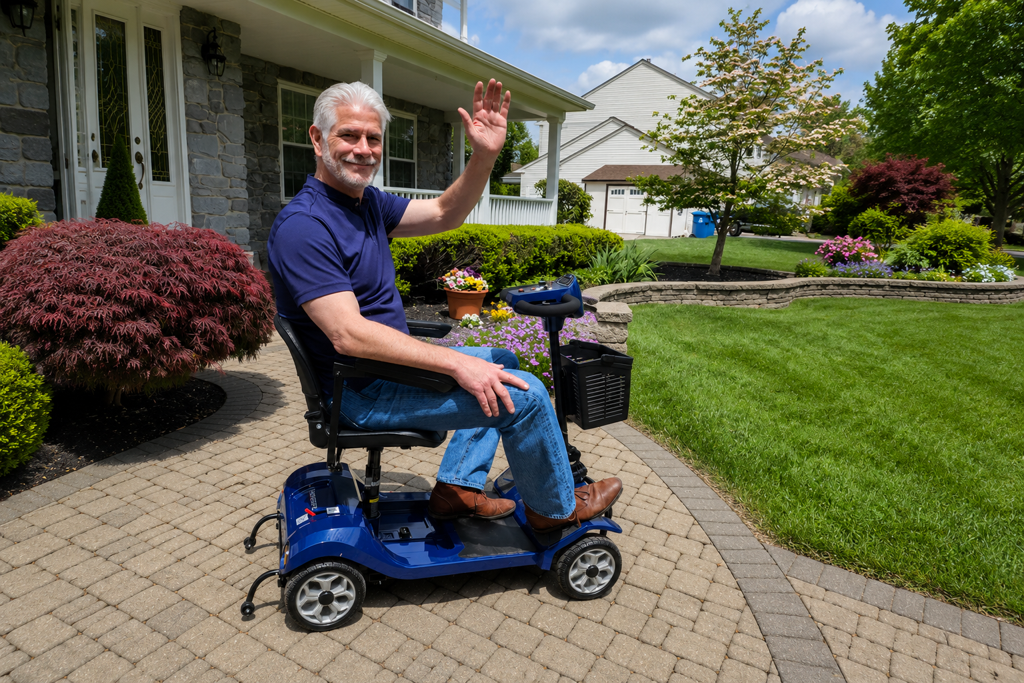
When people ask us which all-terrain electric mobility scooter is the best, we start with your driving routes. The best mobility scooter should have the following features: a motor, tires, ground clearance, suspension, braking system, and seat all adapted to the hardest surfaces you frequently drive on.
For rough outdoor or rural routes, these specs are practical buying minimums, not legal requirements. Based on scooter stability testing guidance and outdoor ramp and curb-ramp guidance, we would look for four wheels, at least 5 inches of ground clearance, a 700W or stronger motor, 12-inch or larger pneumatic tires, and suspension on all wheels. These specs help the scooter avoid scraping on rocks or ruts, keep better grip on grass or gravel, climb mild slopes with less strain, and reduce shaking on rough ground.
Important Components of an All-Terrain Mobility Scooter
Seven components determine how a scooter handles outdoor surfaces, but they work together rather than separately. As you compare options in our mobility scooter collection, picture a real route: leaving an apartment or house, crossing a driveway, riding over cracked sidewalks, entering a grocery store or clinic, then returning with bags or personal items.
On that kind of route, the scooter needs more than motor power. It needs enough tire contact, predictable braking, stable turning, rider comfort, and battery margin for repeated starts and stops. Understanding each component before buying helps you match the scooter to real daily use, not just a spec sheet.
The table below summarizes what each component does and the single spec to check on each unit.
|
Component |
Main Function |
Key Spec to Check |
|
Motor |
Drives wheels and climbs inclines |
Wattage between 250W and 1400W |
|
Battery |
Stores energy for the route |
Chemistry and amp-hour capacity |
|
Tires |
Provide traction and absorb shock |
Pneumatic or solid PU, 10-16 in diameter |
|
Suspension |
Smooths out uneven ground |
Full vs rear-only, independent geometry |
|
Frame and Seat |
Carry rider load and support comfort |
Steel or aluminum frame, swivel captain's chair |
|
Brakes and Safety |
Stop the unit and prevent tipping |
Electromagnetic auto-engage, rear anti-tip wheels |
|
Controls and Display |
Operator interface |
Adjustable tiller, LCD readout |
Motor Wattage and Selection
The motor determines whether your mobility scooter can easily climb hills or struggle on grass. We recommend focusing on motor power and understanding its intended use.
Brushless DC motors are currently the mainstream in the mobility scooter market because they operate more quietly and have a longer lifespan. For paved roads and riders weighing under 300 pounds (approximately 136 kg), a 250-watt motor is sufficient. On broken or gravel surfaces, a 350- to 500-watt motor is typically needed to avoid insufficient power. In rural areas, on continuous slopes, or on soft ground, 700 watts or higher are required.
Peak power and continuous power are not the same. Continuous output is crucial when your mobility scooter needs to climb hills for more than a few seconds. Torque-priority motors accelerate more slowly but climb hills more effectively, while speed-priority motors feel faster on flat surfaces but may experience a performance drop on slopes.
Comfort and Safety Components
Tire shape is more important than many first-time buyers realize. 10- to 16-inch pneumatic tires absorb shocks and provide strong grip, maintaining stability even on uneven surfaces. Solid PU tires won't puncture, which is practical for daily commuting, but they transmit more vibrations to the rider.
Independent suspension on all four wheels is a key differentiator between a true outdoor mobility scooter and a bulky touring scooter. A steel frame increases weight distribution and lowers the center of gravity, while an aluminum frame facilitates transport. A captain's seat with swivel and adjustable grab handles also make long rides easier and more comfortable.

For braking, we treat electromagnetic brakes that auto-engage when the throttle releases as a baseline safety feature. Rear anti-tip wheels add another layer of confidence on slopes and during low-speed maneuvering.
Stability Engineering in an All-Terrain Mobility Scooter
For outdoor mobility scooters, stability is the safety factor we care about first. A scooter that tips on a side-sloped sidewalk or slides on loose gravel can cause a serious injury. For older riders or people managing balance issues after a stroke or long-term condition, confidence in the scooter's stability is what makes going outside feel possible again.
All-terrain mobility scooters are designed around that stability problem. A four-wheel base creates a wide rectangular stance, with weight spread across all four corners, so one tire catching a small rock does not throw the whole platform off balance.
A low frame keeps the center of gravity closer to the ground. Larger tires, usually 10 to 16 inches across, create a wider contact patch than travel scooter wheels. Rear anti-tip wheels add one more layer of protection against backward tipping on inclines.
Background on Stability Testing
Stability should be measurable, not just claimed. The ANSI/RESNA WC-1:2019 standard for wheelchairs and scooters defines tests for stability, performance, and durability, and a unit that has passed relevant WC-1 testing should have documented incline and tilt thresholds.
A PubMed scooter evaluation study that tested 12 three-wheeled scooters found that commercial devices may not meet every WC-1 section. That does not mean every three-wheel scooter is unsafe; it means buyers should pay close attention to platform width, testing data, rider weight, and route conditions before choosing one for outdoor terrain.
Electric mobility scooters with full independent suspension offer better stability because they help each wheel maintain contact with uneven surfaces during strong impacts, providing a smoother and more controlled ride.
Battery and Range Realities of an All-Terrain Mobility Scooter
Battery range is where we see many buyers get disappointed, because real outdoor range is usually lower than the advertised number. Manufacturers often test on level pavement at moderate rider weight, while mixed outdoor routes add gravel, grass, cold weather, inclines, cargo, and frequent stops. Based on our customer route feedback, we recommend planning mixed outdoor trips around a discounted version of the advertised range rather than treating the sticker number as the distance you can reliably ride every time.
Battery Chemistry and Travel Considerations
Lithium-ion and lithium iron phosphate batteries are reshaping outdoor scooter design because they can reduce vehicle weight while supporting longer ranges. Lighter battery packs can make a scooter easier to move, charge, and store, while LFP chemistry is often valued for stability and longer cycle life. Four-wheel mobility scooter market forecasts also support the broader lithium-adoption trend, but battery choice should still be checked against the scooter’s actual range, weight, replacement cost, and charging needs.
For travel, we recommend checking three details before flying with a mobility scooter: the battery’s watt-hour rating, whether the pack is removable, and whether the airline will accept it. The FAA PackSafe guidance says removed lithium-ion mobility-device batteries must be protected from short circuit and carried in carry-on baggage, with a 300Wh limit for certain removed batteries; the IATA 2026 mobility-aid guidance also treats battery type and Wh rating as required information for airline approval. The Hoverfly T5 uses a 25.6V 15Ah LFP battery, about 384Wh, so customers should confirm airline rules before assuming a removable battery is automatically flight-ready.
Replacement Cost and Cycle Life
Battery replacement cost belongs in every long-term budget. A replacement pack can be a meaningful share of the scooter price, so we recommend checking battery pricing, warranty coverage, and replacement availability before you choose a model.

Cycle life is the other variable worth checking. Many lithium packs deliver 800 to 1,000 full cycles before noticeable capacity loss, while lead-acid batteries often run about 300 to 500 cycles. If you ride and charge daily, lithium can pay back part of the price difference through longer service life and easier handling.
All-Terrain Mobility Scooter Specifications That Actually Matter
The best spec depends on the hardest surface you ride regularly. A scooter that meets every cell for its target environment will feel more predictable. A model that hits the motor target but misses the tire or clearance requirement may still struggle outdoors.
Use this table as a route-matching guide rather than a universal rule. At Hoverfly, we base these thresholds on our product-selection experience, common outdoor mobility scooter specifications, and recurring customer route questions rather than one fixed industry standard. Rider weight, cargo, slope, temperature, and surface condition can all change the minimum spec a scooter needs in daily use.
|
Terrain Type |
Minimum Motor |
Min. Ground Clearance |
Tire Profile |
Wheels / Suspension |
|
Smooth sidewalks |
180W |
2 in |
Solid PU 8 in |
3 or 4 wheels; suspension optional |
|
Cracked sidewalks and ramps |
250W |
3 in |
Solid PU 9 in |
4 wheels; rear suspension minimum |
|
Short gravel and grass |
350W |
3.5 in |
Wide pneumatic 10 in |
4 wheels; full suspension |
|
Dirt and park trails |
500W |
4 in |
Pneumatic 10 in |
4 wheels; full suspension |
|
Rural property |
700W+ |
5 in |
Pneumatic 12 in |
4 wheels; full heavy-duty suspension |
Reading the Table Against Your Route
Match against the hardest surface you ride regularly, not the average surface. If 80 percent of your riding happens on smooth pavement but every weekly outing includes a gravel driveway, that driveway sets the minimum spec floor.
Top speed sits outside the table for a reason. Most all-terrain mobility scooters run between 9 and 12 mph at full throttle, but higher speed can reduce stability and shorten range on rough ground. For most real routes, controlled traction matters more than speed.
Matching an All-Terrain Mobility Scooter to Rider Weight
Rider weight affects more than the number printed in the scooter specification. It changes how the scooter feels when turning, how quickly it slows on a ramp, how much range is left after a shopping trip, and how much room you should leave for bags, medical equipment, winter clothing, or personal items.
In our everyday-use range, we do not ask only, "Which model has the biggest number?" We ask, "How much work is the scooter doing in a normal week?" A rider making short trips on flat pavement may benefit from a lighter, easier-to-store scooter. A rider carrying groceries across cracked sidewalks needs more stability and cargo space. A rider who stays outside longer may care more about suspension, seat comfort, and removable battery charging.
A Light Rider Who Mainly Needs the Scooter Outside the Home
For a rider who can still walk short indoor distances but needs help with energy-intensive parts of the day, the route is usually controlled: apartment corridors, elevators, sidewalks, store aisles, paved lots, and short outdoor crossings.
In that situation, deep traction is not the first concern. Storage, portability, caregiver handling, and steady low-speed control matter more. This is where a compact model such as the Hoverfly T3 makes sense. Its foldable three-wheel design and 8.5-inch solid tires fit smooth-surface travel better than heavy outdoor riding. If your weekly route is mostly pavement and indoor public spaces, do not overbuy just because an article says "all-terrain."
A Rider Who Uses the Scooter for Errands, Not Just Occasional Trips
Daily errands create a different problem. The route may include curb ramps, broken sidewalks, sloping driveways, parking lots, store entrances, and repeated starts and stops in pedestrian traffic.
In that setting, we look at rider weight and carried load together. A person weighing 250 pounds who carries groceries, a jacket, a medical kit, or oxygen equipment may put much more practical load on the scooter than body weight alone suggests.
For daily neighborhood errands, our goal is not to turn the scooter into a rugged off-road vehicle. The route is usually about repeated low-speed stability: curb ramps, broken sidewalks, parking lots, store entrances, and short stops with a front basket full of items. For this use case, we recommend the Hoverfly T4 because its wider four-wheel stance, automatic braking, anti-tip design, front basket, and steady everyday control are better suited to slow, repeated trips than oversized heavy-duty off-road hardware.
A Rider Who Wants Longer Outdoor Time Without Extra Fatigue
Some riders are not solving one errand. They want to stay outside longer: a loop around a retirement community, a paved park path, a larger shopping center, or a visit where the scooter may be used for an hour rather than ten minutes.
For these riders, weight capacity is also a comfort question. A scooter may technically carry the rider but still feel tiring if every pavement joint transfers into the seat or if the battery can only be charged while attached to the whole scooter.
This is where the Hoverfly T5 fits more naturally than a heavy-duty bariatric category. We would describe it as a comfort-oriented everyday outdoor scooter for riders within its listed capacity. Its 350W motor, longer rated range, removable LFP battery, and rear suspension make sense for paved or lightly uneven routes where the rider wants a smoother, less tiring ride.
When Weight or Terrain Pushes Beyond the Hoverfly Use Case
The clearest buying advice is sometimes to say when our current models are not the right fit. Our current T3, T4, and T5 mobility scooters are listed around a 220-330pound capacity. That does not mean every rider up to that number should treat the scooter the same way.
A rider close to the limit should leave margin for cargo and route conditions. Outdoor bumps, ramps, turns, and uneven pavement all make that buffer more important. If the rider is above the listed capacity, close to the limit with regular cargo, or needs to cross loose gravel, mud, soft sand, deep grass, steep rural paths, or rutted dirt, we would recommend a purpose-built heavy-duty all-terrain scooter instead.
Our useful place in this buying guide is specific: Hoverfly T3 for smooth-surface trips where storage and transport matter, Hoverfly T4 for everyday neighborhood errands with more stability and cargo space, and Hoverfly T5 for longer comfort-focused rides on paved or lightly uneven routes. That kind of matching is more helpful than treating every outdoor scooter as if it were built for the same rider and the same terrain.
Hoverfly Product Fit Notes
- Hoverfly T3 official specs checked : 200W brushless motor, 13-mile maximum range, 8.5-inch PU solid tires, and 220-pound weight capacity.
- Hoverfly T4 official specs checked : 250W brushless motor, 12.4-mile maximum range, 9-inch PU solid tires, E-brake, front basket, and 330-pound weight capacity.
- Hoverfly T5 official specs checked : 350W brushless motor, 16.78-mile maximum range, 9-inch PU solid tires, rear suspension / double shock absorption, removable LFP battery, and 330-pound weight capacity.
FAQ
What is the minimum ground clearance for an all-terrain mobility scooter?
For short gravel and grass, we would look for at least 3.5 inches. Dirt paths usually need 4 inches, and rural property routes need 5 inches. Anything under 3 inches can scrape or stall on uneven outdoor surfaces. The U.S. Access Board ramp guidance uses a 1:12 slope as the ADA ramp reference, though real curb cuts and driveways can be steeper.
Are all-terrain mobility scooters covered by Medicare?
In most cases, no. Medicare coverage for wheelchairs and scooters is tied to medical necessity for in-home use, while all-terrain scooters are usually treated as outdoor-use equipment. Many buyers use private pay, financing, VA programs where applicable, or FSA/HSA payment when the unit is medically prescribed.
What weight capacity should an all-terrain mobility scooter have?
For heavy-duty outdoor use, many all-terrain mobility scooters fall in the 400- to 600-pound range. When a power-operated vehicle is medically coded, the CMS power mobility devices policy article can help clarify the policy context. For consumer buying, we recommend choosing a scooter with at least a 50-pound buffer beyond your body weight plus any cargo. Riding near the limit can reduce range, slow incline performance, and add stress to the battery and motor.
Can an all-terrain mobility scooter handle sand or snow?
Some outdoor mobility scooters can handle light, dry, compacted sand or less than 2 inches of snow. We would avoid soft sand, mud, standing water, and deep snow. Water reaching the battery enclosure or motor controller can void the warranty on many units.
How long does an all-terrain mobility scooter battery last per charge?
Real-world range often falls between 15 and 35 miles, depending on motor wattage, rider weight, terrain, temperature, and battery condition. Advertised range usually comes from pavement testing at moderate weight, so we suggest planning outdoor mixed-surface routes around roughly two-thirds of the sticker number.
What warranty terms should an all-terrain mobility scooter carry?
We would look for at least a 1-year service warranty on the full unit, with clear coverage for the frame, motor, controller, and battery. Battery warranties commonly run 6 months to 1 year. The ADA mobility device rules can also help buyers understand where mobility devices may be used in public spaces, separate from product warranty coverage.
Summary
The best all-terrain mobility scooter is the one that matches your hardest regular surface and your real weekly load, not the easiest scenario. A four-wheel chassis with 5+ inches of ground clearance, a 700W or higher motor, and pneumatic tires 12 inches or larger is the safer direction for rural property and longer trails.
For lighter everyday use, a 250W to 350W scooter can still be the smarter choice when the route is mostly pavement, store aisles, parking lots, and short uneven crossings. Our advice is simple: start with the route, leave capacity margin, look for documented stability information, and choose the scooter that helps you repeat your real routine with less effort.
Sources & References
- ADA.gov Wheelchairs, Mobility Aids, and Other Power-Driven Mobility Devices
- ANSI Blog: ANSI/RESNA WC-1:2019 Wheelchairs and Scooters
- CMS DMEPOS Prior Authorization Operational Guide
- CMS Power Mobility Devices Policy Article
- Medicare.gov Wheelchairs and Scooters Coverage
- PubMed: Evaluation of Scooters Using ANSI/RESNA Standards
- U.S. Access Board ADA Chapter 4: Ramps and Curb Ramps
- IndexBox United States 4 Wheel Mobility Scooters Market Forecast
- Hoverfly T3 Mobility Scooter
- Hoverfly T4 Mobility Scooter
- Hoverfly T5 Mobility Scooter
- FAA PackSafe guidance
- IATA 2026 mobility-aid guidance



Leave a comment
All comments are moderated before being published.
This site is protected by hCaptcha and the hCaptcha Privacy Policy and Terms of Service apply.