
Choosing between an electric trike and an electric bike usually starts with two worries. Will a two-wheel e-bike feel wobbly at stops? Will the tricycle feel too wide when turning, parking or storing?
If you are choosing for yourself, a spouse, or a parent, we recommend starting with real riding moments: getting on, stopping, turning, carrying groceries, and fitting the ride into your garage.
Here, we compare how each option feels in daily use and how to choose based on balance, comfort, route, cargo, and storage.
Electric Trike vs Electric Bike at a Glance
Here is how the two categories compare on the factors adult riders ask about most.
|
Factor |
Electric Trike (3 wheels) |
Electric Bike (2 wheels) |
|
Stability at rest and low speed |
Very high, stays upright on its own |
Requires balance, can wobble |
|
Stability in fast or sharp turns |
Can tip if you corner too fast |
Leans into turns, stable when moving |
|
Getting on and off |
Easy with a low step-through frame |
Harder, often a higher step-over |
|
Maneuverability and storage |
Wider, heavier, needs more room |
Nimble, lightweight, and easy to store |
|
Cargo capacity |
Large rear basket, carries heavy loads |
Limited unless fitted with racks |
|
Best suited to |
Seniors, balance concerns, errands |
Commuters, hills, fitness, tight spaces |
The Real Safety Question Is Not Just the Number of Wheels
Most people assume that three wheels automatically beat two. That is only half true. A trike and a bike solve different safety problems. A trike helps most when you are slow or stopped. A bike can feel safer once you are moving faster and turning with momentum.
Why a Trike Feels Safer at Rest and Low Speed
A trike gives you static stability. With three wheels under you, it can stand upright at a red light, while you get on or off, or while you load groceries. You do not have to catch your balance or rush to put a foot down.
That matters because many older-adult falls happen during small moments: starting, stopping, turning slowly, or stepping on and off. According to the CDC’s older adult falls data, falls are a leading cause of injury for adults ages 65 and older. A trike reduces one big trigger: low-speed balance stress.
Why a Bike Can Be Safer in a Fast Turn or Emergency
At higher speeds, a two-wheel bike has an advantage. It leans into turns, which helps balance cornering force.
A trike does not lean the same way. It stays flat. If you take a tight turn too fast or cross a slope at the wrong angle, the inside rear wheel can lift.
This is why design matters. In January 2026, the U.S. Consumer Product Safety Commission warned consumers to stop using about 7,490 specific Liberty Trike 16-inch and 20-inch electric tricycles because they could tip while turning, especially on slopes or uneven ground. That warning was for those specific models, not all electric trikes.
When we evaluate a trike, we pay attention to the turn first. A wide stance, low-weight balance, strong brakes, and smooth rear-wheel movement tell us more than the wheel count.
Which Is Safer and Better for You
Pick the ride you can control.
Choose a trike if low-speed balance is the worry. Choose a two-wheel e-bike if you already balance well and need a lighter, narrower ride.
Choose a Three-Wheel Trike If Stability Comes First

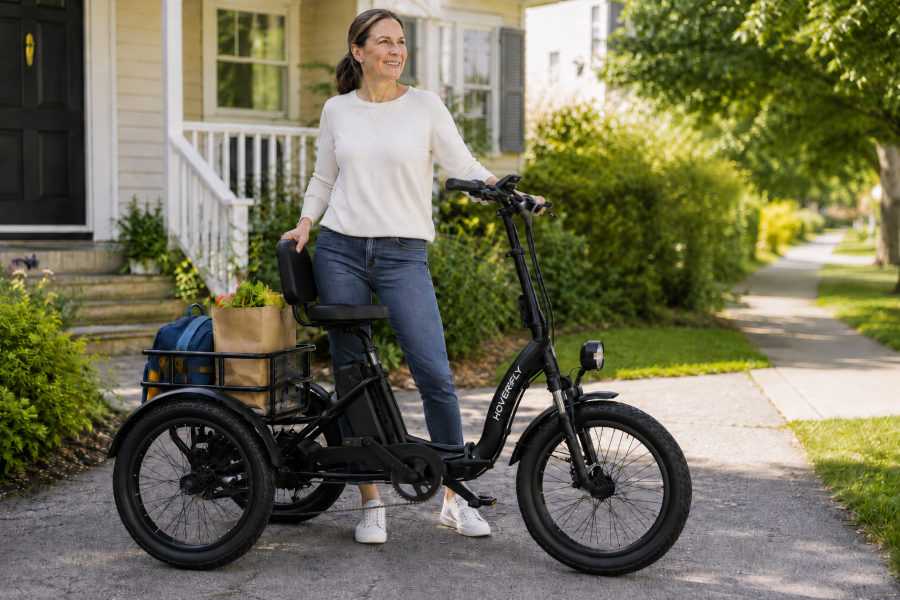
A trike fits riders who care more about steadiness than speed. You can stop without putting a foot down, sit upright with less balance work, and carry daily items without fighting the load.
That is where our Hoverfly ET1 folding electric trike makes sense. Its ultra-low step-through frame lets you step in instead of climbing over a high bar, which helps if knees, hips, or balance are a concern.
A rear differential is a detail we would look for. It helps the rear wheels move more smoothly through turns, so cornering feels more controlled. The rear basket keeps groceries or daily cargo low and centered, which feels steadier than carrying the same load on a two-wheel bike.
Our quick test: ask the rider to get on and off three times, make one slow U-turn, stop fully, and start again. If those slow moments feel easy, that matters more than a long spec list.
Where a Two-Wheel E-Bike Makes More Sense

A two-wheel e-bike is better when you want a lighter, more agile ride. It is easier to steer through narrow spaces, easier to lift and store, and more natural for riders who already feel confident balancing.
Our Hoverfly Ourea electric bike fits that rider. At about 54 lbs, it is easier to lift onto a rack or into a vehicle than most trikes.
On rough pavement, gravel paths, or uneven bike lanes, the 26-inch all-terrain tires and lockable front suspension fork help the Ourea feel more planted. The peak 750W motor helps when you start from a stop, climb a hill, or ride home with a full backpack. Its removable, key-locked 374.4Wh battery offers up to 40 miles of pedal-assist range, enough for commutes, park rides, and weekend errands without charging after every trip.
If stopping, starting, or slow turns are the main worry, a trike is still the safer-feeling choice. But if balance feels fine and the real problem is storage, weight, or tighter routes, Ourea makes more sense.
Our storage rule: measure the tightest real space first: doorway, hallway, elevator, trunk, garage corner, or bike rack. If the ride needs to pass through narrow spaces every day, width and weight may matter more than motor size.
Safety Features That Actually Matter
In our experience, safety comes down to the small moments: getting on, stopping, turning, and loading the bike.
We would first check whether the rider can step on easily, sit upright, and stop without over-gripping the brakes. That is where a low step-through frame, upright seating, strong disc brakes, and lights matter. On a trike, a parking brake is also useful when loading groceries or stopping on a slight incline.
For electric trikes, we would pay close attention to the turn. A wider stance, lower center of gravity, good tire width, and a rear differential can make slow turns feel more predictable. That tells our more than the wheel count.
Battery and speed matter too. Look for battery or system safety certifications such as UL 2271 or UL 2849. Make sure the speed class feels easy to control. Many Class 2 e-bikes assist up to 20 mph, while some adult-focused trikes use a lower top speed for steadier handling. PeopleForBikes is a useful resource for e-bike classes and local rules; you can learn more about e-bike classes from it.
How to Decide
Start with your real week. How far do you ride? Where will you store it? Do you carry groceries, a pet, or daily gear? Are there hills, narrow paths, rough pavement, or tight turns near home?
Then be honest about balance. If stopping, starting, or stepping over a frame feels stressful, a trike may help. If storage, weight, and narrow spaces are bigger problems, a two-wheel e-bike may fit better.
Before buying, do two checks. First, the slow-speed check: start, stop, turn slowly, and look over your shoulder. Second, the storage check: measure the narrowest space the ride must pass through. A folding trike can help, but it is still wider and heavier than most e-bikes.
Before every ride, check the basics:
- Tires inflated and brakes responsive.
- Battery charged and locked in place.
- Lights working and seat set correctly.
- Helmet on, speed down before turns.
Conclusion
There is no single winner between an electric trike and an electric bike. A trike usually works better for low-speed stability, easier mounting, and cargo. A two-wheel e-bike usually works better for agility, storage, and tighter routes.
Our recommendation: if stops and slow turns make you nervous, start with the trike. If you balance well and storage is tight, the two-wheel e-bike is the cleaner daily choice.
FAQs
Do you need a license to ride an electric trike or e-bike?
Usually, no. Most low-speed Class 1 or Class 2 e-bikes do not require a driver’s license, but rules can vary by state, city, and riding area. Always check local laws before riding on roads or shared paths.
Can an electric trike replace a car for short errands?
For many short trips, yes. A trike can work well for grocery runs, neighborhood visits, and daily errands, especially if it has enough basket space and battery range. For long distances, heavy traffic, or bad weather, a car may still be more practical.
Is a folding electric trike easy to transport?
It depends on the weight and folded size. Folding helps with storage, but a trike is still wider and heavier than most e-bikes. Before buying, measure your trunk, garage, or storage area.
How long does the battery last on one charge?
It depends on real riding conditions. Rider weight, hills, cargo, tire pressure, temperature, and assist level all affect range. Use the listed range as a guide, not a guarantee.
What should I check when buying for a parent online?
Start with comfort and control. Look at step-through height, seat support, braking, turning design, and battery certification. For a more senior-focused checklist, see Hoverfly’s guide to choosing an electric trike for seniors.
Can you ride an electric trike or e-bike in the rain?
Light rain is usually manageable, but avoid deep water. Wet pavement reduces grip and braking power, and electrical parts should not be submerged. After riding, dry the vehicle before charging or storing it.



Leave a comment
All comments are moderated before being published.
This site is protected by hCaptcha and the hCaptcha Privacy Policy and Terms of Service apply.