
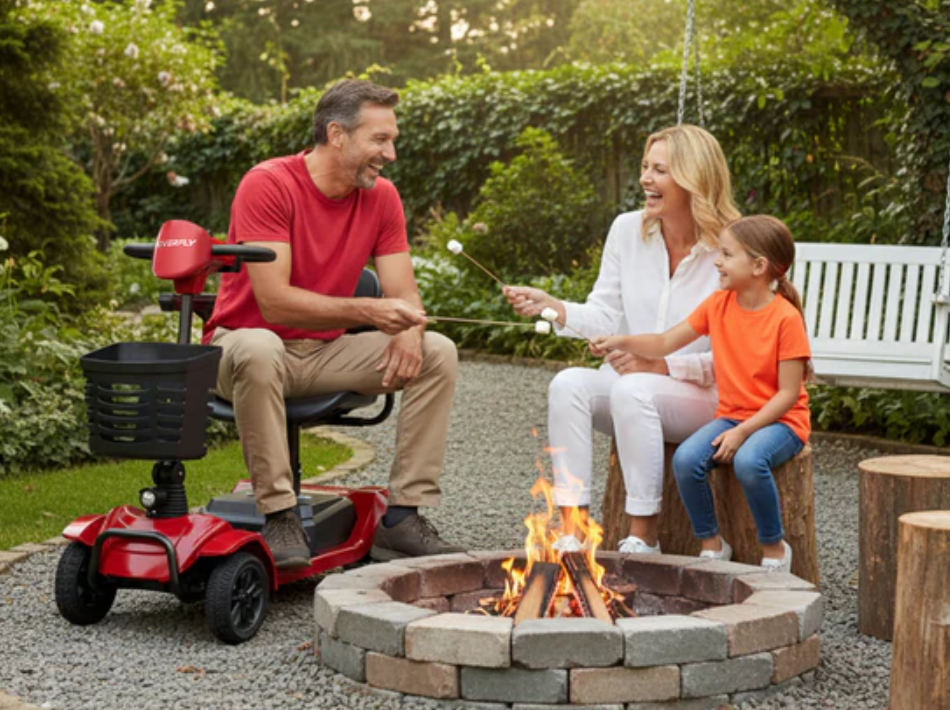
Choosing a mobility scooter for adults isn’t about finding the “best” model. It’s about finding the one that actually works in your home, on your sidewalks, and in your daily routine.
A scooter that feels perfect online can quickly become frustrating if it’s too wide for your bathroom door, hard to turn in your hallway, or unstable on your driveway. That’s why specs alone don’t tell the full story.
In this guide, we break mobility scooters down by real-life situations—inside your home, around your neighborhood, and during everyday errands. You’ll see which features solve specific problems, so you can choose a scooter that supports your independence instead of limiting it.
What Are the Key Mobility Scooter Specs That Matter Most?

Before you compare scooter types, you need to understand a few key specifications. These numbers decide whether a scooter feels easy to live with—or becomes a daily hassle.
Overall width
Overall width determines whether your scooter fits through doorways, elevators, and store aisles. Most residential doors measure 30–36 inches, while bathroom doors often measure 28–30 inches.
As a rule, you need about 2 inches of clearance on each side. That means scooters around 24–26 inches wide work for most homes. Anything wider can turn simple bathroom access into a problem.
Turning radius
Turning radius controls how tight a circle your scooter can make. This matters far more indoors than most buyers expect.
Compact three-wheel scooters usually turn within 32–40 inches. Larger four-wheel models often need 50–70 inches. If your hallways are tight, this single number can decide whether you move freely or constantly back up and reposition.
Wheel size and ground clearance
Wheel size affects how smoothly you roll over cracks, rugs, and thresholds. Small 6–8 inch wheels tend to catch on sidewalk gaps, while 10–12 inch wheels glide over bumps with less effort.
Ground clearance—usually between 1.5 and 4 inches—prevents scraping on door sills, curb cuts, and small ramps. Homes with thick rugs or uneven transitions benefit from extra clearance.
Wheelbase and track width
Wheelbase (front-to-back length) and track width (side-to-side distance between wheels) influence stability.
Longer wheelbases feel steadier on slopes, while wider track widths reduce side-to-side tipping when turning. This is why outdoor-focused scooters usually look longer and wider than indoor models.
Weight capacity
Weight capacity usually ranges from 250 to 500+ pounds. Staying well under the limit improves uphill performance, battery range, and overall safety. A 300-pound capacity with a 200-pound rider performs better than a 250-pound capacity at maximum load.
Total Weight & Heaviest Piece
Scooter weight matters if you plan to transport it. Travel models may weigh as little as 35 pounds, while heavy-duty scooters can exceed 200 pounds.
If the scooter disassembles, focus on the heaviest piece. Many travel scooters break down into 30–50-pound sections, which makes loading into a car far more realistic.
Which Real-Life Scenarios Should You Choose a Mobility Scooter for First?
Indoor Scenarios

1. Narrow Doorways & Hallways (Older homes, small bathrooms, tight corridors)
Key parameters: Overall width, turning radius
If your home has narrow bathroom doors or tight hallways, width becomes your biggest limitation. Many buyers overlook this—and regret it immediately.
Three-wheel scooters around 20–23 inches wide with turning radii under 42 inches work best in older homes and small apartments. They slip through tight spaces while still feeling stable indoors.
Look for responsive low-speed control. Indoors, you’ll constantly adjust speed near walls and furniture. Narrow footplates also help keep the overall footprint compact.
Compact scooters designed for indoor use—such as Hoverfly’s narrower-frame models—are built to handle tight hallways and small bathroom doors while maintaining stable control.
2. Elevator Living (Apartments, medical buildings, frequent in/out)
Key parameters: Overall size, seat mobility
Most elevators fit mobility scooters, but older buildings can be surprisingly tight. Measure both the door width and the interior space before buying.
Swivel seats make a big difference here. Being able to turn sideways lets you reach buttons or interact with others without awkward repositioning.
If your storage area lacks outlets, scooters with quick-release batteries let you charge indoors instead of running extension cords.
3. Tight U-Turns at Home (Kitchen, bedroom, cluttered rooms)
Key parameters: Turning radius, control precision
If you need to turn around in hallways or bedrooms, turning radius matters more than speed or range.
Three-wheel scooters pivot more sharply than four-wheel designs. In many homes, this is the difference between smooth movement and constant three-point turns.
Some longer scooters simply can’t turn around in standard hallways without backing up multiple times—something you’ll notice fast.
4. Grocery Stores & Mall Aisles (Crowds, checkout lines, slow creep)
Key parameters: Width, low-speed control, storage
Store aisles usually range from 36 to 48 inches wide, so most scooters fit. What really matters is how smoothly the scooter moves at very low speeds.
Browsing shelves or waiting in checkout lines means creeping along under 1 mph. Models with good speed modulation prevent jerky starts and stops.
Storage also matters more than people expect. Front baskets, under-seat compartments, and rear storage keep purchases stable and within reach.
5. Thresholds, Rugs, Small Ramps (Door sills, transitions, mats)
Key parameters: Ground clearance, wheel size, approach angle
Most scooters handle 1–2 inch thresholds without trouble. Problems start with thick rugs or steep transitions.
Ground clearance of 2–3 inches helps prevent scraping, while larger wheels roll over obstacles instead of stopping abruptly.
If your home has multiple door sills or area rugs, prioritize wheel size even if it slightly increases the scooter’s footprint.
Outdoor Scenarios

1. Sidewalk Cracks & Uneven Pavement (Neighborhood errands)
Key parameters: Wheel size, suspension, stability
Sidewalks are where many scooters start to feel uncomfortable—or unsafe. Cracked pavement, uneven slabs, and patched sections punish small wheels.
Scooters with 10–12-inch wheels roll over 1–2-inch gaps far more smoothly. Smaller wheels tend to stop abruptly, which can jolt your body and throw off balance.
The front suspension absorbs most of this impact. If you ride outdoors often, four-wheel scooters feel steadier on uneven surfaces than three-wheel designs.
2. Slopes, Driveways, Curb Cuts (Parking lots, ramps, mild hills)
Key parameters: Motor power, wheelbase, braking, anti-tip features
Hills reveal a scooter’s limits quickly. Even mild slopes can feel uncomfortable if the motor strains or the scooter feels unstable.
Check the maximum incline rating, usually between 6 and 15 degrees. Long wheelbases and anti-tip wheels help prevent backward tipping on climbs.
Going downhill matters just as much. Smooth electronic braking keeps speed under control instead of letting gravity take over.
Outdoor-focused scooters with longer wheelbases and stronger motors—like Hoverfly’s four-wheel outdoor models—offer noticeably better stability on slopes and uneven pavement.
3. Crosswalks & Low-Light Riding (Safety-first commuting)
Key parameters: Lighting, visibility, speed control
If you ride near roads or crosswalks, visibility becomes a safety issue, not a convenience.
Bright LED headlights and taillights help drivers see you at dawn, dusk, or in shaded areas. Side and rear reflectors improve visibility from multiple angles.
Some scooters also offer turn signals or hazard lights, which make your movements easier for drivers to anticipate.
4. Parks & Longer Leisure Rides (Comfort + distance)
Key parameters: Battery range, seat comfort, suspension
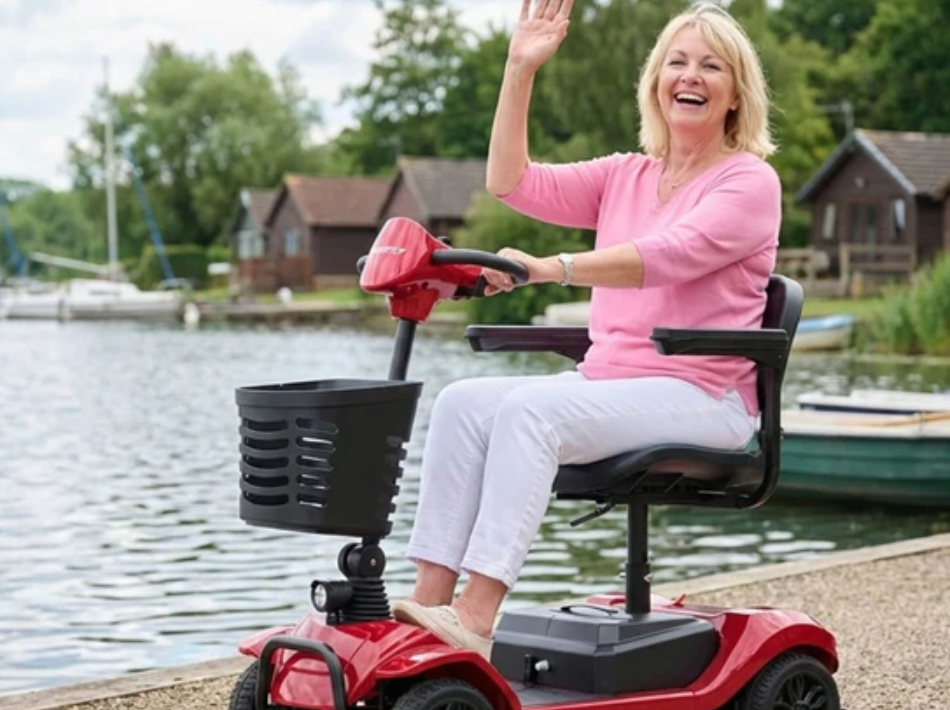
Longer rides demand comfort. If you enjoy parks or extended outings, battery range and seating quality matter more than compact size.
Look for 12–15+ miles of real-world range and a wide, padded seat with lumbar support. Adjustable armrests reduce fatigue during longer rides.
Full suspension and pneumatic tires absorb bumps and keep the ride relaxed instead of tiring.
5. Light Off-Road (Grass edges, packed gravel, rough paths)
Key parameters: Ground clearance, wheel size, traction
Most mobility scooters aren’t built for serious off-road use, but some handle grass edges, packed gravel, and rough paths well.
Wheels in the 12–14 inch range, 3–4 inches of ground clearance, and deeper tread patterns help maintain traction.
Four-wheel scooters with wide track widths feel more stable when surfaces get uneven.
6. Rain, Wet Surfaces, Cold Weather (Environmental factors)
Key parameters: Weather resistance, battery type, tire grip
Light rain usually isn’t a problem, but mobility scooters aren’t fully waterproof. If available, look for water resistance ratings like IP54 or higher. Solid tires also maintain better traction on wet pavement than air-filled tires.
Cold weather reduces battery range by 20–30%. Lithium batteries handle temperature swings better than lead-acid batteries and recover faster indoors.
Which Comfort and Safety Features Are Worth Paying For?
Comfort and safety features aren’t about luxury. They decide whether you enjoy riding or avoid using your scooter altogether.
Suspension
Suspension dramatically improves ride quality. If you ride outdoors or deal with back pain, front suspension is worth the upgrade.
Full suspension costs more, but it smooths rough pavement and reduces fatigue during longer rides.
Seat Design
Seat comfort affects how long you can stay out. Wide seats (18 inches or more) suit larger bodies and reduce pressure points.
Height-adjustable seats help with easier transfers, while swivel seats simplify getting on and off in tight spaces.
Braking Systems
Most scooters use electronic brakes that engage when you release the throttle. Good systems stop smoothly without throwing you forward.
Manual or emergency brakes add reassurance, especially on slopes.
Lighting & Visibility
Headlights and taillights aren’t optional if you ride near traffic. They help drivers notice you early instead of reacting at the last second.
Reflectors and turn signals improve communication when you change direction.
Battery Type
Lithium batteries cost more upfront but charge faster, last longer, and weigh less. They also perform better in cold weather.
Lead-acid batteries cost less initially but require more frequent replacement and longer charging times.
Many newer Hoverfly scooters use lithium battery systems, which makes them easier to transport, faster to charge, and more reliable in colder weather.
Speed Control
Adjustable speed settings let you limit indoor speed to 1–2 mph while still reaching 4–6 mph outdoors.
This flexibility prevents accidents in crowded spaces and keeps outdoor rides efficient.
Storage Options
Front baskets, under-seat compartments, and rear storage keep items secure.
If you run errands regularly, good storage turns your scooter into a practical daily tool instead of just transportation.
What Should You Check Before You Click "Buy"?

Measure Your Home
Walk through your home with a tape measure. Record doorway widths, hallway narrow points, elevator dimensions, and storage space.
Pay special attention to your smallest turning area. That’s where poor fit shows up first.
Measure Your Routes
Think about your typical trips. How far do you travel? Are there hills or rough sidewalks?
Match these conditions to battery range, incline rating, and wheel size instead of guessing.
Plan Transportation
If you’ll load the scooter into a car, measure trunk openings and interior space.
Check the weight of the heaviest disassembled piece and be honest about what you can lift comfortably.
Review Return Policies
Look for trial periods between 7 and 30 days. Confirm return shipping costs and restocking fees.
Home trials are ideal because they let you test the scooter in real conditions.
Check Warranty & Support
Review warranty coverage for the frame, electronics, and battery.
Reliable customer service and easy access to replacement parts matter far more than most buyers expect.
Conclusion
The right mobility scooter for adults isn’t about labels like “indoor” or “outdoor.” It’s about how well the scooter fits your home, your routes, and your daily routine.
Measuring doorways, turning spaces, and typical travel distances removes most wrong options immediately. What’s left is a short list that actually works in real life.
Test a scooter to see how it turns, brakes, and feels at low speed.
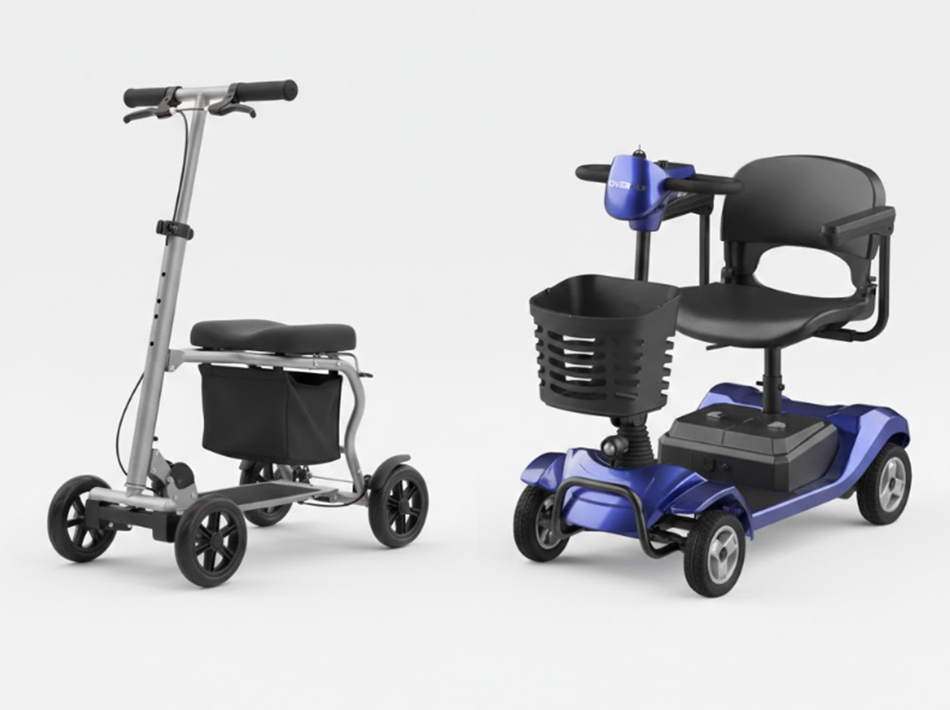
When you’re ready to compare real options, explore Hoverfly’s full range of mobility scooters designed for indoor, outdoor, and travel use. If easy transport is your top priority, consider our foldable mobility scooters, designed for both travel and storage.
FAQ for Types of Mobility Scooters for Adults
1. What problems do new mobility scooter owners run into most often?
Most problems happen because buyers don’t measure their space or plan transport before purchasing.
Scooters often end up too wide for bathroom doors, unable to turn in hallways, or too heavy to lift into cars.
Other common issues include choosing models with insufficient battery range, poor outdoor stability, or weight limits that are too close to the rider’s actual weight. Storage and charging are also frequently overlooked.
2. How far can a mobility scooter go on a full battery?
Most mobility scooters travel 6–25 miles per charge, depending on size and usage.
Travel scooters usually cover 6–10 miles, mid-size scooters 10–15 miles, and heavy-duty outdoor models 15–25+ miles. Real-world range is typically 70–80% of the advertised figure and drops 20–30% in cold weather. Hills, higher speeds, and frequent stops reduce range further.
3. What is better, a mobility scooter or an electric wheelchair?
A mobility scooter is better for users who can walk short distances, while an electric wheelchair suits users who need full-time seating support.
Scooters require upper-body strength to steer and offer longer range and better outdoor performance. Electric wheelchairs work better indoors, handle tight spaces more easily, and suit people with limited upper-body strength or difficulty transferring.
4. Is a 3-wheel mobility scooter safe outdoors?
Yes, a 3-wheel mobility scooter is safe outdoors on flat, well-maintained surfaces.
However, it provides less stability than a 4-wheel scooter on slopes, uneven pavement, or sharp turns.
Three-wheel models work well on smooth sidewalks and indoors, while four-wheel scooters are safer for hills, rough terrain, and frequent outdoor use.
5. How do I know if a mobility scooter will fit in my home?
A mobility scooter will fit if it is at least 4 inches narrower than your narrowest doorway and can turn within your tightest space.
Measure your narrowest door, hallway width, and smallest turning area, then compare those numbers with the scooter’s width and turning radius.
If the hallway width is smaller than the turning radius, expect three-point turns. Testing a scooter in person is the most reliable way to confirm fit.



Leave a comment
All comments are moderated before being published.
This site is protected by hCaptcha and the hCaptcha Privacy Policy and Terms of Service apply.