
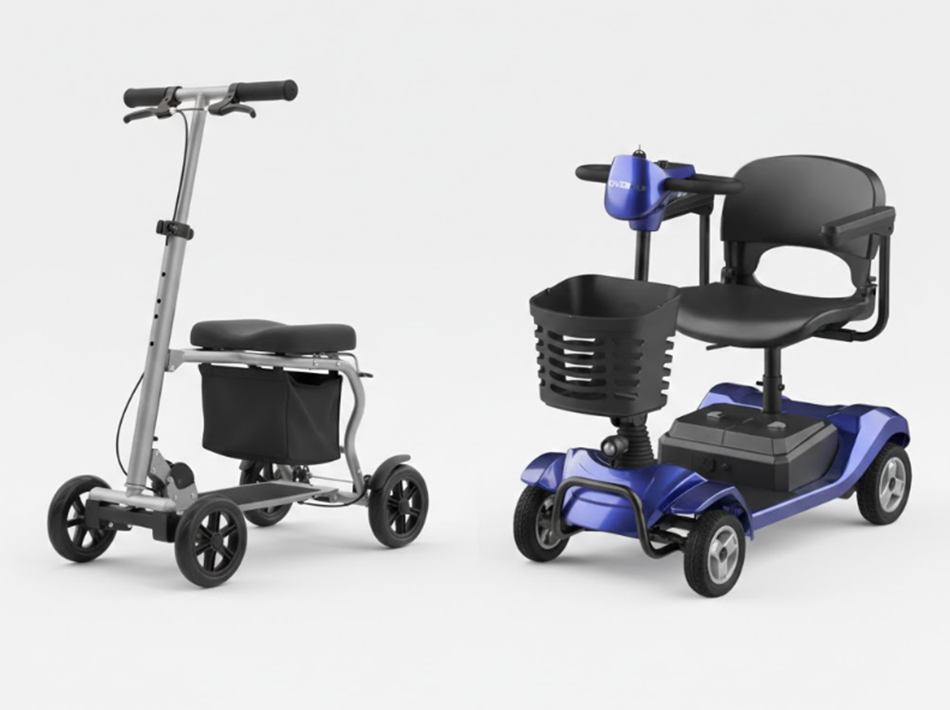
The difference between a knee scooter and an electric mobility scooter comes down to how long you need help—and how much effort your body can handle.
Knee scooters work best for short-term, non-weight-bearing recovery. Electric mobility scooters are built for long-term, seated mobility with very little physical strain.
If you’re healing from foot or ankle surgery, the right choice can make daily tasks manageable. If you’re dealing with ongoing pain, fatigue, or limited endurance, the wrong choice can leave you sore, frustrated, and stuck at home.
In this guide, we’ll show how each option works in real life, where they fall short, and how to choose based on recovery time, comfort, and where you actually need to go each day.
What Is the Core Difference Between a Mobility Scooter and a Power Wheelchair?

Before diving into knee scooters, it helps to clear up one common point of confusion: mobility scooters and power wheelchairs are not the same thing.
This distinction matters for one simple reason—knee scooters are not seated mobility devices at all, and they solve a completely different problem.
Mobility scooters prioritize independent sitting with tiller-style steering (similar to bicycle handlebars). They work best for people who can walk short distances but need help covering longer ones and have enough upper-body strength to steer.
Power wheelchairs, on the other hand, provide full-time seated support with joystick control. They suit users who need constant posture support or have limited upper-body strength, but they cost more and serve a different mobility level.
Keep this in mind as you compare knee scooters and electric mobility scooters—because the decision isn’t about brands or features. It’s about how your body needs support right now.
What Is a Knee Scooter, and When Does It Make Sense?
What a Knee Scooter Is Designed For
A knee scooter, sometimes called a knee walker, supports one knee on a padded platform while you steer with both hands and push forward using your good leg. If you’ve ever used a child’s kick scooter, the motion feels familiar.
Doctors often recommend knee scooters as a temporary alternative to crutches when you must keep all weight off one foot or ankle. The keyword here is temporary. Knee scooters are designed to help you get through a recovery phase—not to support daily mobility long term.
They work best in predictable environments like homes, offices, or medical buildings, where floors are smooth and distances are short.
Common Situations Where Knee Scooters Work Well
Knee scooters work best in these situations:
- Foot or Ankle Surgery Recovery: Procedures like bunion correction, Achilles tendon repair, or ankle reconstruction often require 6–12 weeks of non-weight-bearing.
- Lower Leg Fractures: Broken foot, ankle, or lower tibia bones that require casts or boots.
- Temporary Offloading Needs: Severe sprains or diabetic foot ulcers where weight must stay off one leg during healing.
Key Limitations to Understand
Knee scooters also come with limitations that matter more the longer you use them.
- Balance Demands: You’re steering while balancing on one leg. That feels manageable at first, but fatigue builds quickly—especially late in the day or when your hands are full.
- Limited Outdoor Use: Small sidewalk cracks, uneven pavement, gravel, or sloped driveways can turn into real safety risks. Many people underestimate this until they try going outside.
- Short Comfort Window: Even with good padding, most users feel knee pressure after 20–30 minutes. What feels tolerable for a quick trip becomes frustrating during longer errands.
What Is an Electric Mobility Scooter, and Who Is It Built For?

Core Purpose of Electric Mobility Scooters
Electric mobility scooters provide seated, motor-powered mobility with almost no physical effort. You sit comfortably while electric motors handle movement, speed, and distance.
For many people, the biggest difference shows up immediately: you’re no longer managing balance, knee pressure, or constant pushing. You’re simply getting where you need to go—with energy left afterward.
Typical Users and Daily Scenarios
Electric mobility scooters are built for repeated, everyday use.
Many seniors use them to manage joint pain from arthritis or general fatigue without giving up independence.
Others rely on them because conditions like COPD, heart disease, multiple sclerosis, or post-polio syndrome limit how far they can walk comfortably.
In daily life, that often means grocery shopping without needing breaks, moving through large stores or parks without pain, attending community events, or simply getting around the neighborhood without worrying about running out of energy halfway through.
How It Differs From Knee Scooters in Daily Life
Electric mobility scooters place far less strain on your body—and you feel the difference immediately.
You sit rather than balance on one leg, eliminating the constant physical effort and coordination knee scooters demand. Your hands lightly guide steering rather than supporting body weight.
Most users feel secure and confident quickly, even if they initially worried about operating motorized equipment.
A longer travel distance becomes possible through battery power. While knee scooters exhaust users after a few hundred feet, electric scooters cover miles on a single charge, opening access to community spaces, nature areas, and extended shopping trips.
Is Short-Term Recovery or Long-Term Mobility the Bigger Factor in Your Choice?
Short-Term Recovery (Weeks to a Few Months)
Knee scooters make the most sense when recovery is clearly time-limited. If you’re facing 6–12 weeks of non-weight-bearing healing after foot or ankle surgery, the trade-offs are usually acceptable because you know there’s an end date.
You can tolerate knee pressure and balance demands for a few weeks when the goal is simply getting through recovery. Once healing is complete, the scooter goes back to the rental company—or into storage—without lingering consequences.
Long-Term or Ongoing Mobility Needs

When mobility needs stretch beyond a few months, knee scooters often become the wrong tool. What started as a short-term solution turns into daily knee pain, extra strain on your good leg, and growing frustration with limited range.
Electric mobility scooters are designed for this reality. The seated position, back support, and motorized movement protect your joints and conserve energy over time.
Instead of planning your day around physical limits, you regain freedom to move without constantly thinking about recovery or pain.
Indoor vs Outdoor Use: How Do You Choose?
Indoor Use Considerations
- Knee Scooters: Narrow width and tight turning radius work well in small bathrooms and hallways.
- Electric Scooters: Need more space, but three-wheel models still work in many homes.
Outdoor Use Considerations
- Knee Scooters: Best for smooth pavement only; cracks and slopes quickly become unsafe.
- Electric Scooters: Designed for outdoor terrain, longer distances, and real-world obstacles.
What Comfort, Safety, and Fatigue Factors Are Often Overlooked?

Comfort and Safety With Knee Scooters
Knee pressure buildup causes discomfort that worsens with use. Even well-padded platforms create pressure points during extended kneeling. Most users find 20–30 minutes the maximum comfortable duration before needing to rest or switch to crutches.
Balance-related fall risk increases when you're tired, distracted, or navigating obstacles. The one-legged stance requires constant attention and core strength. Reaching for items, opening doors, or carrying objects while steering multiplies fall danger.
Comfort and Stability With Electric Mobility Scooters
Seated posture support protects your back, hips, and joints. Quality seats with padding and lumbar support let you maintain good posture rather than compensating for an injured leg's absence.
Reduced joint strain matters for people with arthritis or joint deterioration. You're not loading your good leg with extra weight or stressing your knee with extended kneeling. The seated position distributes weight naturally.
Better stability on longer trips builds confidence. You won't worry about losing balance when reaching for grocery items or navigating crowds. The wide wheelbase and low center of gravity keep you secure.
How Do Cost, Transport, and Ownership Practicalities Compare?
Knee scooters cost $100-300 to purchase or $30-50 monthly to rent. They fold into car trunks easily, weigh 25-35 pounds, and require minimal maintenance beyond occasionally tightening bolts. Storage takes closet space similar to a vacuum cleaner.
Electric mobility scooters cost $500-3,000, depending on features, with travel models at the lower end and heavy-duty outdoor scooters at the upper range. Foldable mobility scooters designed for car transport weigh 40-65 pounds and fit in most trunks, while larger models require vehicle ramps or lifts.
Maintenance includes battery charging (nightly or every few days), occasional tire pressure checks if using pneumatic tires, and eventual battery replacement every 1-3 years ($200-600). Storage requires garage or closet space, though compact models minimize footprint.
Insurance sometimes covers mobility scooters through Medicare or private insurance if prescribed as durable medical equipment for long-term medical conditions. Knee scooters rarely qualify for insurance coverage since they address temporary situations.
What Common Mistakes Do People Make When Choosing Between These Two Options?

The most common mistakes we see:
- Using A Knee Scooter Too Long: What feels fine for 6 weeks becomes painful over months.
- Overestimating Balance Ability: Not everyone can safely manage one-leg steering.
- Choosing By Price Alone: Short-term savings often lead to long-term discomfort.
- Ignoring Outdoor Needs: Equipment that traps you at home limits independence.
Quick Decision Guide: Which One Fits You Best?
Choose a Knee Scooter If:
- Recovery is short-term (6–12 weeks).
- You must keep all weight off one leg.
- Most movement happens indoors.
Choose an Electric Mobility Scooter If:
- Mobility needs are long-term.
- Walking causes fatigue or pain.
- You need to travel longer distances.
Final Thoughts
Choosing between a knee scooter and an electric mobility scooter comes down to three things: how long you’ll need support, what your body can realistically handle, and where you need to go each day.
Knee scooters make sense for short-term, single-leg recovery when your goal is simply getting through the healing period. Electric mobility scooters are better suited for long-term or ongoing mobility challenges, especially when comfort, range, and energy conservation matter day after day.
Before you decide, be honest about one thing: is this a short recovery—or a long-term change in mobility? That answer usually points to the right choice.
If you’re leaning toward long-term mobility, it helps to compare foldable travel scooters versus full-size outdoor models based on where you’ll use them most.
And if your situation falls somewhere in between, testing both options—even briefly—can save you weeks of discomfort and frustration later.
FAQs
1. What are the disadvantages of a knee scooter?
The main disadvantages of a knee scooter are balance demands, limited outdoor use, and short comfort duration. Knee scooters also struggle on uneven surfaces like sidewalk cracks, gravel, or slopes. Most people find the kneeling position uncomfortable after 20–30 minutes, making it unsuitable for long daily use.
2. What are the disadvantages of a mobility scooter?
Electric mobility scooters require more storage space, cost more upfront, and can be harder to transport without a vehicle or lift. They also require regular charging and battery maintenance. Indoors, larger models may struggle in tight hallways or small bathrooms. However, these trade-offs are usually acceptable for people who need long-term, seated mobility support.
3. What is a better option than a knee scooter for long-term use?
For long-term or daily mobility needs, electric mobility scooters are usually a better option. They reduce physical strain, allow longer travel distances, and provide stable, seated support that knee scooters can’t offer over time.
4. Are knee scooters medically recommended?
Doctors often recommend knee scooters for short-term, non-weight-bearing recovery after foot or ankle surgery. They are not intended for long-term mobility or for people with balance issues, upper-body weakness, or chronic mobility limitations.
5. Is it better to rent or buy a knee scooter?
Renting a knee scooter is usually better if your recovery lasts only a few weeks. Monthly rentals are affordable and eliminate long-term storage concerns. Buying a knee scooter makes sense if you expect to use it for several months or want the flexibility to resell it later. The right choice depends on your recovery timeline and budget.



Leave a comment
All comments are moderated before being published.
This site is protected by hCaptcha and the hCaptcha Privacy Policy and Terms of Service apply.