
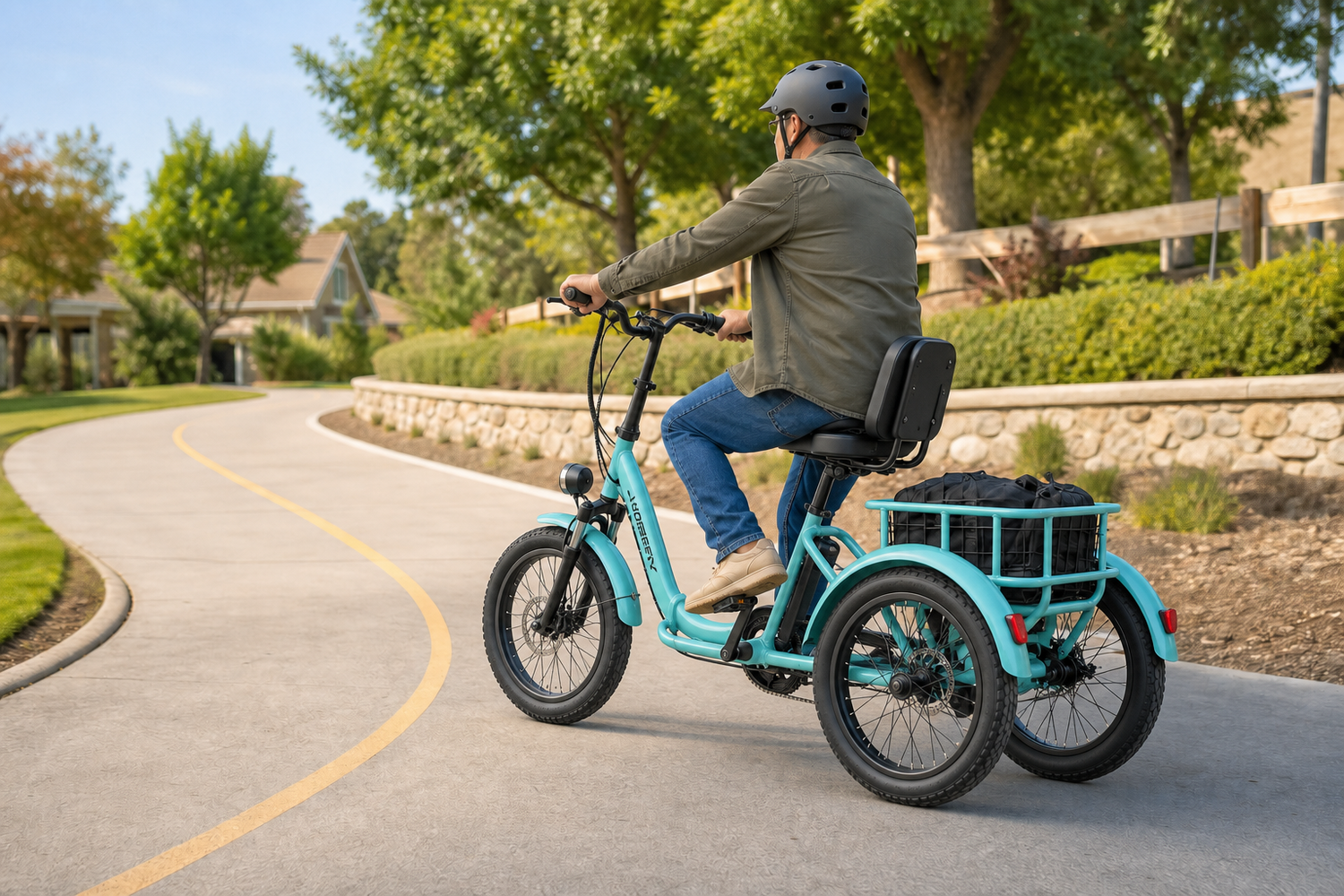
Many riders choose a folding e-trike for storage and everyday errands, but cornering stability is often the part they worry about most. We designed the Hoverfly ET1 to address that concern with a rear differential, a 49.2-inch wheelbase, 20" x 3.0" fat tires, and a low step-through frame.
The rear differential is the core part of that stability setup, while the foldable frame and 60-mile range keep the ET1 practical for storage and daily errands.
To judge its cornering performance, we look at three practical factors: rear-wheel movement, wheelbase and tire contact, and how the trike behaves with a heavier rider plus cargo.
ET1 Components That Determine Its Cornering Performance
For everyday turns, four parts have the biggest influence on how a three-wheel trike feels: the rear axle, wheelbase, tires, and frame height. On the ET1, we tune those elements to help reduce wheel hop, body roll, and grip loss during turns.
|
Component |
ET1 Specification |
Effect on Cornering |
|
Rear axle |
Sealed differential |
Each wheel rotates independently in turns |
|
Wheelbase |
49.2 in |
Resists body roll under lateral load |
|
Tires |
20" x 3.0" fat tires |
Wider footprint maintains grip during turns |
|
Frame |
Step-through, ultra-low standover |
Lower center of gravity |
|
Motor |
750W ( peak 1000w) |
Smooth torque without mid-turn lurch |
|
Top throttle speed |
15.5 mph |
Keeps cornering inside a manageable range |
|
Brakes |
Hydraulic disc, power cut-off |
Reduces forward weight transfer mid-turn |
|
Load capacity |
400 lbs |
Stable handling under a heavier rider plus cargo |
The Rear Differential
Basic delta-style trikes mount both rear wheels onto a single solid axle, forcing them to spin at the same speed at all times. Through any turn, the outside wheel travels a longer arc than the inside one, so one wheel may slip while the other scrubs the pavement. Riders may feel that as a mid-turn lurch or audible wheel hop.
That is why we use a rear differential on the Hoverfly ET1. It lets each rear wheel rotate at its own pace, so the trike does not have to fight against itself through a turn. Instead of forcing one rear tire to scrub or hop, our differential supports smoother wheel movement and more predictable acceleration out of the corner. Some basic solid-axle trikes still use a simpler rear setup, which is why riders may feel more tire drag, rear-wheel hop, or a small lurch during tight turns.

Wheelbase and Frame Geometry
The distance between axles is also critical. In shorter-wheelbase trikes, sharp turns are more likely to create a noticeable side-lean or tipping sensation, especially under throttle or with added cargo. This is a geometry-based handling observation; actual stability also depends on rider weight, cargo load, speed, turning radius, tire pressure, and road surface.
That is why we gave the ET1 a 49.2-inch wheelbase. A wheelbase closer to 50 inches can help the chassis feel more settled through everyday curves, and the ET1 sits in the same length class as Addmotor's Citytri E-310.
We also use a low step-through frame to help lower the rider's mounting position, which can reduce the top-heavy feeling during turns. Heavier riders may benefit more from that geometry, and our safety guide for plus-size riders explains how geometry outweighs motor wattage above 250 lbs.
Fat Tires and Contact Patch
During a low-speed U-turn on damp pavement, or when the rear basket is loaded with groceries, tire contact matters more than raw motor power. The ET1’s 20" x 3.0" fat tires put a wider patch of rubber on the road, helping the trike hold its line better than narrower tires on loose gravel or wet surfaces. Paired with an 80mm front shock absorber, the setup also softens bumps that might otherwise knock a rigid trike off-line mid-turn.
Hydraulic Disc Brakes with Power Cut-Off
We equip the ET1 with hydraulic disc brakes with a power cut-off function, plus a parking brake that helps prevent the trike from rolling when parked. When a rider brakes, the power cut-off stops motor output, helping the trike slow down more predictably instead of pushing through the turn.
How the ET1 Cornering Compares to Other E-Trikes
A shorter 36-inch wheelbase can make a trike feel more agile, but compared with longer wheelbases near 50 inches, it may feel less settled during sharp, low-speed turns, especially under throttle or with added cargo.
|
Model |
Differential |
Wheelbase |
Field Notes |
|
Yes |
49.2 in |
Stable through turn-in and exit at 10–15 mph |
|
|
Addmotor Citytri E-310 |
Yes |
49.2–52 in |
Long-wheelbase planted feel |
|
Mooncool TK1 |
Yes |
36 in |
Shorter base feels tippier in sharp turns |
|
Lectric XP Trike2 |
Yes |
~44 in |
Confident cornering reported in factory testing |
|
EvryJourney 250W |
No |
~42 in |
Visible wheel hop in sharp turns under throttle |
Other Advantages of the ET1 E-Trike
Cornering is the headline, but we designed the ET1 as more than a stable ride: it offers a 30–60 mile single-charge range, folds down to 43.3 × 33.1 × 30.7 inches, and supports up to 400 lbs of user weight for everyday mobility, storage, and errands. Each one addresses a specific friction point that keeps people from riding regularly.
Foldable Design and Compact Storage
The ET1 folds down to 43.3 × 33.1 × 30.7 inches, which slips into most SUV trunks and hatchback cargo areas without a hitch rack. Folding takes seconds.
One ET1 owner shared on our official product page that they spent weeks comparing foldable trikes for SUV transport before choosing the ET1. Their goal was simple: fold the trike, load it into the SUV trunk for day trips, and store it more easily at home without adding a trailer or hitch rack. They called the ET1 “the absolute winner for our SUV trunk.”

Long Range and Removable Battery
We equip the ET1 with a removable 48V 13.5Ah lithium-ion battery rated at 696Wh, which delivers up to 60 miles per charge in pedal-assist mode. A full charge from empty takes roughly 4 to 5 hours on a standard outlet. We also make the pack removable so riders can charge it indoors, which is especially useful for apartment owners or households with indoor-only charging policies.
On our official ET1 product page, we list the battery as a UL 2271-certified 48V, 13.5Ah (696Wh) lithium-ion battery. UL 2271 is a safety certification for batteries used in light electric vehicle applications. Riders can check the battery pack for the UL hologram label to verify certification.
Step-Through Accessibility and Rider Comfort
We designed the ET1 with our lowest step-through frame to date. Riders do not need a high leg swing to mount or dismount, which helps remove one of the biggest barriers for people with hip or knee mobility limitations. The adjustable seat height and handlebar position also help the ET1 fit riders across a wide size range.
A reviewer on our ET1 product page wrote that they were “riding confidently in 5 minutes flat.” That kind of quick first ride reflects what we built the ET1 for: easy mounting, steady balance, and less hesitation for people new to e-trikes.
Practical Cargo for Everyday Errands
We pair an oversized rear basket with a 400-lb total load rating so the ET1 can support everyday errands without a car. Grocery runs and pharmacy pickups become easier without needing a trailer hitch or extra cargo setup. One owner shared that the basket alone made car-free errands realistic for the first time since they stopped driving regularly.
We also designed the chassis to support adaptive use cases beyond standard riding. In our guide to trikes for riders with disabilities, we explain how these same accessibility features can support riders recovering from surgery or managing chronic mobility conditions.
Mixed-Surface Capability
We use 20" x 3.0" fat tires and an 80mm front shock absorber to help the ET1 handle pavement, gravel, dirt paths, and grassy park trails. Riders are not limited to flat sidewalks or smooth bike lanes.
Warranty and After-Sale Support
We back every ET1 with a 1-year warranty and a 30-day return window. That coverage matters more on a folding electric platform than on a standard bike, since first-time three-wheel riders sometimes need a few weeks to know whether the geometry fits their daily routine. The return window helps reduce the risk of trying a new mobility format.
FAQs
Are e-trikes safer than two-wheel bikes for older riders?
Yes, for everyday cornering and stopping. Three wheels stay upright at every red light and through slow turns, removing the balance demand that causes most senior cycling falls. Two-wheel bikes handle high-speed, sharp turns better, but neighborhood e-trike use rarely needs that range.
What does the rear differential do on an e-trike during a turn?
It lets each rear wheel spin at its own speed. Without one, both wheels lock to a single axle and one must slip during every turn. Differential-equipped e-trikes corner flat without the chassis hop that signals a solid-axle design.
Do you need balance skills to ride an e-trike?
An e-trike requires much less balancing than a two-wheel bike at stops and low speeds. Three wheels keep e-trikes upright at every stop and through every turn, with no leaning needed even at low speeds. That makes them the standard choice for riders returning to cycling after surgery or managing balance concerns.
How far can e-trikes typically go on one charge?
Most folding e-trikes deliver 25 to 60 miles per charge in pedal-assist mode. Throttle-only riding cuts that range by roughly a third. Battery capacity and rider weight are the two biggest factors in real-world distance for any e-trike platform.
Are e-trikes street-legal in the United States?
In many states, e-trikes are street-legal when they meet Class 1 or Class 2 e-bike rules. Local rules can vary by state, city, and riding area, so riders should check local regulations before using an e-trike on public roads or paths. Most folding e-trikes cap at 15.5 to 20 mph and need no license or registration under federal rules. Local jurisdictions can add helmet or age requirements, so check city ordinances first.
Conclusion
The ET1 corners well because we designed its rear differential, 49.2-inch wheelbase, fat tires, and hydraulic disc brakes with power cut-off to solve different challenges in everyday turns. We also built in the range, cargo capacity, and step-through accessibility that many riders need when choosing their first folding e-trike.
Owner reviews point to the same outcome from different angles: a trike that feels steady, practical, and easier to use in daily life. Ready to see whether the ET1 fits your daily rides? Contact Hoverfly for current availability, specs, and support.




Leave a comment
All comments are moderated before being published.
This site is protected by hCaptcha and the hCaptcha Privacy Policy and Terms of Service apply.