
I've spent the last several riding seasons chasing e-bike routes across the country, and I've narrowed the shortlist down to the 50 trails below. My picks come from three things I actually check before every trip: current legal access for Class 1 and Class 2 e-bikes under federal, state, and local rules; surface and grade that pedal-assist motors handle well; and length that lines up with real-world battery range. Instead of grouping the list by geography like most write-ups do, I've grouped it by riding style — so you can skip past anything that doesn't match how you ride.
How I Picked These Trails
Every trail below cleared four filters before it made my list. First, I checked current legal access for Class 1 or Class 2 e-bikes under the relevant federal, state, or local rules. Second, I looked at whether the surface and grade actually suit pedal-assist riding, not dirt-jump or extreme downhill use. Third, I matched trail length against real-world battery range, from short loops to multi-day corridors. Fourth, I confirmed ridability and amenities through official trail authorities and state park sources rather than aggregator sites.
The 50 Trails, Grouped by Riding Style
Rather than repeat the same table format five times, I've grouped my picks the way I'd actually recommend them to a friend — a short note on what each trail delivers, so you can scan and pick without wading through repeated columns of length and surface.
Beginner-friendly routes
First-time e-bike riders do best on short, flat, well-marked routes close to towns with bike shops and food. My ten picks here run 11 to 34 miles on forgiving surfaces:
- Capital Crescent Trail (MD, 11 mi, paved) — smooth D.C.-to-Bethesda run with easy trailhead parking and cafés along the way.
- Norwottuck Rail Trail (MA, 11 mi, paved) — flat, shady Pioneer Valley path that's ideal for a first solo outing.
- Legacy Trail (KY, 12 mi, paved) — Lexington's downtown-to-Kentucky Horse Park connector, well-signed and lightly graded.
- East Bay Bike Path (RI, 14.5 mi, paved) — Providence-to-Bristol coastal ride with harbor views and frequent food stops.
- Hiawatha Trail (ID, 15 mi, gravel) — the famous tunnel-and-trestle route through the Bitterroots; reserve a shuttle for the return.
- Heritage Trail (IA, 26 mi, crushed stone) — quiet Dubuque-to-Dyersville corridor along the Little Maquoketa River.
- Lehigh Gorge Trail (PA, 26 mi, crushed stone) — gentle downhill through a state park gorge — one of the easiest "big miles" days I know.
- American River Bike Trail (CA, 32 mi, paved) — Sacramento's classic paved commuter route with mile markers and drinking fountains.
- Elroy-Sparta State Trail (WI, 33 mi, crushed stone) — three lit railroad tunnels and shaded farmland; bring a headlamp.
- Virginia Creeper Trail (VA, 34 mi, crushed stone) — shuttle to Whitetop, coast down through Damascus, and let gravity do most of the work.
Check status before you book, though: the upper Whitetop-to-Damascus section has been closed since Hurricane Helene, and the open stretch has been Abingdon to Damascus. E-bikes are permitted on the trail.
Long-distance corridors
These trails rewrite the planning checklist — battery range, charging stops, and lodging spacing matter far more than top speed. Each runs at least 78 miles, and several are multi-day rides:
- Empire State Trail (NY, 750 mi, mixed) — the longest continuous multi-use trail in the country, crossing New York end to end.
- Pacific Coast Highway route (CA, 650 mi, paved) — Although it is a highway route, it mixes paved highway with quiet country roads and unbeatable ocean views.
- Katy Trail (MO, 240 mi, crushed limestone) — the longest rail-trail conversion in the U.S., with charging-friendly trail towns like Sedalia and Hermann.
- C&O Canal Towpath (MD-DC, 184.5 mi, dirt/gravel) — historic canal route from D.C. to Cumberland; plan around wet spring conditions.
- Great Allegheny Passage (PA-MD, 150 mi, crushed limestone) — pairs seamlessly with the C&O for a Pittsburgh-to-D.C. run.
- Centennial Trail (SD, 111 mi, mixed) — Black Hills route stitching prairie, pine forest, and Bear Butte together.
- Mickelson Trail (SD, 109 mi, crushed stone) — gentle grades on former Deadwood-area railbed, with lodging in every trail town.
- White Rim Trail (UT, 100 mi loop, dirt road) — classic Canyonlands backcountry loop; permits required, water planning critical.
- Little Miami Scenic Trail (OH, 78 mi, paved) — Cincinnati-area rail-trail with dense small-town amenities.
- Greenbrier River Trail (WV, 78 mi, crushed stone) — remote, quiet river corridor; carry more battery than you think you need.
Class 1 eMTB routes
These are the technical end of e-bike riding — singletrack, slickrock, granite, and real elevation. Since Mar 1, 2026, the Moab BLM Field Office opened designated non-motorized trails to Class 1 e-bikes, which adds significant new Utah access. Expect technical features, real exposure, and full-suspension performance where it counts:
- Slickrock Trail (UT, 10.5 mi loop, advanced) — the iconic Moab test piece; grippy sandstone rewards low-speed torque.
- Hell's Revenge (UT, 6.8 mi, intermediate) — shorter but consequential ledges; a good introduction to Moab terrain.
- Poison Spider Mesa (UT, 17.5 mi, advanced) — long climb with exposure, then Portal descent views over the Colorado River.
- Mammoth Mountain Bike Park (CA, 80+ mi, all levels) — lift-served network with routes for every ability.
- Monarch Crest Trail (CO, 35 mi, expert) — high-alpine ridgeline with sustained exposure; pick a stable weather day.
- Imogene Pass (CO, 11.6 mi, expert) — 13,000-foot pass between Ouray and Telluride; battery drain is brutal.
- Flume Trail (NV, 14 mi, intermediate) — Lake Tahoe rim views along a historic water flume alignment.
- McDowell Mountain Regional Park (AZ, 50+ mi, intermediate) — well-signed Sonoran desert loops close to Phoenix.
- South Mountain Park & Preserve (AZ, 70 mi, all levels) — one of the largest municipal parks in the country, with progression-friendly options.
- Rubicon Trail (CA, 22 mi, expert) — legendary rock crawl through the Sierra; usually done as a two-day.
Paved rail-trails
The workhorse category of American e-bike riding — smooth asphalt, gentle grades, mile markers, and town access. These corridors follow abandoned railbeds and welcome Class 1 and Class 2 e-bikes under standard 750-watt limits:
- Schuylkill River Trail (PA, 75 mi, paved) — connects Philadelphia to Pottsville with well-spaced trailheads.
- W&OD Trail (VA, 45 mi, paved) — D.C.'s go-to commuter corridor out to Purcellville.
- Wabash Cannonball Trail (OH, 63 mi, paved) — quiet northwest Ohio route through farmland and small towns.
- Cardinal Greenway (IN, 62 mi, paved) — Indiana's longest rail-trail; runs through Muncie and Marion.
- Silver Comet Trail (GA, 61.5 mi, paved) — Atlanta-metro rail-trail connecting to Alabama's Chief Ladiga for 94 miles total.
- Withlacoochee State Trail (FL, 46 mi, paved) — shady Central Florida corridor with reliable trailhead water.
- Mohawk-Hudson Bike-Hike Trail (NY, 41 mi, paved) — Albany-to-Schenectady route along the Erie Canal.
- Springwater Corridor Trail (OR, 21 mi, paved) — Portland's core commuter path out toward Boring.
- Banks-Vernonia State Trail (OR, 21 mi, paved) — Oregon's first rails-to-trails conversion, forested and low-traffic.
- Mt Vernon Trail (VA, 18 mi, paved) — Potomac riverside route with monument views.
Coastal routes
Coastal trails deliver views no inland route matches — salt air, ocean wind, and mostly flat grades. Most are paved or hard-packed and welcome Class 1 and Class 2 e-bikes:
- Florida Keys Overseas Heritage Trail (FL, 90 mi, paved) — island-hopping route parallel to US-1, with historic railroad bridges.
- Pinellas Trail (FL, 47 mi, paved) — St. Petersburg-to-Tarpon Springs Gulf Coast corridor.
- Acadia Carriage Roads (ME, 45 mi, gravel) — Rockefeller-built stone-arch bridges and Maine coastal views.
- Tammany Trace (LA, 31 mi, paved) — Louisiana's first rail-trail, running through pine forest along Lake Pontchartrain.
- Cape Cod Rail Trail (MA, 25 mi, paved) — connects six Cape Cod towns with beach access at every end.
- Bayshore Bikeway (CA, 24 mi, paved) — San Diego Bay loop with quiet marina stretches.
- Marvin Braude Bike Trail (CA, 22 mi, paved) — the iconic "Strand" from Will Rogers Beach to Torrance.
- Burke-Gilman Trail (WA, 20 mi, paved) — Seattle's core commuter-and-coastal trail along Lake Washington.
- Monterey Bay Coastal Recreation Trail (CA, 18 mi, paved) — aquarium-to-Castroville route hugging the water.
- Lakefront Trail (IL, 18 mi, paved) — Chicago's shoreline path with skyline and lake views the whole way.
Matching the Hoverfly Ourea to These Trails
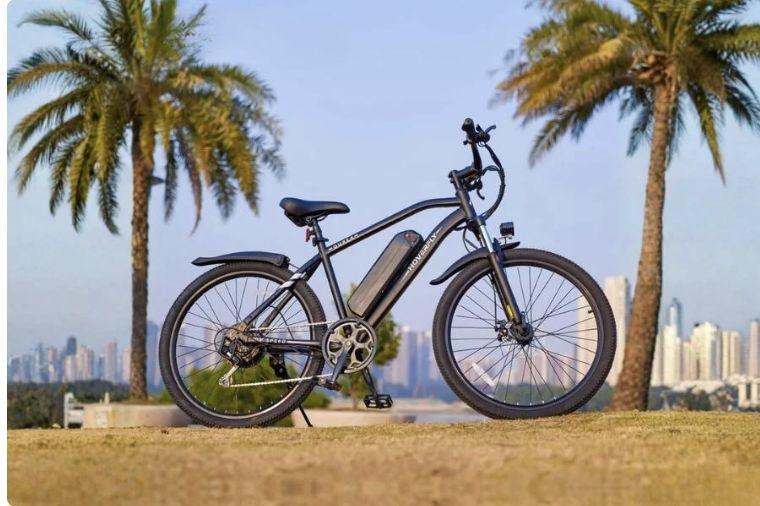
For the paved rail-trail, long-distance, and mixed-surface routes above, the Hoverfly Ourea Electric Bike is the model I'd point to. Rather than a generic pitch, here's how the specs listed on the official Ourea product page line up with the specific trails on my list.
- Range vs. trail length. The Ourea delivers up to 40 miles of pedal-assist range with a cadence sensor, and up to 20 miles in pure electric mode. That covers all ten of my beginner routes end to end, and puts the 41-mile Mohawk-Hudson, 45-mile W&OD, 46-mile Withlacoochee, and 47-mile Pinellas within reach of a single-day ride on lower assist. Multi-day corridors like the Katy Trail and Great Allegheny Passage need planned recharges.
- Removable 374.4Wh battery for overnight charging. The 48V 7.8Ah pack detaches with a key lock and offers two charging methods, so it's the pattern that actually works on multi-day rail-trail tours — pull the battery, bring it inside, plug in at a B&B.
- 26" all-terrain tires for mixed surfaces. The 26" × 2.0 puncture-resistant, anti-slip tires are built for the crushed-limestone and crushed-stone surfaces that dominate my long-distance and beginner picks — the Katy Trail, GAP, Mickelson, Elroy-Sparta, Heritage, Lehigh Gorge, Virginia Creeper, and Greenbrier River trails all fall in that category.
- Lockable front suspension. Efficiently absorbs shocks on rough terrain when you want it, locks out on smooth pavement when you don't — useful across the paved-to-crushed-limestone transitions on the C&O Canal Towpath and the mixed sections of the Empire State Trail.
- 7-speed shifting. Precise gear changes help on the gentle rail-trail grades and the light climbs on paved corridors like the Schuylkill River Trail and Cardinal Greenway.
- Class 1 & 2 compatible. Legal on the paved multi-use paths, national park roads, and state park trails where Class 1 and Class 2 e-bikes are permitted — which covers the great majority of the 50 routes on this list.
- 54 lbs and fits riders 5'2"–6'2". Light enough for a standard hitch rack, so you can drive to trailheads that aren't within pedaling distance of home.
- 5 pedal-assist modes. Eco through boost — the practical way to stretch the 40-mile figure toward the top of its range when you're pacing a long day.
A pattern I follow on any multi-day ride: pull the battery at day's end and charge indoors. Hoverfly's guide to storing your e-bike battery without damage covers the temperature and state-of-charge rules that keep pack life healthy on tour.
Fully UL2849 Certified, the Ourea delivers up to 40 miles (or 28 miles) of range and speeds up to 20 MPH. Because it easily handles commutes, leisure, and trails, you may only need to charge it once or twice a week.
Where the Ourea isn't the right tool: the Class 1 eMTB routes on this list — Slickrock, Poison Spider Mesa, Monarch Crest, Imogene Pass, the Rubicon. Those are technical singletrack and slickrock, and they call for a purpose-built full-suspension eMTB rather than a commuter model. Use the right bike for that terrain.
Electric Bike Trail Rules and Class Restrictions
Federal and state agencies set different rules for the same bike, and the gap matters. Under Secretary's Order 3376, national parks generally manage Class 1 and Class 2 e-bikes according to where traditional bicycles are allowed, but superintendents can still restrict or close specific routes. The Forest Service treats Class 1, Class 2, and Class 3 e-bikes as motor vehicles, so they are currently allowed on motorized roads and motorized trails. If a non-motorized trail is to be opened to e-bikes, it must go through a formal designation process, including environmental analysis and public participation.

State parks set their own policies. Most states now use the three-class system as a baseline, though many state parks allow Class 1 e-bikes on natural-surface trails while restricting throttle-equipped Class 2 bikes to limit trail wear. I check the trail or park website — and the Rails-to-Trails Conservancy's e-bike guidance — before every trip because rules change between seasons and local management areas.
Wilderness areas remain closed to e-bikes nationwide under the Wilderness Act. Snowbound winter roads designated for skiing also stay off-limits during winter months. The 750-watt federal motor cap defines the upper limit for e-bike classification, and any bike above that threshold counts as a moped or motor vehicle for legal purposes on most trails—actual road and trail permissions are still determined by state law and specific management agencies.
FAQs
Are electric bikes allowed on all US trails?
No. Paved rail-trails, most national park roads, and many state park multi-use paths welcome Class 1 and Class 2 e-bikes. Wilderness areas and over-snow winter routes stay closed. Always confirm with the trail authority before you ride.
What is the longest electric bike trail in the US?
The Empire State Trail in New York, at 750 miles, is the longest continuous multi-use trail in the country. The Katy Trail in Missouri, at 240 miles, is the longest continuous rail-trail conversion.
Do I need a license to ride an electric bike on trails?
No license is required for Class 1 or Class 2 e-bikes in most states. Class 3 bikes face age minimums in some states and are usually restricted to bike lanes and roads rather than natural-surface trails.
What's the difference between Class 1 and Class 2 e-bikes for trails?
Class 1 bikes deliver pedal-assist only up to 20 MPH. Class 2 bikes add a throttle. Many natural-surface mountain bike trails accept only Class 1 e-bikes to prevent throttle-driven wear and resource impact.
Summary
My 50 trails cover every common riding style, from a 12-mile family loop in Lexington to a 750-mile crossing of New York State. Beginner routes and paved rail-trails welcome almost any reliable Class 1 or Class 2 e-bike. Long-distance corridors reward removable-battery setups with overnight charging stops — where the
's 40-mile pedal-assist range, 374.4Wh removable battery, and 26" all-terrain tires earn their keep across mixed rail-trail surfaces. Class 1 eMTB routes demand higher torque, grippy tires, and full-suspension capability best served by a purpose-built eMTB. Coastal paths deliver ocean views in exchange for basic corrosion care. Whatever route you ride, confirm current class restrictions with the trail authority, plan around real-world battery range, and the country opens up.
Sources & References
- Missouri State Parks – Katy Trail State Park
- Allegheny Trail Alliance – Great Allegheny Passage
- Empire State Trail – New York State
- National Park Service – E-Bike Policy Memo (Secretary's Order 3376)
- National Park Service – C&O Canal National Historical Park
- Rails-to-Trails Conservancy – E-Bikes on Trails
- Ride The Hiawatha – Trail Operator
- Chicago Park District – Lakefront Trail
- Virginia Creeper Trail Conservancy
- Phoenix Parks – South Mountain Park & Preserve
- Moab BLM – Class 1 E-Bike Access Policy (March 2026)
- Hoverfly Ourea Commuter Electric Bike – official product page





Leave a comment
All comments are moderated before being published.
This site is protected by hCaptcha and the hCaptcha Privacy Policy and Terms of Service apply.