
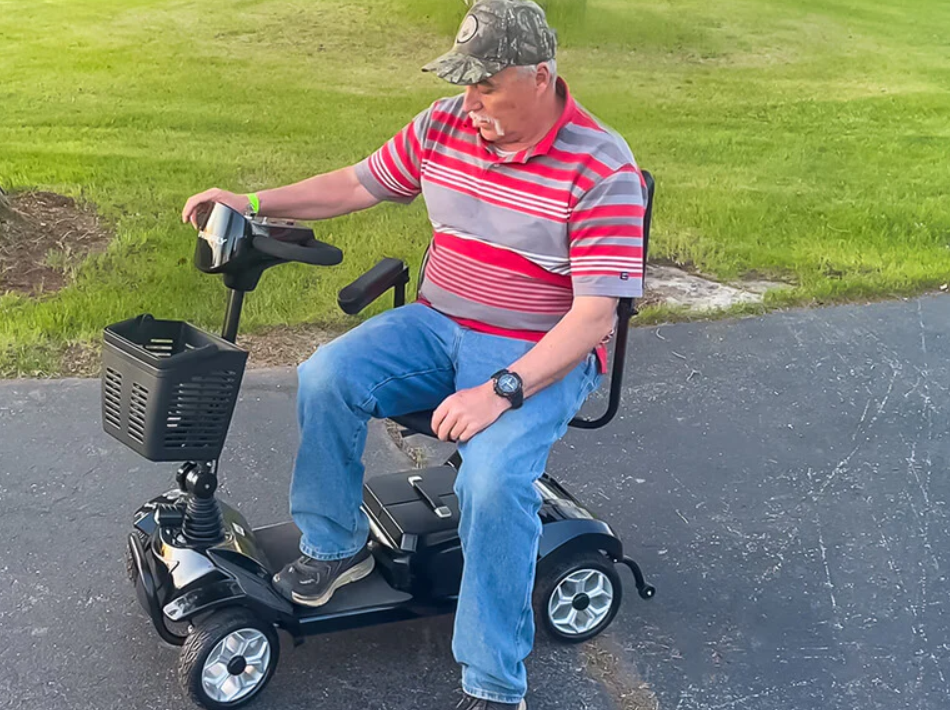
To have safe and efficient rides, one must maintain the proper mobility scooter tire pressure. The proper pressure helps your scooter ride on rough surfaces as well as gives you a good hold on corners or slopes.
Underinflated tires cause friction and battery wastage, whereas overinflated tires result in rough and unstable rides.
Statistics indicate that well-inflated tires may contribute to a battery life of up to 15 percent and a tire life of almost 25 percent more than underinflated tires.
Types of Mobility Scooter Tires and Their Pressure Needs

Scooters typically use pneumatic, foam-filled, or solid tires. Only pneumatic tires require PSI checks.
Pneumatic (Air-Filled) Tires:These are very good in traction and comfort particularly on rugged ground. They should have regular pressure monitoring, approximately 30-45 PSI to avoid slow leakage.
Solid Tires: They are non-maintenance and are hard when they hit bumps. They do not need air, but marginally make comfort and hold on rough surfaces less comfortably and firmly.
Foam-Filled Tires: They imitate the comfort of pneumatic tires but they do not deflate. They are more weighty and need no inflation.
| Tire Type | Air Pressure Needed | Comfort Level | Maintenance | Durability |
| Pneumatic (Air-Filled) | 30-45 PSI | Excellent | Regular | Moderate |
| Foam-Filled | None | Good | Minimal | High |
| Solid | None | Average | None | Very High |
Hoverfly Mobility Scooters mainly use solid tires, which are designed for seniors and riders who prefer worry-free maintenance.
With solid, puncture-proof wheels, there’s no need for air checks, PSI monitoring, or dealing with leaks—making daily use simpler and safer.

How to Check Mobility Scooter Tire Pressure Correctly?
- Use a digital gauge on a cold tire and compare the PSI with your scooter manual.
Find the Tire Valve: There is a small cap on top of which there is a valve stem.
- Install Digital Tire Pressure Gauge: Make sure that the gauge is attached to the valve in case it gives an exact reading in PSI.
- Compare with Manufacturer's Recommendations: Typically found on either the tire sidewall or user manual.
- Check Diligently: Check your tire pressure every week or prior to long rides.
To achieve uniform pressure, it is better to measure the check pressure when the tires have cooled and not right after riding.
What Is the Ideal Tire Pressure Range for Mobility Scooters?
Most scooters stay between 30–45 PSI, with rear tires usually requiring slightly higher pressure.
However, the level of pressure differs with the type of scooter and body weight. Higher PSI might be required for heavier riders to support them.
Note: If your scooter has solid or foam-filled tires, you can ignore PSI—these types of tires don’t need inflation.
| Tire Position | Recommended PSI | Remarks |
| Front Tires | 28-35 PSI | Less weight, low gear handling. |
| Rear Tires | 35-45 PSI | Increased support of weight, improved traction. |
Staying within these scales will enhance performance and also keep your scooter from dragging and bouncing on the ground and not to mention, these limits will improve the performance of your scooter.
What are the Signs of Incorrect Tire Pressure?
Low pressure causes slow performance and fast battery drain; high pressure makes the ride harsh and reduces grip.
If pressure is too low:
- Scooter is tired.
- The battery drains quickly.
- When the tires are parked, they flatten at their bottom.
If pressure is too high:
- The ride is rough and protruding.
- Typically, tires lose their grip, particularly on slopes.
- Inequality in the wearing of treads is observed in the mid-plane.
However, Riders using solid-tire models won’t face low-pressure issues such as flattening or uneven tread wear.
It’s one of the reasons solid tires are popular with seniors who want stability without the hassle of constant checks.
These maintenance-free tires also help lightweight mobility scooter users protect overall performance by avoiding pressure-related wear and reducing long-term mechanical stress.

How Temperature Affects Tire Pressure?
The aspect of temperature is significant in mobility scooter tire pressure. Air is expanded under heat and contracted under cold.
- Hot weather: The pressure rises approximately 1 PSI per 10 deg F.
- Cold conditions: Every 10 deg F of decrease in pressure causes a 1 PSI decrease.
Tools & Devices for Easier Tire Pressure Maintenance
A digital gauge, portable pump, and sealant kit help keep tires consistent and safe.
| Tool | Function | Approx. Price Range |
| Digital Pressure Gauge | Quick, accurate PSI readings | $10-$20 |
| Portable Tire Inflator | Automatic adjustment of pressure. | $25-$50 |
| Hand Pump | Renowned and convenient to carry. | $10-$15 |
| Sealant Kit | Fixes small leaks instantly | $5-$10 |
Accuracy and consistency in the maintenance of your tires are guaranteed by using dependable tools.
How Does Tire Pressure Affect Scooter Battery Efficiency?
Underinflated tires increase rolling resistance, reducing range by up to 20%.
Deflated tires have the effect of raising the rolling resistance, which causes your scooter motor to be more power-hungry. Experiments indicate that tires that are underinflated can decrease the range that is covered by a charge by up to 20%.
Ensuring that your tires are always filled to the right amount also makes your scooter move easily and puts less pressure on the motor, which consequently increases its battery life and efficiency.
Common Tire Pressure Mistakes to Avoid
To ensure stable tire pressure in a mobility scooter, as well as prolong tire life, it is advisable to avoid the following errors:
- The neglect of noticing slack leaks.
- Inflation to the maximum PSI printed on the sidewall rather than the recommended one.
- Forgetting rear tires
- Checking the car tire gauges (which are usually inaccurate in smaller tires)
- Riding on laboriously swollen tires.
Routine helps you to avoid accidents and unnecessary repair expenses.
What Long-Term Habits Help Maintain Stable Tire Pressure?
- Store Indoors: Store should not be exposed to direct sunlight or cold.
- Check Tires Monthly: Tires would naturally lose approximately 1 PSI every month, regardless of whether they are used or not.
- Rotate Tires: Alternate front and rear regularly to evenly wear tires.
- Not to Overload: Use the maximum weight for the scooter as stated in your scooter manual.
- Apply Anti-Leak Sealants: Stops small holes and loss of air.
These tips help both foldable mobility scooter and lightweight mobility scooter users enjoy consistent safety and performance.
When to Replace Your Mobility Scooter Tires?
Replace tires with cracks, bald spots, or repeated air loss—usually every 18–24 months.
- Cracks or bald spots
- Frequent air loss
- Decreased traction or bouncing rides.
- These include superfluous vibrations on smooth surfaces.
Depending on the use, the manufacturers recommend replacement of tires after 18-24 months. This is done through frequent inspection to avoid blowups.

How Often Should You Check Tire Pressure?
You are to check the tire pressure of your mobility scooter:
- Once per week for daily users.
- Every two weeks for the occasional riders.
Check more frequently in cold seasons or in those cases when your scooter is used outside most frequently. It is always a good idea to have a pressure gauge in your scooter bag.
How Does Tire Pressure Affect Ride Comfort?
A significant difference between the smooth and bumpy ride is the noticeable pressure in the tires.
Low Pressure:
- Low Pressure: More comfortable, although the chance of rim damage is high.
- High Pressure Sharper response but harsh comfort.
The optimum PSI provides you with both stability and comfort. Balance pressure makes your scooter light, smooth and easy to maneuver.
Safety Checklist for Tire Pressure Maintenance
Checklist at a glance to ensure that your rides are hustle-free:
- Check PSI weekly.
- Inflation to recommended levels only.
- Keep tires clean.
- Avoid overloading.
- Inspect for leaks or cracks.
- Rotate tires every 3-6 months.
- Carry a pump-up inflator.
Conclusion
The right mobility scooter tire pressure keeps you safe, battery life is saved, and you will have a comfortable ride daily.
Many Hoverfly scooters feature solid, puncture-proof tires, which eliminate the need for air pressure checks.
Still, all riders—whether using pneumatic or solid tires—benefit from routine inspections, clean tires, and timely replacements.
FAQs About Mobility Scooter Tire Pressure
1. What PSI should my mobility scooter tires be?
The majority of the scooters require 30-40 PSI, which varies according to the model and rider weight. Never make a mistake in the number on your reference or tire sidewall.
2. What is the frequency of checking tire pressure?
The best results are twice a week or once a month. Adjust when you find that the rides have changed or the temperatures have changed.
3. Can I use a car tire pump on my scooter?
Yes, however, a pump with an inbuilt gauge should be used to avoid overinflation.
4. Why does my tire lose air overnight?
It can have a slow valve leak or a tiny puncture. Attempt to seal it or change the core of the valve.
5. Do solid or foam tires need pressure checks?
No. Pneumatic tires require no process other than regular checking of air pressure. Foam and solid ones are maintenance-free.




Leave a comment
All comments are moderated before being published.
This site is protected by hCaptcha and the hCaptcha Privacy Policy and Terms of Service apply.