
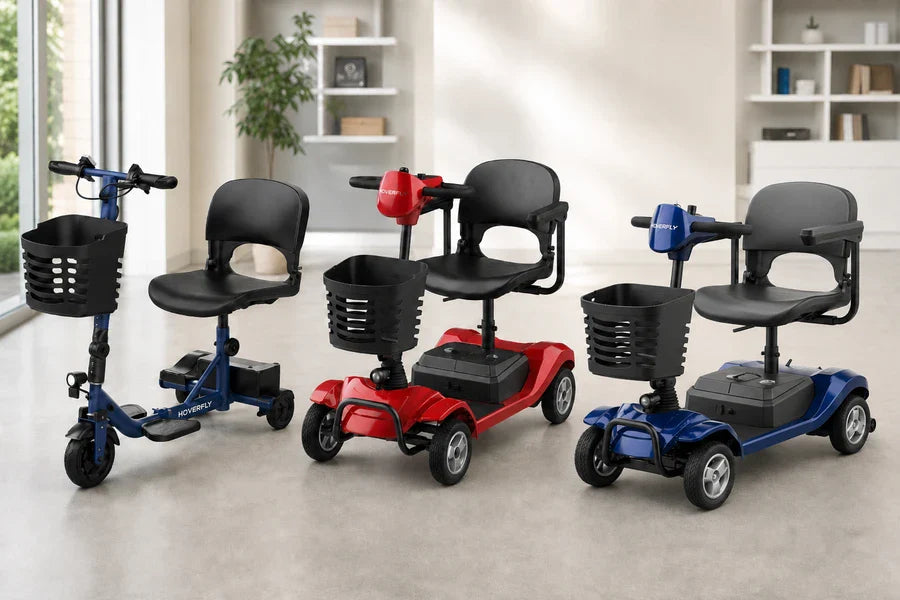
On average, a mobility scooter weighs between 40 and 350 pounds (18 to 158 kg). Lightweight folding travel scooters weigh 40 to 70 lbs, mid-size everyday scooters weigh 90 to 150 lbs, and heavy-duty bariatric models range from 150 to over 350 lbs. Weight matters more than most first-time buyers expect, because it quietly controls everyday tasks like loading the scooter into a car trunk or fitting through a doorway. So choosing the right weight is one of the most practical decisions before buying a scooter.
What a Mobility Scooter Weighs by Category
Mobility scooters fall into three broad categories, and each one sits in a different weight range. Knowing where your needs land is the first step toward picking the right model.
| Category | Total Weight | Heaviest Piece | Rated Rider Capacity | Best For |
|---|---|---|---|---|
| Travel / folding | 40–70 lbs | 25–35 lbs | 250–300 lbs | Flights, cruises, trunks |
| Mid-size 3 or 4 wheel | 90–150 lbs | 40–65 lbs | 300–350 lbs | Daily indoor and outdoor |
| Heavy-duty / bariatric | 150–350 lbs | 70+ lbs | 400–500 lbs | Long range, larger riders |
Travel and folding scooters sit at the lighter end of the range. These models typically weigh 40 to 70 lbs with the battery installed, and many split into pieces under 35 lbs to make car loading easier. As one example, the Hoverfly T5 four-wheel travel scooter weighs 61 lbs total with a 50 lb heaviest piece.
Mid-size scooters bring weight up by adding comfort features. Padded seats, larger wheels, and stronger motors push these models into the 90 to 150 lb band. They handle outdoor errands well, though they no longer slide into a sedan trunk without a ramp or lift.
Heavy-duty mobility scooters cross 150 lbs and reach 350 lbs at the top end. You'll find reinforced frames, larger batteries, and higher rider weight capacities here, sometimes carrying riders up to 500 lbs. Transport almost always requires a vehicle lift or hitch carrier.
What Affects How Much a Mobility Scooter Weighs
Every pound on the scale traces back to a design choice. The next five components account for nearly all of the variation between a 50 lb travel model and a 300 lb heavy-duty unit.
Battery Chemistry and Capacity
Sealed lead-acid batteries weigh roughly twice as much as lithium-ion packs at the same energy level. The extra weight comes with a real safety advantage, since lead-acid chemistry stays stable and avoids the thermal runaway risk that lithium-ion cells can develop when damaged, overcharged, or overheated.
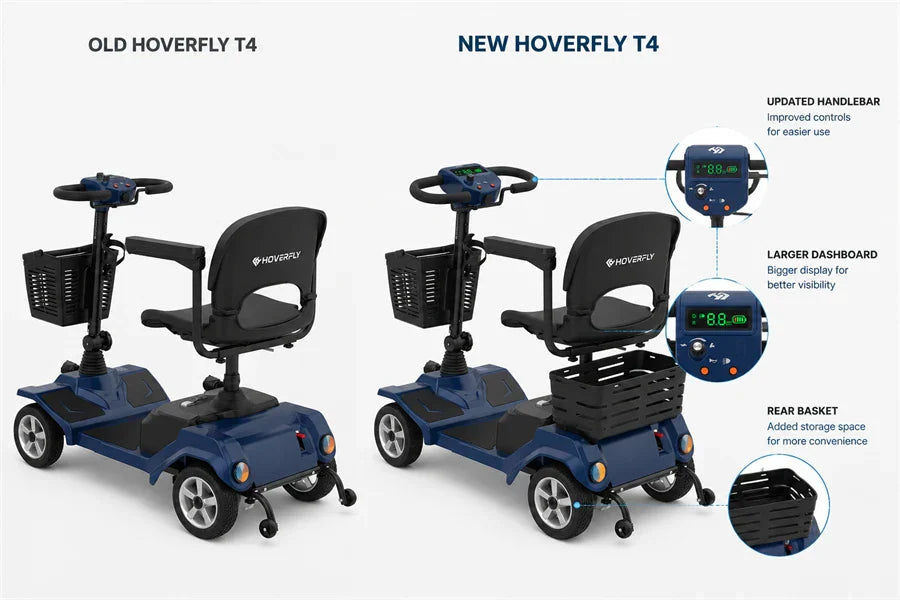
Indoor models like the Hoverfly T4 four-wheel often keep sealed lead-acid for the safety profile and lower replacement cost.

Frame Material
Aluminum dominates the travel category. It saves real weight against an equivalent steel frame at the same size, which is why folding scooters almost always list aluminum on the spec sheet. Steel comes back into play on heavy-duty units because higher load ratings call for thicker tubing, and carbon fiber appears on a small number of premium folders at a higher price.
Motor and Drive System
When you take the scooter onto inclines, curbs, or grass, motor size grows along with the gearbox housing wrapped around it. A single rear-hub motor handles indoor floors and flat pavement with minimal added weight, while dual-drive systems split torque across two motors for better climbing and add noticeable mass to the rear assembly.
Belt drives stay lighter than chain drives at the same output. The drive choice quietly influences your final number on the scale.
Wheels, Tires, and Suspension
Tire choice, wheel size, and suspension design all contribute to the total. Solid foam tires add the least weight and never need inflation, while pneumatic tires roll smoother over uneven pavement but bring extra rubber and tubes onto the frame.
Front and rear suspension assemblies improve comfort over broken sidewalks at the cost of a few extra pounds. Larger wheels found on heavy-duty units add weight to every corner of the chassis.
Seat, Basket, and Other Add-Ons
Comfort features add up quickly. A captain's chair with armrests and a headrest weighs noticeably more than a basic flat seat, and storage baskets, canopies, lighting kits, and rearview mirrors each bring a small amount of their own. The total grows fast when these are ordered as a bundle.
Why the Weight of a Mobility Scooter Matters
You'll feel the weight in four different parts of a normal week. Each one shapes whether the scooter actually fits the routine you have.
Lifting and Vehicle Loading
This is the moment most buyers care about first. A scooter that splits into smaller pieces lets one adult of average strength handle car loading, while a heavier base usually needs a ramp or a second pair of hands. Hitch carriers and trunk lifts remove the lifting problem entirely at the cost of a one-time install on the vehicle, and heavier scooters move best with a van conversion or trailer.

Indoor Maneuvering
Tight corners and narrow doorways favor lighter scooters. In older homes and apartments where hallways run narrow, every pound the scooter loses shows up as easier handling around furniture, kitchen islands, and bathroom entrances.
Stability on Outdoor Surfaces
Heavier frames hold the wheels firmly on broken pavement, ramps, and grass. The added mass lowers the center of gravity and resists tipping during dismounts, which feels safer on slopes and uneven trails. Lighter scooters can feel less planted on the same terrain because the rider's weight shifts more relative to the frame.
Three-wheel models usually weigh slightly less than four-wheel models in the same class, and the 3-wheel scooter benefits article breaks down the maneuverability and stability tradeoffs in more detail.
Battery Range and Performance
Range and weight pull against each other for travel scooters. A heavier scooter draws more current on slopes and starts, though heavy-duty models usually compensate with larger batteries and longer per-charge range. Lighter travel models accept shorter range in exchange for portability, which works well for users who only need short daily loops.
How to Pick the Right Mobility Scooter Weight for Daily Life
The best way to pick a weight is to match the scooter to the part of your week that happens most often. Three common scenarios cover most buyers, and each one lands in a different weight band.
Apartment Living and Neighborhood Errands
If you live in an apartment and the scooter mostly handles indoor moves and short outdoor trips, a model in the 60 to 100 lb range usually fits best.
You need it to clear standard interior doorways, ride inside elevators, and roll smoothly along sidewalks for grocery runs or pharmacy visits. Compact three-wheel models in this band turn tighter in kitchen corners and store aisles. Daily charging on a standard outlet is easy, so range matters less than maneuverability.
All-Day Outdoor Use at Home
If the scooter mostly stays at home and goes outside for several hours each day, the weight can climb without much practical cost. Heavy-duty units in the 200 to 350 lb range bring larger seats, stronger suspension, and pneumatic tires that smooth out gravel paths and grass.
Per-charge range tends to be longer at this size, which covers a full day of park visits or community trails. Plan parking in a garage rather than a closet, and use a vehicle lift if the scooter ever needs to travel.
Mixed Daily Use with Regular Car Loading
Some buyers need indoor comfort and outdoor stability while still loading the scooter into a car a few times a week. Mid-size models with removable batteries fit this pattern well. The Hoverfly T4 weighs around 101 lbs and disassembles into manageable pieces once the battery comes off.
For longer outdoor trips in the same routine, the Hoverfly T3 three-wheel uses an LFP battery for extended range.
FAQ
How much does a folding mobility scooter weigh compared to a standard model?
A folding mobility scooter weighs around 40 to 70 lbs, while a standard mid-size model weighs around 90 to 150 lbs. Folding models trade some range and seat size for portability, which makes them popular for travel and apartment use.
Can I lift a mobility scooter into my car by myself?
It depends on the heaviest piece. If a mobility scooter weighs under 70 lbs total and disassembles into smaller parts, most adults can load it alone. Heavier units usually need a ramp, hitch carrier, or trunk lift for safe loading.
Does a heavier mobility scooter weigh against battery range?
Not in the way you might expect. A heavier mobility scooter weighs more partly because of a larger battery, which usually delivers a longer range per charge.
How much does a mobility scooter weigh after the battery is removed?
Removing the battery drops noticeable weight, since the pack itself is one of the heaviest components on the scooter. Lithium-ion packs are lighter than lead-acid packs of the same energy. Pulling the battery before lifting is one of the fastest ways to reduce the heaviest piece.
How much does the heaviest piece of a mobility scooter weigh after disassembly?
For travel models, the heaviest single piece of a mobility scooter weighs around 25 to 35 lbs once it is broken down. Mid-size scooters reach 40 to 65 lbs at the heaviest piece, while heavy-duty units weigh 70 lbs or more. Removing the battery first drops the heaviest piece further.
Summary
How much a mobility scooter weighs comes down to category, battery, frame, and add-ons. Travel and folding scooters weigh between 40 and 70 lbs and fit airline and trunk constraints. Mid-size scooters land between 90 and 150 lbs and trade some portability for comfort. Heavy-duty units run 150 to 350 lbs for users who need higher capacity or longer range. Lithium-ion batteries weigh much less than lead-acid batteries at the same energy, and FAA rules cap installed batteries at 300 watt-hours per battery for flight. The right weight is the one that matches how you move, where you store, and how often you travel.



Leave a comment
All comments are moderated before being published.
This site is protected by hCaptcha and the hCaptcha Privacy Policy and Terms of Service apply.