
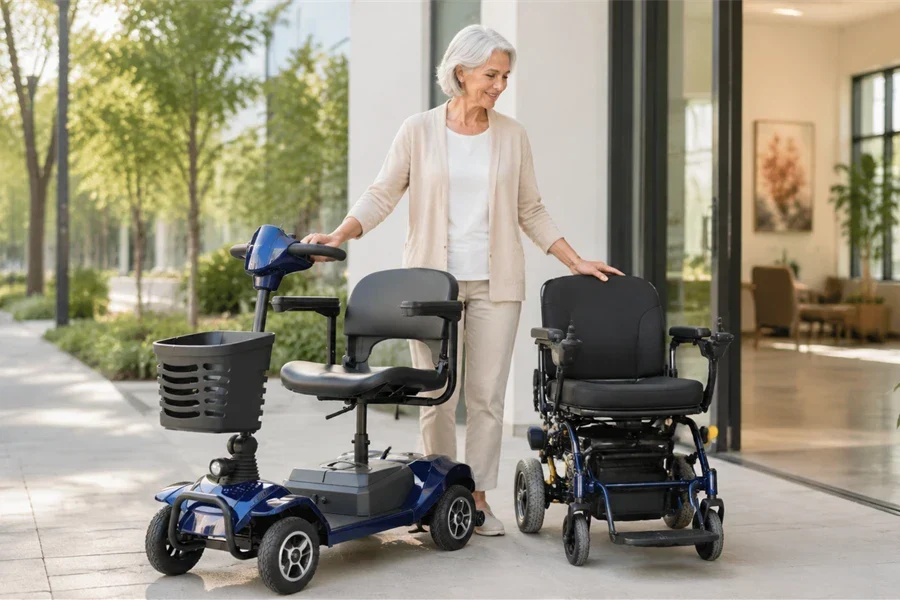
What specific obstacle is limiting your daily movement? If walking long distances is the main problem, a scooter can make errands, travel, and outdoor trips easier. If sitting support, tight indoor movement, or limited upper-body control is the bigger issue, a power wheelchair may offer more independence. This guide compares both options side by side so you can choose the device that fits your body, home, and daily routine.
Handicap Scooter vs Wheelchair at a Glance
Both devices are battery-powered seated mobility aids. What separates them is how you steer, how many wheels carry you, and which body the engineering was built around.
| Feature | Handicap Scooter | Power Wheelchair |
|---|---|---|
| Control | Tiller and handlebars, two-handed | Joystick, one-handed |
| Wheels | 3 or 4 | 4 to 6 |
| Typical top speed | 3.7 to 5 mph | 4 to 6 mph, some up to 8 to 10 mph |
| Turning radius | Wider, 4 to 5 feet | Tight, often zero-turn |
| Best environment | Outdoors and open indoor spaces | Indoors and tight spaces |
| Required user ability | Can transfer, sit upright, and use both hands | Minimal physical effort needed |
| Portability | Many fold or split into pieces | Heavier, less travel-friendly |
| Typical price range | $600 to $5,000 | $1,500 to $15,000 or more |
Price ranges based on consumer market data from Disabled World.
What Is a Handicap Scooter?
A handicap scooter, more commonly called a mobility scooter, is a battery-powered device with 3 or 4 wheels, a seat, and handlebar-style steering. It is usually best for people who can sit upright, transfer safely, and use both hands to steer.
What Is a Power Wheelchair?
A power wheelchair is a battery-powered wheelchair controlled by a joystick. It is usually better for people who need stronger seated support, tighter indoor movement, or easier one-handed control.
Where Each Device Wins, and Where It Doesn't
The biggest difference between the two devices is the physical control, seated support, and indoor precision that the user needs.
A mobility scooter is usually the better choice for people whose main challenge is limited walking distance. It is also the more travel-friendly option. Many scooters fold or disassemble, so they are easier to store at home or load into a car. The trade-off is tight-space control. Because a scooter uses a tiller and a longer front frame, it usually needs more room to turn.
A power wheelchair is usually the better choice for users who need stronger seated support or want to reduce physical effort. The joystick can often be used with one hand, and the chair can turn in a much smaller space than a scooter, which helps in small homes or tight rooms. The trade-off is transport and cost. Power wheelchairs are usually heavier, more expensive, and harder to move without a ramp, lift, or accessible vehicle.
In simple terms, choose a scooter when distance is the main problem, and the user has good sitting balance and hand control. Choose a power wheelchair when support, precision, or lower physical effort matters more than portability.
Who Should Choose a Handicap Scooter?
Based on our team's years of experience in developing electric mobility vehicles, we have identified the following three groups of people who are most suitable for using such vehicles.
The first is that walking distance is the whole problem. You manage fine at home, but a grocery aisle or an airport terminal leaves you sore and unsteady before you arrive. In this situation, the convenience and comfort of the scooter are of great importance. The Hoverfly T4 4-Wheel Mobility Scooter is heavily optimized for this lifestyle. It features a height-adjustable swivel seat that rotates to let you step off safely, alongside a lightweight paddle throttle designed so that stiff or arthritic hands don't have to fight tension all day.
Note: Built with a heavy-duty 24V 12Ah lead-acid battery system, the T4 prioritizes robust outdoor stability and cost-efficiency over airline transport.
 The second is when the device has to travel with you. Cruises, road trips, flights to see family — here, portability outranks speed, range, even comfort.
This is the use case our design team spent the most time on. Travelers kept telling us the same thing: the scooter that works at home is too heavy to lift into a car trunk alone. So we built the Hoverfly T3 folding 3-wheel scooter to come apart into three pieces — a 1.8 lb basket, an 8.3 lb seat, leaving the ultra-compact frame simple to fold down flat for a cruise cabin or trunk. Plus, its internal, non-removable battery design keeps the electronics fully protected from the wear and tear of frequent travel The third situation is temporary mobility loss: recovering from knee or hip replacement, healing after a fall, or getting through a season of arthritis flare-ups. For months-long support, a mobility scooter is practical, affordable, and easy to move in and out of daily life. Use it while you need it, then store it, resell it, or pass it on.
Who Should Choose a Power Wheelchair?
 A power wheelchair is especially suitable in these three situations:
First, it is needed for long periods of sitting. If someone relies on a wheelchair for most of the day, seat support becomes especially important, including back support, pressure relief, tilt, and recline functions.
Second, for homes with limited indoor space. Small apartments, older homes, or rooms where furniture cannot easily be moved often require a power wheelchair that can turn in place and move with precision.
Third, if the physical condition is complex or may continue to change. For conditions such as poor trunk control, paralysis, or other illnesses that seriously affect daily independence, a power wheelchair can provide the support needed for everyday life.
How to Test Before You Buy
Buying a mobility device should start with a careful fit check. First, compare the scooter or power wheelchair dimensions with your real environment. Such as car trunk space or storage area.
Next, assess your physical condition. For example, can you safely sit and get in and out of the seat? Is it easy to control the steering wheel with both hands? If you mainly use it outdoors, you should also focus on the device's stability, braking performance, hill-climbing ability, and range.
The most reliable way to guarantee a correct fit is through an Occupational Therapy (OT) assessment. An OT will professionally evaluate your upper-body strength, range of motion, transfer ability, home layout, and daily routines, then recommend the type of mobility device that may fit your needs. If you plan to seek insurance coverage, check with your physician, OT, or mobility equipment supplier first, because Medicare and private insurers may require specific medical documentation before approving a scooter or power wheelchair. Learn more about what occupational therapists do from the American Occupational Therapy Association.
Conclusion
So, handicap scooter vs wheelchair, which gives more independence? It depends on the type of support needed.
A handicap scooter is a good fit for people who can sit upright, transfer safely, use both hands, and mainly need help with longer distances, errands, travel, or outdoor movement.
A power wheelchair is better suited for people who need stronger seating support, have limited upper-body control, spend most of the day seated, or move mostly in tight indoor spaces.
FAQs
What is the difference between a handicap scooter and a wheelchair?
A handicap scooter is better for distance, while a power wheelchair is better for support and tight control. A scooter uses tiller steering and usually needs both hands; a power wheelchair uses a joystick and is easier to maneuver indoors.
Which is better for seniors, a mobility scooter or a power wheelchair?
A mobility scooter is better for active seniors who mainly need help with longer distances. A power wheelchair is better for seniors who need more seated support, have limited arm strength, or move mostly indoors.
How long do mobility scooter batteries last?
Most mobility scooter batteries last about 1 to 3 years. Lithium batteries usually last longer and weigh less, while lead-acid batteries cost less but are heavier. Either way, how you charge and store the battery decides how close you get to the upper end of that lifespan.
Is a 3-wheel or 4-wheel mobility scooter better?
A 3-wheel scooter is better for tighter turns, while a 4-wheel scooter is better for stability. Choose 3 wheels for easier indoor movement and 4 wheels for outdoor paths or uneven ground.
How much does a mobility scooter cost compared to a power wheelchair?
Mobility scooters usually cost less than power wheelchairs. Scooters typically range from $600 to $5,000, while power wheelchairs often range from $1,500 to $15,000 or more.
This article is informational and is not medical advice. Talk to a physician or licensed occupational therapist before purchasing a mobility device.
Last updated: May 2026. Reviewed by the Hoverfly content team.



Leave a comment
All comments are moderated before being published.
This site is protected by hCaptcha and the hCaptcha Privacy Policy and Terms of Service apply.