
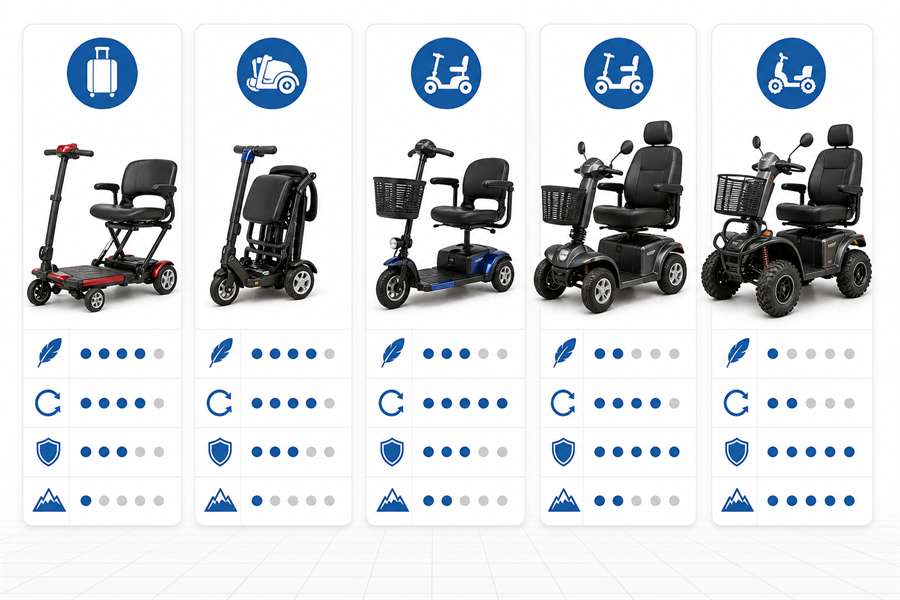
The right mobility scooter is the one matched to your daily routes, your body weight, and how often you fold or transport it. A mobility scooter is a battery-powered personal vehicle designed to help adults with limited walking ability get around indoors and outdoors. It runs on rechargeable batteries and is steered with a tiller, which houses the throttle, brake controls, and a dashboard for monitoring speed and battery level.
These scooters are well-suited for seniors, individuals recovering from surgery or injury, and adults living with conditions that affect walking distance or balance. According to the CDC, 12.2% of US adults live with a mobility disability involving serious difficulty walking or climbing stairs, and the right type of scooter can restore much of that lost daily independence.
The Five Main Types of Mobility Scooters
The table below summarizes the typical specifications and best-use scenarios for each category, giving you a fast way to narrow down options before reading the details.
|
Type |
Typical Weight Capacity |
Range per Charge |
Best For |
|
Travel |
250–300 lbs |
8–12 miles |
Air travel, errands, and car trunks |
|
Folding |
250–300 lbs |
8–12 miles |
Apartments, tight storage |
|
Three-Wheel |
250–350 lbs |
10–20 miles |
Indoor turns, narrow aisles |
|
Four-Wheel |
330–500 lbs |
12–25 miles |
Outdoor use, slopes, sidewalks |
|
All-Terrain |
400–500+ lbs |
15–30 miles |
Grass, gravel, hills |
Travel Scooters
Anyone who needs to load a scooter into a car trunk or check it on a plane will look at travel scooters first. They break down into 4 or 5 manageable pieces, and no single component weighs more than about 35 pounds.
The frame uses lightweight aluminum, while the tiller and battery often detach for easier lifting. Most carry up to 300 pounds and cover 8 to 12 miles per charge. Top speed sits near 4 mph.
They suit retirees who fly often and infrequent users who value storage compactness, though the trade-off is a less padded seat and minimal suspension compared with full-size models.
Folding Scooters
Folding scooters collapse in one motion instead of breaking into separate parts. Many newer models use a remote control or one-touch lever, which suits riders with arthritis or weaker grip strength.
Its frame weight typically runs 50 to 65 pounds, and the battery is usually built into the frame to keep the fold compact. Carry capacity sits around 250 to 300 pounds, and range matches the travel category at 8 to 12 miles per charge.

Three-Wheel Scooters
Three-wheel scooters are perfect for indoor use, offering a much tighter turning radius than four-wheel models. Plus, the single front wheel clears up extra legroom, giving taller riders a more comfortable fit.
The trade-off is stability, since the three-wheel base tips more easily on slopes or uneven curbs. They generally work best for indoor-dominant riders or those on smooth, level pavement.
Four-Wheel Scooters
Two wheels at each end give four-wheel scooters their stability advantage. The wider stance handles slopes, curb cuts, and outdoor sidewalks far better than a three-wheel design, which is why most outdoor-focused buyers settle on this layout.
Frames tend to be heavier and longer overall, with reinforced steel sections at the chassis to support higher weight loads. Top speeds usually range between 4 and 8 mph, and weight capacity often reaches 330 to 500 pounds.
A typical full-size four-wheel scooter covers 12 to 25 miles per charge. Active seniors, outdoor errand-runners, and adults who feel uneasy on slopes favor it the most. They are less agile in tight indoor spaces, which is the main reason apartment dwellers often choose three-wheel models instead.
All-Terrain and Heavy-Duty Scooters
Built for grass, gravel, and uneven trails, all-terrain models feature higher ground clearance, larger pneumatic tires, advanced suspension, and stronger motors. Heavy-duty variants overlap with this category and usually carry users up to 400 to 500+ pounds, with reinforced frames built for daily outdoor use.
Main Components of a Mobility Scooter
Two scooters at the same price can ride very differently because of how their parts are designed. Each component below directly shapes range, comfort, and long-term reliability.
Battery
The battery is the most important component for daily reliability. Sealed lead-acid batteries are heavier and slower to charge, while lithium-ion batteries weigh less, charge faster, and last longer per cycle.
Charging habits and storage temperature have a major impact on lifespan, and a scooter left at low charge for weeks will lose capacity far faster than one kept properly maintained.
Motor and Drive System
Top speed, hill-climbing ability, and slope response all come from the motor. Most consumer scooters use 200W to 350W motors, with all-terrain and heavy-duty models reaching higher wattage. Rear-wheel drive setups offer better outdoor traction and weight capacity, while front-wheel drive handles indoor turns and tight corners more easily.
Tiller and Controls
The tiller is the steering column in front of the rider. It houses the throttle, brake, indicator lights, and battery gauge. An adjustable tiller matters for taller users or for shared household use.
Wheels and Tires
Wheel size usually runs between 8 and 12 inches in diameter. Larger wheels handle bumps and curb edges better, while smaller wheels suit indoor navigation. Pneumatic tires deliver a softer outdoor ride and absorb shock. Solid or flat-free tires, in contrast, eliminate puncture risk and need almost no maintenance.
Seat and Suspension
Comfort on rides longer than about 15 minutes depends heavily on seat width, padding, and adjustability. Swivel seats make boarding and dismounting easier for riders with hip or knee issues. Front and rear suspension come standard on full-size and all-terrain models.
Frame and Chassis
Everything else is mounted to the frame. Aluminum frames keep weight low for folding and travel scooters, while steel frames give heavy-duty models the strength to support higher weight capacities and tow accessories.
Ground clearance and wheelbase length, both shaped by frame design, directly affect curb-crossing ability and turning radius.
How to Choose the Right Mobility Scooter for Your Routine
The simplest way to narrow your choice is to think about where you actually ride on a typical week. The scenarios below cover the most common situations and the type of scooter that fits each.
Tight Indoor Spaces and Small Apartments
Apartment dwellers, condo residents, and seniors with limited storage often need a scooter that turns sharply and parks easily. A three-wheel folding model works well for indoor routes, and the Hoverfly T3 3-wheel scooter fits this scenario thanks to its 60 lb total weight, foldable frame, and tight turning radius for kitchen and hallway use.

Daily Outdoor Errands and Neighborhood Walks
Outdoor errands at grocery stores, sidewalks, and neighborhood parks call for the wider stance of a four-wheel model. Stability on curb cuts and uneven pavement matters far more than turn radius here.
The Hoverfly T4 4-wheel mobility scooter is a good choice with a 12.4-mile range, a 330 lb capacity, and an anti-tip system for secure stops.
Mixed Indoor and Outdoor Daily Use
When your routes include both indoor and outdoor segments, a compact four-wheel scooter usually offers the best balance. It holds stability on sidewalks and ramps while still managing most household doorways and tight turns.
Riders who lean more toward indoor use can pick a mid-size three-wheel model instead, which trades a bit of outdoor stability for a tighter turning radius.
Frequent Travel and Family Trips
Portability becomes the deciding factor for shoppers who travel by car, train, or plane. A folding or travel scooter that breaks down into trunk-friendly pieces makes a real difference on the road.
But air travel adds another layer of battery rules; you should verify the relevant rules before booking.
Larger Riders and Rough Terrain
Heavier riders or those who ride on grass, gravel, or hilly streets need an all-terrain frame with stronger motor torque, suspension, and higher ground clearance. The Hoverfly T5 mobility scooter handles this scenario well, with a 350W motor, all-terrain tires, and a detachable battery for easier handling.
For shoppers who want to compare more options at this size, the all-terrain mobility scooter collection groups available models by power, range, and weight capacity.
New Users and First-Time Buyers
Many first-time buyers are seniors or family members shopping for a parent. Ease of operation, simple controls, and reliable customer support matter as much as raw specs.
A lightweight folding scooter or compact three-wheel model is usually the easiest entry point. The lower top speed, simpler steering, and lighter frame all reduce the learning curve for someone riding a scooter for the first time.
FAQs
What is a mobility scooter?
A mobility scooter is a battery-powered personal vehicle for adults with limited walking ability. It has a seat, a tiller for steering, and three or four wheels for stability.
Who should use a mobility scooter?
Seniors, individuals recovering from surgery, and adults with walking limits benefit most. A doctor or physical therapist can confirm whether a mobility scooter or a wheelchair fits your needs better.
How many types of mobility scooters are there?
Five main types cover most needs. Travel and folding scooters lead in portability. Three-wheel scooters turn tighter indoors, four-wheel scooters offer outdoor stability, and all-terrain scooters handle grass, gravel, and hills.
What is the difference between 3-wheel and 4-wheel mobility scooters?
Three-wheel scooters turn more tightly and give riders more legroom, which suits indoor use. Four-wheel scooters use a wider base for better balance on slopes and outdoor surfaces.
How long does a mobility scooter battery last?
A full charge typically powers 8 to 25 miles, depending on battery type, rider weight, and terrain. The pack itself lasts 1 to 3 years for sealed lead-acid and 3 to 5 years for lithium-ion.
Can mobility scooters handle grass or uneven ground?
All-terrain and heavy-duty models can. Travel and folding scooters are designed for smooth pavement only, and rough surfaces will reduce both their range and lifespan.
Summary
Choosing among the five mobility scooter categories starts with how and where you ride most often. Travel and folding models win on portability. Three-wheel scooters suit indoor agility, while four-wheel and all-terrain models offer outdoor stability and longer range. Matching component choices, including battery type, motor power, wheel design, and frame strength, to your everyday routes is what separates a good purchase from a regretted one.
Sources & References
CDC, Disability Impacts All of Us infographic (2024)




Leave a comment
All comments are moderated before being published.
This site is protected by hCaptcha and the hCaptcha Privacy Policy and Terms of Service apply.