
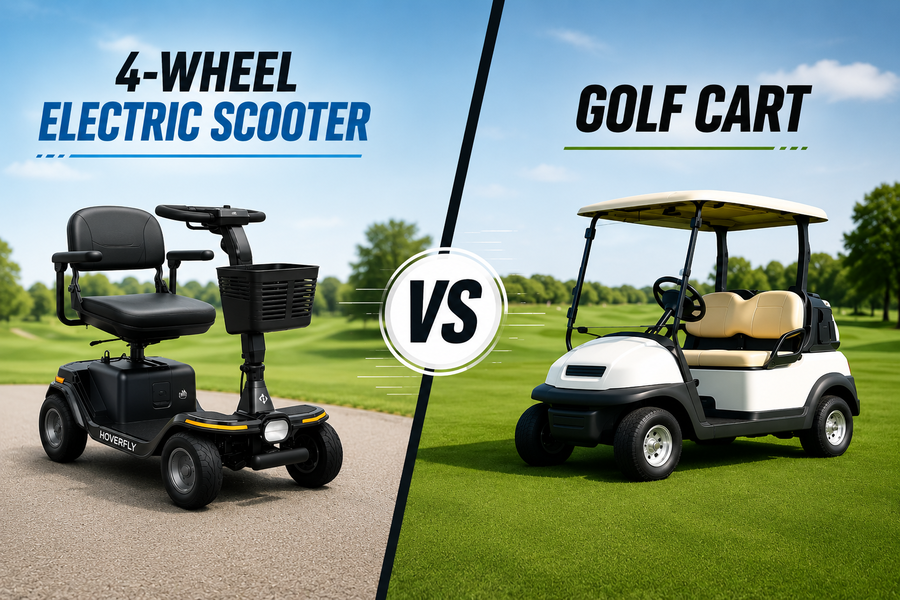
A 4-wheel electric scooter is best for affordable everyday mobility, solo errands, and easy parking in retirement communities. A golf cart is better for multiple passengers, cargo, regular golfing, and approved community-road use.
For active adults in retirement villages, getting around the clubhouse, mailbox, and grocery store without a car is a daily question. Many residents assume the answer is a $12,000 golf cart, then regret the cost, the garage space, and the registration paperwork. Research published in the National Library of Medicine confirms that powered mobility devices are a fast-growing solution that helps older adults stay independent after they stop driving. For most one- or two-person trips, a 4-wheel electric scooter wins on cost, parking, and flexibility. This guide compares both vehicles on price, regulations, range, and stability so you can choose the right fit.
What Is a 4-Wheel Electric Scooter?
A 4-wheel electric scooter is a battery-powered, single-rider vehicle with tiller steering and four wheels arranged in a wide base for stability. The wider footprint lowers tip risk on uneven sidewalks and makes the scooter easier to steer at slow speeds, which matters most when you are turning into a doorway or rolling over a curb cut.
Typical specs
- Speed: 3.7 to 15 mph
- Range: 12 to 40 miles per charge
- Weight capacity: 300 to 500 lb
- Price: roughly $480 to $6,500
- Charging: standard 110V wall outlet
For broader context on configurations, see our mobility scooter buying guide for 2026.

What Is a Golf Cart?
A golf cart is a small motor vehicle, typically with two to four seats, designed for golf courses and short community trips. Modern street-legal versions, known as low-speed vehicles, add headlamps, mirrors, and seat belts so they can operate on certain public roads.
Typical specs
- Speed: 12 to 25 mph (LSV*)
- Range: 25 to 40 miles
- Price: roughly $8,000 to $18,000 for a street-legal LSV* (industry pricing range, 2026)
- Charging: dedicated 110V or 220V circuit
*LSV: Low-Speed Vehicle

Side-by-Side Comparison
| Factor | 4-Wheel Electric Scooter | Golf Cart (Street-Legal LSV) |
|---|---|---|
| Upfront cost | ~$480–$6,500 | ~$8,000–$18,000 |
| Top speed | 3.7–15 mph | 12–25 mph |
| Range per charge | 12–40 miles | 25–40 miles |
| Weight capacity | 300–500 lb | 600–1,200 lb |
| Garage footprint | ~4 × 2 ft | ~8 × 4 ft |
| License required | Usually no | Yes (LSV) |
| Registration & insurance | Usually no | Yes (LSV) |
| Sidewalk & indoor access | Yes | No |
| Charging | Standard wall outlet | Dedicated circuit |
Sources: FMVSS 500; Florida Statute §316.003; ADA Title III regulations.
Cost Breakdown
A 4-wheel electric scooter saves most community residents thousands of dollars over the life of the vehicle. The savings come from four places.
- Lower purchase price. A reliable everyday 4-wheel scooter starts under $1,000. A street-legal golf cart begins around $8,000.
- No registration or LSV insurance. Most U.S. states do not require these for mobility scooters used on sidewalks or private community roads.
- Standard wall-outlet charging. No electrician visit needed.
- Lower maintenance. Smaller motor, fewer moving parts, and no tire-pressure upkeep on flat-free PU tires.
Stacked together, these four savings often mean the difference between a one-time $500 purchase and a multi-year $10,000-plus commitment that includes registration renewals and insurance premiums. For a deeper look at total ownership costs, our electric scooters for adults guide also covers everyday-related savings.
Parking and Storage in a Real Home
A 4-wheel electric scooter fits where a golf cart cannot. A typical scooter occupies about 4 × 2 ft. Many models, including those covered in this portable mobility scooter comparison in 2026, break into four pieces and fit in an SUV trunk. That portability matters for residents who want to bring a scooter on road trips, cruises, or visits to family without renting one at the destination.
A golf cart needs roughly 8 × 4 ft, which often forces residents into a 2-car garage or a dedicated parking pad. Some HOAs also cap the number of carts per household, so a second vehicle for a spouse may not even be permitted under community rules.
Where Each Vehicle Can Actually Go
The scooter wins on access. The cart wins on cargo and passengers.
- 4-wheel scooter: sidewalks, grocery aisles, doctor's offices, indoor clubhouses, and elevators. Protected by the ADA.
- Golf cart: golf carts and LSVs are regulated differently. A street-legal LSV may be allowed on roads with posted speed limits up to 35 mph, depending on state/local law. A non-LSV golf cart is usually limited to golf courses, private/community roads, or specifically designated public roads.
Rule of thumb: pick the scooter for solo or two-person errands. Pick the cart for groups and golf bags.
Regulations to Check Before You Buy
Rules vary by state and HOA, so always confirm before purchase. A few baseline points:
- Golf carts are typically defined by state vehicle codes. Florida, for example, requires headlamps, brake lamps, mirrors, seat belts, and a valid driver license for LSVs (Florida Statute §320.01(41)).
- Mobility scooters are generally exempt from registration and license rules under the ADA's definition of mobility devices.
- Community CC&Rs can add further restrictions on either vehicle.
A quick call to your HOA management office takes five minutes and prevents costly returns. Ask specifically about cart speed limits, designated paths, overnight parking rules, and whether the community recognizes mobility scooters as protected medical devices.
Safety, Comfort, and Independence
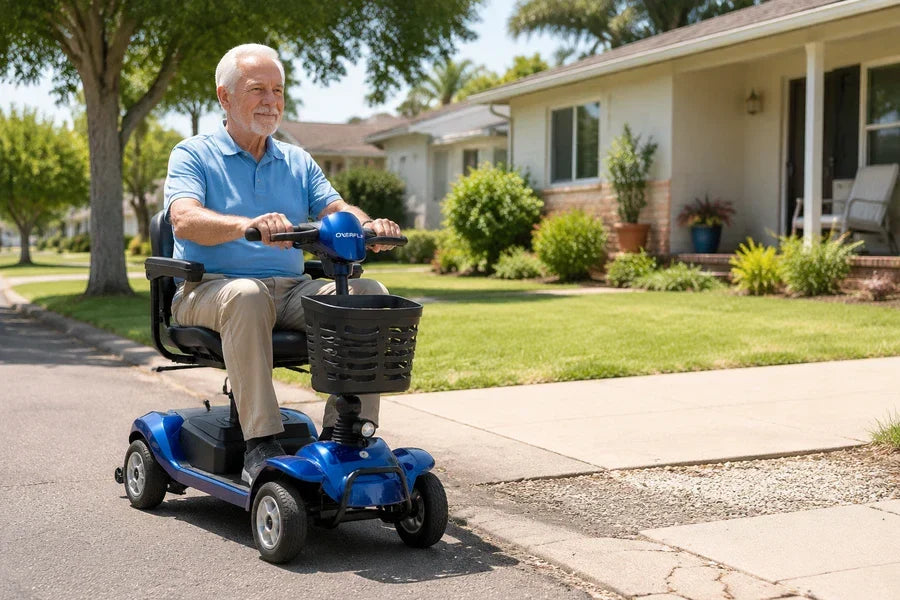
Four-wheel scooters are designed for stability. The wide base reduces tip risk on uneven sidewalks compared with 3-wheel models, as explained in this 3-wheel vs 4-wheel electric scooter overview.
Independence outcomes are also measurable. A peer-reviewed study published in Disability and Rehabilitation: Assistive Technology found that older adults using mobility scooters report improved quality of life, greater social engagement, and stronger feelings of autonomy. A research agenda paper in the National Library of Medicine (PMC7425546) reached the same conclusion: powered mobility devices help residents stay active after they stop driving.
A golf cart cannot match this for a solo user. Its bench seat sits higher, has no swivel, and requires stepping in and out without armrest support.
Why a Hoverfly 4-Wheel Electric Scooter Wins
For most retirement community trips, a 4-wheel electric scooter is the better fit. The Hoverfly T4 4-wheel electric mobility scooter maps directly to the five buyer worries above.
| Buyer Worry | How the Hoverfly T4 Solves It |
|---|---|
| Cost | $484.49 sale price (under 10% of a street-legal LSV golf cart) |
| Parking & storage | Folds to 41.1 × 20 × 16.7 in, splits into 4 pieces, fits a car trunk |
| Charging | Powered by a highly dependable 24V 12Ah Lead-Acid Battery that charges safely via any standard wall outlet in ~6 hours. |
| Range | Up to 12.4 miles per charge |
| Stability | Anti-tip rear wheels, E-brake, swivel seat |
Best for: daily errands, clubhouse visits, grocery runs, mailbox trips, and short loops with a spouse or friend.
Need more range or off-pavement capability for grass and gravel routes? Step up to the Hoverfly T5 FDA-cleared premium mobility scooter, with a 16.8-mile range, 350W motor, double shock absorption, and a 15Ah LFP battery.
Both are designed in the USA and ship with a 30-day return and 1-year warranty.
Quick Decision Guide
| Use Case | Best Vehicle | Why |
|---|---|---|
| Daily errands and clubhouse visits with a spouse | 4-wheel electric scooter | Lower cost, single-car garage fit, no license required |
| Weekly golf and group rides | Street-legal golf cart | More seats, faster speed, road-legal in many states |
FAQs
Is a 4-wheel electric scooter cheaper than a golf cart?
Yes. A reliable 4-wheel scooter starts under $1,000, while a street-legal LSV golf cart starts near $8,000.
Can I drive a 4-wheel electric scooter on the road or sidewalk?
Sidewalks and indoor public spaces, yes, under ADA rules. Public roads, usually no. State and local rules vary, so confirm before riding.
Do I need a license, registration, or insurance for a 4-wheel electric scooter?
In most U.S. states, no. Mobility scooters are not classified as motor vehicles. Always check your state DMV.
Will it fit in my garage and charge from a standard outlet?
Yes. Most 4-wheel scooters, including the Hoverfly T4, charge from a standard 110V outlet and fold to fit a single-car garage.
Can a 4-wheel scooter handle grass, gravel, and hills like a golf cart?
Heavy-duty 4-wheel models equipped with solid tires and suspension can easily handle short, dry grass, packed gravel, and inclines up to 10°. Steep off-road terrain is still better suited to a golf cart.
References
- U.S. Access Board. ADA Standards, Chapter 3.
- U.S. Department of Justice. ADA Title III Regulations and Other Power-Driven Mobility Devices.
- U.S. National Highway Traffic Safety Administration. FMVSS 500: Low-Speed Vehicles, 49 CFR §571.500.
- Florida Legislature. Florida Statute §316.003 (Definitions) and §320.01.
- Underwriters Laboratories. UL 2272: Standard for Electrical Systems for Personal E-Mobility Devices.
- Thoreau, R. (2018). Perception of needing and using a mobility scooter. Disability and Rehabilitation: Assistive Technology, PubMed 30044686.
- Isaacson, M. (2020). Mobility scooters in urban environments. National Library of Medicine, PMC7425546.
- Isaacson, M., et al. (2020). Mobility scooters in urban environments: A research agenda. Journal of Transport & Health, National Library of Medicine, PMC7425546.




Leave a comment
All comments are moderated before being published.
This site is protected by hCaptcha and the hCaptcha Privacy Policy and Terms of Service apply.