
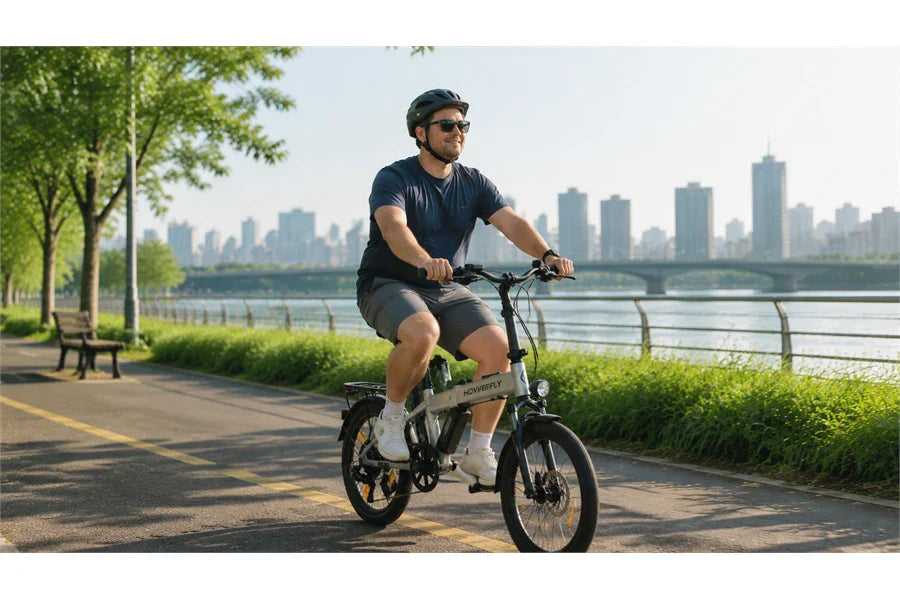
Cycling can reduce belly fat. Regular rides burn calories, lower your overall body fat, and trim your waistline as a result. You cannot target one area,so the trick is consistency, not intensity. For heavier riders, seniors, and absolute beginners, an electric bike (e-bike) is the ultimate gateway. The Pedal-Assist System (PAS) takes the agonizing sting out of steep hills and long commutes, so you actually ride often enough to see results.
This guide walks through whether cycling really burns belly fat, how regular bikes and e-bikes compare, real-world stories from heavier riders, how often to ride, the diet basics that actually move the needle, and how to pick the right electric bike for fat loss.
Can Cycling Really Burn Belly Fat?

Yes — cycling burns belly fat by lowering your overall body fat percentage. As total body fat drops, belly fat drops with it. Spot reduction (like doing hundreds of crunches) is a fitness myth. Cycling solves the problem hormonally and metabolically: you burn more calories than you consume, maintain a caloric deficit, and your waistline naturally tightens.
Here's what's happening under the hood during a steady ride:
- Your heart rate climbs into the moderate-intensity zone, roughly 60 to 70 percent of your maximum.
- Your body shifts toward burning fat as its main fuel — a process called fat oxidation.
- With consistent riding, your basal metabolic rate creeps up, so you burn more calories even at rest.
- Visceral fat, the deep abdominal fat tied to heart disease and type 2 diabetes, becomes increasingly available for energy.
A 2024 study of 11 recreational cyclists aged 50 to 66, published in the American Journal of Physiology and highlighted by news-medical.net, found that one week of intensive cycling produced a 14.6% drop in visceral fat even when participants ate more to match their energy output. That's why steady rides of 45 to 60 minutes are so effective for beginners — they keep you in the fat-burning zone long enough to make a real dent.
Regular Bikes vs. E-Bikes: Which Burns Belly Fat Faster?

This is the common misconception that most beginners fall into. Their intuition is that riding an ordinary bicycle will inevitably consume more fat because it is more difficult to ride. But the real situation is often the opposite.
The exercise that burns the most belly fat is the one you keep doing. Hills, sore knees, and long routes home are what stop most beginners. A traditional bike rewards you for being already fit; an e-bike meets you where you are.
Research backs this up. A BikeRadar review of e-bike fitness studies notes that e-bike riders take longer trips and log more weekly saddle time than traditional cyclists, which means more total calories burned over the week — even at lower per-minute intensity.
And pedal assist reduces your burden. Your heart rate still climbs into the fat-burning zone, your legs still work, and your body still uses fat for fuel.
How Heavier Riders Are Losing Weight on E-Bikes

If you weigh more than 220 pounds, traditional cycling can feel discouraging. Standard bikes have weight limits around 275–300 pounds. Hills become walls. Long rides become impossible. An e-bike changes that math.
Take the story of Marc Edwards, a former IT professional who weighed 365 pounds when he first climbed onto an e-bike. He started commuting 25 miles to work on it. One year later, he had logged nearly 16,000 miles and dropped 174 pounds on the bike alone. His total weight loss across his journey reached 239 pounds. Marc has shared his story publicly, and while diet and surgery played roles, he credits the e-bike for making daily exercise possible when traditional cycling was out of reach.
Pair Your Riding With Smart Eating
You cannot out-ride a bad diet. A 45-minute moderate ride burns roughly 300 to 500 calories — about one large bagel with cream cheese. If your eating is off, the bike will not save you.
The good news: you don't need a complicated meal plan. The basics are enough for most beginners.
- Aim for a small calorie deficit. The CDC recommends losing 1 to 2 pounds per week, which works out to a deficit of 500 to 1,000 calories per day across food and exercise combined.
- Get enough protein. The American College of Sports Medicine and Academy of Nutrition and Dietetics recommend 1.2 to 2.0 grams of protein per kilogram of body weight for active adults. Protein protects muscle while you lose fat and keeps you full between meals.
- Increase dietary fiber. Vegetables, beans, and whole grains keep you full on fewer calories. They also feed gut microbiome bacteria linked to lower visceral fat.
- Drink water before you snack. Mild dehydration after a ride often feels like hunger. A glass of water and ten minutes usually settles it.
- Don't drink your calories. Sugary drinks, sweetened coffees, and alcohol are the fastest way to undo a week of riding.

How Often Should You Ride?
The World Health Organization recommends 150 minutes of moderate-intensity activity per week for adults. That works out to about 30 minutes a day, five days a week, or three longer rides of 50 minutes each. For belly fat specifically, aim a bit higher.
A reasonable progression for beginners on an e-bike:
- Weeks 1–2: Three rides of 20 to 30 minutes at a comfortable pedal-assist level. Focus on getting your saddle height right and your route habits set. Many new riders feel extra hungry these first weeks (that's normal). Lean on protein and fiber, not pastries.
- Weeks 3–4: Four rides of 30 to 45 minutes. Drop the pedal assist one level. Expect sore quads on day two; they'll quiet down by week four. A practical example: a 30-minute morning loop before work three days a week, plus a 45-minute Saturday ride to a coffee shop.
- Week 5 onward: Four to five rides per week, mixing one longer endurance ride of 60 to 90 minutes with shorter weekday efforts. Add a few short sprints when you feel ready — 30 seconds harder, two minutes easier, repeat five times.
Consistency is the most important factor. Five 30-minute rides per week will outperform one 3-hour ride every Sunday. Your body responds to regular metabolic demand.
Safety Tips for Heavier Riders
The four things to check before every ride are simple: tire pressure, brakes, loose bolts, and helmet fit. Get those right, and you'll skip 90 percent of the problems that knock heavier riders off the bike.
Start with tires. Look at the side of the tire — it shows a PSI range, like "35 to 45 PSI." Heavier riders should pump close to the higher number. Soft tires roll slowly, drain the battery faster, and pop more easily when you hit a curb or pothole.
Next, your brakes. Before any longer ride, lift the front wheel, spin it, and squeeze the front brake lever. The wheel should stop fast, and the pads shouldn't rub when you let go. Do the same for the back wheel.
If you have major balance concerns or weigh over 250 pounds, a three-wheeled electric bike may feel safer than a standard two-wheel e-bike. For a deeper breakdown of stable, high-capacity options, see our guide to the safest three-wheeled electric bicycles for plus-size riders.
A few smaller things that matter more than they sound:
- Loose bolts. Once a week, give your handlebars, seat post, and wheel quick-releases a wiggle. Anything loose, tighten it.
- Real battery range. Expect about 75 to 80 percent of the advertised range. A bike that says "40 miles" is more like 30 miles when you weigh 280 pounds.
- Helmet fit. Your helmet should sit flat on your head with the front edge two fingers above your eyebrows. Tighten the chin strap so only one finger fits underneath.
Picking the Right E-Bike for Fat Loss
The right e-bike for fat loss is the one you'll actually ride frequently. That means comfort, easy storage, and a frame strong enough for your weight matter more than top speed or motor wattage. Here's what to check before you buy.
Weight Capacity and Frame
If you weigh 200 pounds or more, look for a frame rated for at least 264 pounds with a sturdy carbon steel or reinforced aluminum build.
Step-Through Frame and Wider Tires
A step-through frame (sometimes called a low-step frame) is far kinder to your hips and knees than swinging a leg over a high crossbar. Fat tires absorb bumps, distribute weight better, and feel more stable.
Storage and Foldability
If you live in an apartment, take elevators, or want to throw the bike in a car trunk for weekend rides, you need a folding model. Our Hoverfly foldable electric bikes collapse to roughly 20 × 27 × 31.5 inches — small enough for a closet or trunk.
Battery Range
Look for at least 25 miles of pedal-assist range. That covers most weekly riding without daily charging. The Hoverfly Ourea, for example, is equipped with a 750W peak motor and 60 N·m of torque, providing the raw pushing power needed to conquer steep inclines without forcing you off the saddle. Its battery delivers up to 40 miles on a single charge.
Pedal Assist, Not Throttle
Throttle-only riding is fun, but it isn't exercise. Use pedal-assist mode and let your legs do the real work while the motor smooths out the hard parts. Reserve the throttle for getting started from a stop or climbing the steepest hills.
UL2849 Certification and Upright Position
UL2849 is a fire safety standard for the battery and electrical system — don't skip it. All Hoverfly models are UL2849 certified. Also, sit on the bike before you buy it if you can. If your back hurts after five minutes, it will hurt worse over the long term.
For daily city commutes that double as fat-loss rides, an electric commuter bike with an upright posture works well. If you want one bike that handles weekday commutes and weekend trail rides, an electric mountain bike like the Ourea covers both jobs without needing a second purchase.
Conclusion
Cycling reduces stomach fat, and an e-bike is one of the most forgiving tools to get there. It lowers the barrier on the days you don't feel like riding, supports heavier riders without punishing their joints, and gives you the time in the saddle that actually changes body composition. Pair it with a small calorie deficit and decent protein intake, and you have the simplest fat-loss formula that exists.
FAQ
How long does it take to see belly fat results from cycling?
Most beginners notice waistline changes between weeks 5 and 12 of consistent riding. Visible changes depend on starting weight, ride frequency, and diet. Plan on three to six months for meaningful, lasting results.
Is throttle-only riding good for weight loss?
No. Throttle-only riding feels great, but burns very few calories because your legs aren't doing the work. Use pedal-assist mode for fat loss and reserve the throttle for steep hills or starting from a stop.
Should I ride before or after eating?
For shorter rides under an hour, a light snack 30 to 60 minutes beforehand works well, like a banana, a slice of toast, or a small handful of nuts. For longer rides, eat a more substantial meal two to three hours ahead. Riding fasted in the morning is fine for some people, but it can leave beginners lightheaded, so test it carefully.
Can I lose a lot of belly fat by riding an e-bike to work?
Daily commuting is one of the most reliable ways to build the consistency that drives fat loss, and many riders see gradual weight loss just from swapping a car commute for an e-bike commute. That said, if you're starting from a higher weight, exercise alone usually isn't enough. Larger fat loss almost always requires combining riding with a real calorie deficit and adequate protein.
Sources and References
- News-Medical (2024). A week of intense cycling may burn abdominal fat without major weight loss, study finds. news-medical.net
- World Health Organization. Physical Activity Guidelines for Adults. who.int
- BikeRadar. Can you get fit on an electric bike? Ebike fitness explained. bikeradar.com
- Centers for Disease Control and Prevention. Losing Weight. cdc.gov
- Harvard Health Publishing. Abdominal fat and what to do about it. health.harvard.edu
- American College of Sports Medicine and Academy of Nutrition and Dietetics. Joint Position Statement on Nutrition and Athletic Performance.



Leave a comment
All comments are moderated before being published.
This site is protected by hCaptcha and the hCaptcha Privacy Policy and Terms of Service apply.