
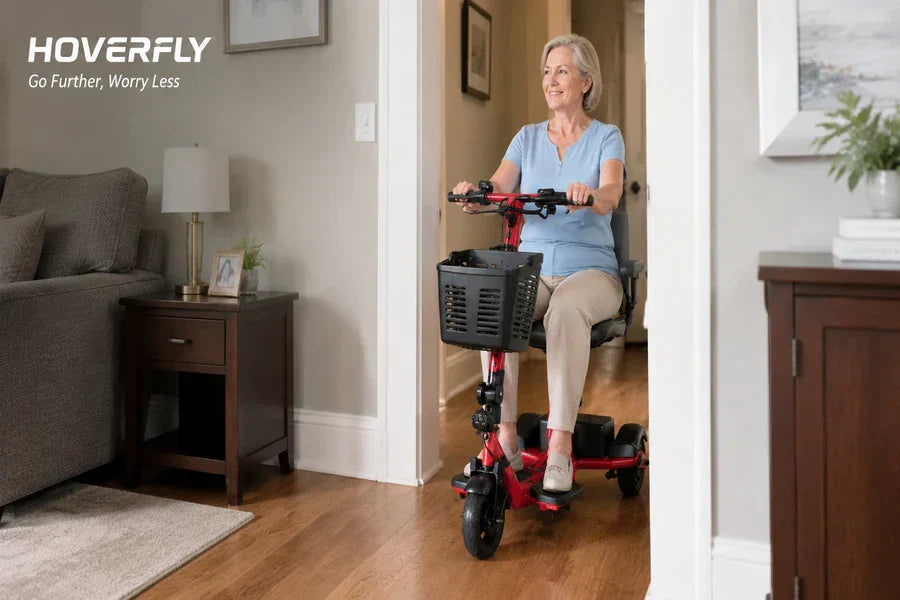
For most indoor users, the daily frustration isn't getting around outside — it's the doorway that doesn't quite clear, the hallway too narrow for a one-motion turn, or the threshold strip that catches a wheel.
This guide uses a five-step Indoor-Fit Method to help you compare 3-wheel mobility scooters by the measurements that matter indoors: doorway clearance, hallway turning space, threshold height, tire type, and charging setup.
Why a 3-Wheel Mobility Scooter Is Built for Indoor Use
I've spent six years working in personal mobility R&D — bench-testing prototypes, riding scooters through real homes and retirement-community hallways, and reading the same complaint over and over in customer support tickets: "the scooter doesn't fit my home." From that work, one pattern is consistent: when more than 70% of riding happens indoors, three wheels almost always beat four. Here's why.
The single front wheel is the entire reason. With only one wheel up front, the chassis can pivot much more sharply. A 3-wheel scooter can complete a full U-turn in a space where a 4-wheel scooter would need a three-point turn.
Four practical advantages follow from that geometry:
- Tighter turning radius. Three-wheel scooters routinely turn a foot or more tighter than four-wheel models — the difference between making it into a bathroom in one motion and not.
- More legroom and a narrower base. With no front wheel wells flanking the tiller, your knees and feet sit further forward without contact.
- Easier furniture navigation. The narrower nose threads gaps between a sofa and a coffee table, or around a kitchen island, that a wider 4-wheel base can't.
- Lower-speed control matters more. Indoors, you're rarely above 2 mph. A good 3-wheel scooter has a speed dial that can hold a true walking pace without surging, which is the difference between a clean turn and a scuffed baseboard.
Safety-wise, modern 3-wheel scooters are engineered with anti-tip rear wheels, electromagnetic e-brakes, and welded steel or aluminum frames rated well above the listed weight capacity — durability is rarely the failure point. The honest tradeoff is lateral stability: a narrower base is more prone to tipping on sharp turns at speed or on uneven outdoor terrain, which is why most 3-wheel scooters cap top speed under 5 mph.
The Indoor-Fit Method: 5 Things to Measure Before You Buy
Most buyers' regret comes from one thing: the scooter looked fine in the dealer's showroom, but it doesn't fit the rider's home. Before you compare brands, measure the rooms you'll actually use it in.
1. Doorway Clear Width vs. Scooter Overall Width

Open every interior door to 90 degrees. Measure between the face of the open door and the doorstop on the opposite jamb — that's the clear width, not the rough opening. Your bathroom doorway is usually the tightest.
Rule of thumb: the scooter's overall width should be at least 2 inches less than your narrowest doorway, to account for hand position on the tiller and clearance for the rider's elbows.
2. Turning Radius vs. Hallway Width

Measure your hallway baseboard-to-baseboard at the narrowest point. If the hallway is narrower than the scooter's turning radius, you cannot turn into a side room in one motion. 2010 ADA §403.5.1 sets 36 inches as the minimum accessible passage; residential hallways typically run 36–42 inches.
Easy test: tape two marks on the floor at the width of your hallway and walk an imaginary U-turn between them with your arms out at shoulder width. If you can't pivot cleanly, the scooter won't either.
3. Ground Clearance for Thresholds and Transitions
Door thresholds, transition strips between rooms, and the lip from tile to carpet all defeat scooters with low ground clearance. To measure: stand a ruler upright next to the threshold and read the height in inches. 2010 ADA §404.2.5 caps most interior-door thresholds at 0.5 inch and exterior sliding-door thresholds at 0.75 inch.
Look for at least 2 inches of ground clearance for a typical home. Approach every threshold head-on at 90 degrees — sideways crossings are how 3-wheel scooters tip.
4. Non-Marking Tires and Low-Speed Control
Check the spec sheet for the phrase "non-marking" or "non-scuffing" tires. If a scooter's listing avoids that term entirely, assume the tires will leave streaks on hardwood and tile. Equally important: a variable speed dial. Indoors, you want the ability to crawl at 1–2 mph through tight quarters. If you can, test the lowest-speed setting before buying.
5. Indoor Charging Safety

Mobility scooters charge inside the home, usually overnight, so battery chemistry matters. The three types you'll see:
- Lithium iron phosphate (LiFePO4): the safest mainstream chemistry — thermally stable, very low fire risk, and the longest cycle life of any consumer lithium type.
- Standard lithium-ion (NMC/NCA): lighter and more energy-dense, but more sensitive to overheating. Acceptable when paired with a quality BMS and charged indoors away from flammable surfaces.
- Sealed lead-acid (SLA): older, heavier, cheaper. Safe to charge indoors, but the pack will need replacing every 1–2 years.
Best 3-Wheel Mobility Scooters for Indoor Use (2026 Picks)
Six scooters are covered below, organized by the kind of indoor setting each may fit best. The goal is not to rank by brand, but to match each scooter's published width, turning radius, weight capacity, and portability to the rooms where it will actually be used.
Hoverfly T3 — Built for Pre-War Apartments and Sub-32″ Doorways
If your bottleneck is a sub-32-inch doorway or a hallway under 36 inches, the T3 is worth shortlisting because its published turning radius is under 30 inches, which is unusually tight for this category.
Key indoor-fit specs to verify:
- Turning radius: under 30″
- Weight: 61 lb assembled; folds into 3 pieces: basket 1.8 lb, seat 8.3 lb, main frame 51 lb
- Capacity: 330 lb
- Range: about 13 miles per charge
- Top speed: 3.75 mph
- Battery: 25.6V 8Ah LiFePO4, a thermally stable chemistry with longer cycle life than standard lithium-ion
- Tires: 8.5″ puncture-proof solid tires
Two design details are relevant for apartment use. First, the 15-degree tiller turning limit, noted in the Hoverfly T3 product specs, helps reduce the chance of the front column contacting the rider's feet during tight turns, especially for larger shoe sizes. Second, the solid tire footprint can feel steadier on tile and hardwood during low-speed indoor braking than smaller pneumatic-style tires on some travel scooters.
The Travel-Class Benchmark: Pride Go-Go Ultra X 3-Wheel
The industry's long-running benchmark. Nothing about the Go-Go Ultra X is unusual; everything works the way the spec sheet says it will.
Verified specs (Pride data sheet):
- Overall width: 19.25″ · Turning radius: 36.5″ · Length: 40.25″
- Top speed: 4.3 mph · Range: up to 8 miles · Capacity: 300 lb
- Total weight: 94.25 lb · Heaviest piece (disassembled): 29.5 lb
The 19.25″ width clears any ADA-compliant doorway with more than a foot to spare, and the non-scuffing tires are a known quantity on hardwood and tile. The 36.5″ turning radius is the main indoor limit. Best for travelers who want a name-brand scooter that disassembles into a 29.5-lb heaviest piece for car-trunk loading. (For sedan, hatchback, and SUV owners, Hoverfly's guide to fitting a folded mobility scooter into different car trunks walks through the lift mechanics in detail.)
When a Travel Scooter Feels Too Small, Look at the Pride Revo 2.0
The scooter to buy when a travel-class model feels too small. Bigger seat, longer wheelbase, more legroom, more weight capacity.
Verified specs:
- Capacity: 400 lb
- Overall width: 20.75″ · Length: 46″ · Turning radius: 40″
- Top speed: 5.2 mph · Range: up to 17.4 miles (200 lb rider) / 12.8 miles (400 lb rider)
- Total weight: 170 lb · Heaviest piece: 48 lb
The 20.75″ width still threads a 32″ ADA doorway. The 40″ turning radius does not work cleanly in a 36″ hallway, however. Read this as a condo / ranch-home / wide-corridor scooter, not a pre-war apartment scooter. Buy it for comfort and capacity, not for tight quarters.
Amigo RT Express: No Travel Pretense, Pure Indoor Performance
A different category entirely. The RT Express isn't a travel scooter that happens to work indoors; it's an indoor scooter that doesn't pretend to travel. It doesn't disassemble. The charger is built in.
Verified specs:
- Overall width: 23.5″
- Turning radius: 33″
- Total weight: 130 lb · Capacity: 250 lb
- Top speed: 5 mph · Range: up to 22 miles per charge
- Onboard retractable charger cord (no separate charger brick)
What makes it work for tight homes: the 33″ turning radius is competitive with travel scooters despite the bigger overall footprint, the 360° swivel seat makes boarding easier next to a wall or in a corner, the retractable onboard charger cord eliminates the lost-charger problem, and the one-piece steel platform means fewer moving parts to fail. The 23.5″ width is wider than the travel-class options here, so verify your tightest doorway clears 25″+ before buying.
A Budget Folder That Earns Its Place — Vive 3 Wheel Mobility Scooter
The value pick — and a credible one. Vive's 3-wheel scooter has a 2.6-foot (31.2″) turning radius, breaks into four pieces with the heaviest at 29 lb, weighs 77 lb total, supports 265 lb, tops out at 3.7 mph, and goes up to 12.4 miles per charge. LED headlight and front basket are standard. The 29-lb heaviest piece — versus the T3's 51-lb main frame — makes a real difference for a solo caregiver loading a trunk. Worth noting: this is a manual-fold design, not an auto-fold; we cover the real-world differences between manual and automatic folding mechanisms separately. Tradeoffs: the seat is smaller and less padded than premium options, and the 265-lb capacity is lower than most of this list.
For Riders Above Standard Weight Limits: Golden Companion HD 3-Wheel
One reason to buy it: rider weight. The Golden Companion HD 3-Wheel supports up to 500 lb capacity, with a 26″ overall width, 51″ turning radius, and 225.5 lb total weight. Full-size, non-folding, designed to live in one home. The 30.5″ width and 51″ turning radius rule it out for most apartments — but if no other 3-wheel scooter rates your weight, this is the indoor-capable option.
Indoor Safety and Maintenance: Practical Habits
A 3-wheel scooter is safe indoors when operated correctly. Most accidents I've reviewed are habit problems, not engineering ones. The fixes are small and repeatable.
Dial the speed governor down before you leave the room. I tell every new rider to set the speed knob to its lowest tier the moment they unbox the scooter, and only raise it for outdoor sidewalks. Indoors, a 2 mph crawl gives you roughly 3 feet of stopping distance.
Cross every threshold at 90 degrees, in two phases. Approach the strip slow, square the scooter to it, pause for half a beat, then ease the throttle so the front wheel rolls over before the drive wheels arrive. Diagonal crossings are the single most common cause of indoor tipping. If a threshold is over 0.5 inches tall, add a low-profile rubber ramp from a hardware store.

Charge in the 20–80% sweet spot for lithium. For lithium packs (including LiFePO4), don't run them flat and don't leave them at 100% for days on end — both shorten pack life. For sealed lead-acid, the rule flips: charge after every use, and never store the scooter discharged. Plug in nightly, unplug in the morning, and keep the charger on a hard, non-flammable surface.
Move loose rugs before the first ride. Throw rugs and runners catch the front wheels and shift unpredictably under the weight of the scooter. Either remove them or secure them with rug tape on all four corners. Bath mats are the worst offender — replace with a non-slip mat backed in rubber.
Inspect tires monthly. Roll the scooter forward by hand on a hard floor and look for flat spots, embedded debris, or cracks in solid tires. For pneumatic tires, do a quick PSI check with a stick gauge — the recommended pressure is usually printed on the sidewall.
Wipe the wheels weekly. Indoor scooter tires pick up grit from outdoor trips and grind it into hardwood and tile on the next ride. A damp microfiber cloth around each tire takes 30 seconds and saves your floors.
Once you have your doorway width, hallway width, threshold height, and weight-capacity requirement, compare those numbers against the spec sheets for any scooter you are considering. If Hoverfly is on your shortlist, check the Hoverfly T3 and related 3-wheel models against the same measurements rather than choosing by brand alone.
FAQs
Is a 3-wheel mobility scooter safe for indoor use?
Yes, on level floors at low speed, with one caveat: three wheels are more prone to tipping than four, especially on sharp turns. Anti-tip rear wheels are standard equipment for this reason. Lower your speed indoors, cross thresholds straight on, and avoid loose rugs.
What turning radius do I need to fit through a standard doorway?
For a 32-inch ADA-minimum doorway, look for a scooter turning radius of roughly 33–36 inches and an overall width under 22 inches. Many older homes have narrower interior doors — measure each doorway you'll use before buying.
Can a 3-wheel mobility scooter go over thresholds and rugs?
Yes, for low thresholds (under ~1 inch), if you approach them at a 90-degree angle. For higher thresholds or area rugs, a threshold ramp or removing the rug is the better fix. ADA caps most interior-door thresholds at 0.5 inches and exterior sliding-door thresholds at 0.75 inches, but residential thresholds often exceed those limits.
What's the difference between a 3-wheel and a 4-wheel mobility scooter for indoor use?
Three wheels turn more tightly and give more legroom; four wheels have a wider base and feel steadier outdoors. Switch to a 4-wheel if the rider has balance issues, regularly crosses uneven terrain or sloped driveways, or is near the scooter's max weight capacity. Hoverfly's side-by-side breakdown of turning radius, legroom, and stability in 3-wheel vs. 4-wheel scooters goes deeper if you're still on the fence.
Will a 3-wheel scooter scratch hardwood floors or scuff baseboards?
Not if it has non-marking tires — a standard feature on most modern travel scooters. Non-scuffing wheels prevent black streaks on wood or tile. Baseboard scuffing is a clearance problem, not a tire problem: if it happens, your hallway is narrower than the scooter's overall width plus the rider's hand position.
How much weight can a 3-wheel indoor scooter support?
Most travel-class 3-wheel scooters support 250–300 lb; full-size 3-wheel models like the Pride Revo 2.0 support up to 400 lb. The Hoverfly T3 supports 330 lb. The Golden Companion HD goes to 500 lb. Always check the rated capacity — performance and battery range degrade as the rider approaches the upper limit.
Are 3-wheel mobility scooters covered by Medicare?
Sometimes, under Medicare Part B as durable medical equipment (DME). You'll need a face-to-face exam, a written prescription stating medical need for in-home use, and documentation that a cane, walker, or manual wheelchair won't work. If approved, Medicare covers 80% of the approved amount after the deductible, per the official Medicare Coverage of Wheelchairs & Scooters fact sheet. Outdoor-only and knee scooters aren't covered.
Conclusion
For most indoor users, the right 3-wheel mobility scooter is the one whose width and turning radius beat your home's tightest doorway and hallway, with non-marking tires and a battery that's safe to charge inside. The Indoor-Fit Method tells you which of those numbers matters most in your specific home. Measure first, then shop.





Leave a comment
All comments are moderated before being published.
This site is protected by hCaptcha and the hCaptcha Privacy Policy and Terms of Service apply.