
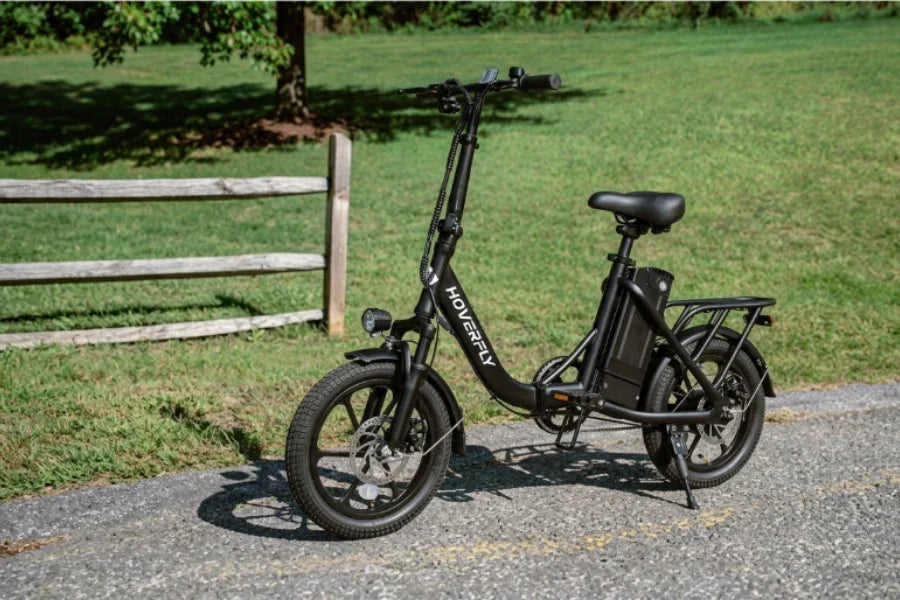
Getting around town shouldn't require a full-size bike and a garage to store it. That's exactly where 20-inch electric bikes shine — they're compact, nimble, and surprisingly capable. But are they right for you?
This guide breaks down everything you need to know: who benefits most, how they compare to larger wheels, what specs actually matter, and the mistakes to avoid before you buy.
What Is a 20-Inch Electric Bike?
A 20-inch electric bike is an e-bike that uses 20-inch diameter wheels instead of the larger wheels found on traditional bicycles. These smaller wheels are commonly used on folding bikes and compact urban bikes, and they are paired with an electric motor and battery to assist with pedaling.
Smaller wheels come with:
- Faster acceleration. Smaller wheels spin up quicker, which means snappier starts at traffic lights and stop signs.
- Compact footprint. Most 20-inch e-bikes fold or fit into tight spaces — think apartment closets, car trunks, or RV storage bays.
- Lower standover height. If you're on the shorter side, mounting and dismounting feels far more natural.
- Slightly different handling. Smaller wheels are more responsive to steering input, which some riders love and others need time to adjust to.
One common worry is stability. Research from Paudel & Yap (2020), published in the Proceedings of the Institution of Mechanical Engineers, studied 27 small-wheel bicycle designs and found that instability isn't caused by the wheel size itself — it comes from poor steering geometry. A well-engineered 20-inch bike can ride just as smoothly as a full-size one.
In short, the 20-inch format is a deliberate design choice for portability and urban practicality.
Advantages of 20-Inch Electric Bike
The biggest advantage is the combination of compactness and real riding capability — you get a legitimate e-bike that fits into spaces a full-size model never could.
Here's what you gain with a 20-inch e-bike:
- Easy storage. Fold it and slide it under a desk, into a closet, or behind a car seat. No bike rack needed.
- Lighter weight (usually). Smaller frames and wheels mean many 20-inch models weigh 10–15 pounds less than their 26-inch counterparts.
- Better maneuverability. Tight U-turns, weaving through traffic, and navigating crowded bike lanes all feel easier on smaller wheels.
- Quicker off the line. Less rotational mass means the motor gets you up to speed faster — ideal for city riding with constant stops.
- Lower center of gravity. This makes the bike feel planted and predictable, especially for newer riders still building confidence.
- Multi-modal friendly. Taking the bus, train, or ferry? A folding 20-inch e-bike goes where full-size bikes are banned or impractical.
For daily commuters, this adds up to a genuinely more convenient ownership experience. You ride it, fold it, carry it inside, and never worry about locking it up outside overnight.
Disadvantages of 20-Inch E-Bike
No bike is perfect for every situation. A 20-inch e-bike trades certain capabilities for its compact size, and you should know the tradeoffs upfront.
- Rougher ride on bad roads. Smaller wheels drop into potholes and cracks more noticeably. Fat tires (4.0") help, but don't fully eliminate this.
- Less efficient at sustained high speeds. Smaller wheels require more revolutions to cover the same distance, which can drain the battery slightly faster on long rides.
- Limited fit for very tall riders. If you're over 6'2", most 20-inch frames won't offer enough leg extension for comfortable extended rides.
- Reduced obstacle rollover. Curbs, roots, and rocks that a 26-inch wheel rolls over smoothly will require more effort — or more speed — on 20-inch wheels.
- Perception of "toy-like" size. This is purely cosmetic, but some riders feel self-conscious on a smaller-framed bike. Fat tire models help offset this with a chunkier, more substantial look.
The honest takeaway: if your rides are mostly under 10 miles on paved or lightly graveled surfaces, these downsides are minor. If you're tackling rough trails or marathon-distance commutes daily, a larger wheel will serve you better.
Who Should (and Shouldn't) Buy a 20-Inch E-Bike?
A 20-inch e-bike is a perfect fit for riders who want something easy to control, lightweight, and simple to store. The smaller wheels make them quicker to handle and faster to turn than larger-wheel models — perfect for navigating crowded city streets and winding paths.
Best For These Riders
- Urban commuters with limited storage. No bike room? No problem. A folding 20-inch e-bike slides under a desk or into a hall closet.
- Apartment dwellers. Carrying a 60-pound full-size e-bike up stairs is brutal. A compact 20-inch model cuts that struggle significantly.
- Shorter riders (under 5'8"). The lower frame and saddle height make for a more comfortable, confidence-building ride.
- RV and camper travelers. Portability is king when every inch of storage counts.
- Multimodal commuters. If your trip involves a bus, train, or car trunk, a foldable 20-inch e-bike fits into that routine seamlessly.
Think Twice If…
- You ride long distances on rough trails regularly. Larger wheels (26"+) roll over rocks and roots with less effort.
- You're over 6'4". Most 20-inch frames simply won't offer enough leg extension for very tall riders.
- Top-speed stability is your priority. At 25+ mph, larger wheels naturally feel more planted.
❗ The bottom line: if portability and city riding are your top priorities, 20-inch is hard to beat. If aggressive off-roading or long-distance touring is the goal, size up.
What Specs Matter on a 20-Inch E-Bike?
Not all 20-inch e-bikes are created equal. Focus on these four specs and you'll avoid most buyer's remorse.
Motor Power
For standard tires (2.0"–3.0"), a 500W motor handles city riding just fine. But if you're going with fat tires, aim for 750W. Fat tires create more rolling resistance, and an underpowered motor will feel sluggish on hills.
Battery and Real-World Range
Look for at least a 48V battery system. Here's the reality check: expect about 60–70% of the advertised range in real-world conditions. A bike marketed at "60 miles" will likely deliver 36–42 miles depending on terrain, rider weight, and assist level.
Brakes
Hydraulic disc brakes are non-negotiable if you plan to ride above 15 mph. Mechanical disc brakes work at lower speeds, but hydraulic versions offer stronger, more consistent stopping power — especially in wet conditions.
Tire Width
- 4.0" fat tires: Best for mixed terrain, sand, light snow, and maximum comfort.
- 2.0"–3.0" standard tires: More efficient on pavement, lighter overall weight.
Match your motor to your tire choice. That single decision shapes your entire riding experience.
20-Inch vs. 26-Inch E-Bikes: Which Size Fits You?
The most common question is: how does a 20-inch wheel actually compare to a 26-inch? Here's a side-by-side look.
| Feature | 20-Inch E-Bike | 26-Inch E-Bike |
|---|---|---|
| Acceleration | Faster (quicker spin-up) | Moderate |
| Top-Speed Stability | Good up to ~20 mph | More stable at 25+ mph |
| Obstacle Rollover | Needs more effort over bumps | Smoother over roots and potholes |
| Storage & Portability | Excellent — many fold | Bulky; rarely foldable |
| Ideal Rider Height | 5'0" – 6'0" | 5'4" – 6'4" |
| Best Terrain | Pavement, light gravel | Mixed terrain, trails |
| Comfort (long rides) | Good with fat tires | Naturally smoother |
Fat tires (4.0") on a 20-inch wheel can close the comfort gap considerably. As one Reddit user in r/ebikes put it: "My 20-inch fat tire feels more torquey and fun than 26-inch standard." That extra tire volume absorbs bumps and adds traction.
However, physics still applies. A 26-inch wheel covers more ground per rotation, so it's inherently more efficient on long flat stretches. For rides under 10 miles in a city environment, most riders won't notice a meaningful difference.
Common Mistakes to Avoid
Most first-time 20-inch e-bike buyers make at least one of these errors. Knowing them upfront saves you money and frustration.
- Buying too little motor for fat tires. A 350W motor paired with 4-inch fat tires will disappoint on anything but flat ground. Go 500W minimum, 750W for hills.
- Ignoring brake quality. Budget models often ship with low-end mechanical brakes. At e-bike speeds, this is a safety issue — not just a comfort one.
- Chasing top speed instead of usable torque. A bike that hits 28 mph on flat ground but crawls up a moderate hill isn't practical. Torque matters more for daily riding.
- Skipping local regulations. E-bike class rules vary by state and city. A Class 3 bike might be restricted on certain bike paths. Check before you buy.
- Overlooking frame weight. If portability is your reason for choosing 20-inch, verify the total weight. Some "compact" e-bikes still weigh 70+ pounds — defeating the purpose.
Different Wheel Size for Different Priority
If 20-inch e-bikes feel like a compromise — not compact enough to truly fold small, not large enough to ride smoothly over distance — Hoverfly's lineup goes to both ends instead.
For maximum portability, the HoverFly Nephele uses 16-inch wheels and a low step-through frame that folds small enough for apartments, car trunks, and public transit. For smoother handling and longer routes, the HoverFly Ourea steps up to 26-inch wheels with a 750W peak motor and up to 64 km of pedal-assist range — ideal when ride feel matters more than folding.
FAQs
Are 20-inch e-bikes stable enough for adults?
Yes, modern 20-inch e-bikes offer reliable stability for adult riders. Fat tire versions feel especially planted. Stability issues typically come from poor frame engineering, not the wheel size itself.
How fast does a 20-inch electric bike go?
Most 20-inch e-bikes reach 20–28 mph depending on the motor class. Class 2 models typically top out at 20 mph with throttle, while Class 3 pedal-assist models can reach 28 mph.
What's a realistic range on a single charge?
Plan for 25–45 miles in real-world conditions. Variables include rider weight, terrain, wind, assist level, and tire type. Fat tires reduce range slightly compared to standard tires due to higher rolling resistance.
Can I use a 20-inch e-bike for off-road riding?
For light gravel, packed dirt, and easy trails — absolutely. For technical mountain biking with large rocks and steep descents, a 26-inch or 27.5-inch bike is the better tool. A 20-inch fat tire model sits comfortably in between as a capable all-rounder.
New to e-bikes entirely? Our beginner's guide to choosing a good starter bicycle walks you through the basics — or explore the best e-bikes for daily commuting if getting to class or work is your main goal.



Leave a comment
All comments are moderated before being published.
This site is protected by hCaptcha and the hCaptcha Privacy Policy and Terms of Service apply.